The night you realize "I might fail IB"
It usually happens quietly.
You're not lazy. You're not even "behind" in the dramatic way people describe online. You're just staring at a question you've technically learned before, and your brain refuses to cooperate. You do the thing IB students do when panic shows up: you promise yourself you'll "grind" tomorrow.
And tomorrow becomes a loop.
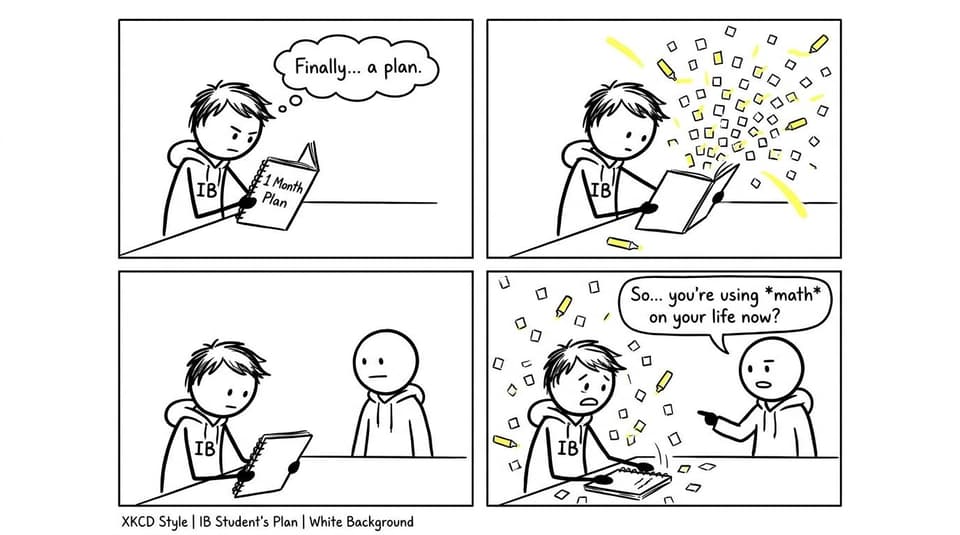
If you're reading this with one month left, here's the honest truth: passing IB in 30 days is possible, but only if you stop trying to feel motivated and start building a system that creates marks. Not vibes. Not pretty notes. Marks.
This article is a one-month turnaround plan built for IB students who feel like they're failing and need a realistic path to passing. It's calm, structured, and designed to work even when your confidence doesn't.
The 30-day IB rescue checklist (print this mentally)
Here's the checklist that separates "I revised a lot" from "I passed IB":
- Triage your subjects: decide what must be saved and what must be stabilized.
- Switch to exam-mode: questions first, notes second.
- Use a feedback loop: every mistake becomes a flashcard or a rule.
- Do weekly mock blocks: stamina is a grade.
- Protect sleep and routine: your brain is the resource.
This plan assumes you're aiming to pass IB, not necessarily chase perfect scores. That's the difference between heroic and effective.
Why "failing IB" feels personal (and why it isn't)
IB has a special talent: it turns confusion into identity.
You miss a 6-marker and it doesn't feel like "I don't understand this topic." It feels like "I'm not an IB student." That story is powerful, and it's also inaccurate.
Most students who feel like they're failing IB are dealing with one (or more) of these:
- They studied the syllabus but not the questions.
- They revised broadly instead of targeting weak marks.
- They never built retrieval strength (they reread instead of recall).
- They didn't get consistent feedback (so mistakes repeat).
The one-month shift is not about becoming a different person. It's about changing the inputs.
The rule that changes everything: IB marks come from patterns
A month is not enough time to "relearn everything" from scratch.
But it is enough time to learn the patterns IB rewards.
In most subjects, examiners reward:
- the right command term response (define vs explain vs evaluate)
- the right structure (especially in essays and long responses)
- the right methods (especially in Math and sciences)
- the right common mark points (recurring ideas that appear again and again)
So the strategy is simple: train on patterns until your brain recognizes them faster than your anxiety does.
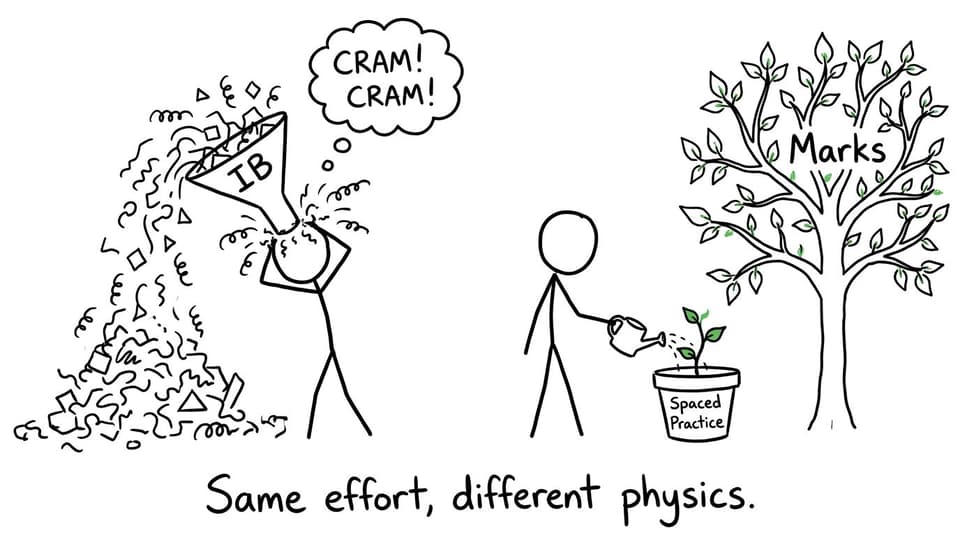
Your 1-month IB plan (the calm version that actually works)
Week 1: Triage and rebuild the basics that create marks
Week 1 is about honesty without drama.
- Pick your passing priorities
For each subject, write:
- "I can get marks here" topics (strong)
- "I sometimes get marks" topics (medium)
- "I lose marks almost every time" topics (weak)
Your goal is not to make every topic strong. Your goal is to make "weak" smaller.
- Switch to questions-first study
If you're failing IB, rereading notes feels safe because it's quiet and familiar. But it's not the skill the exam uses.
Instead:
- attempt questions (even if it's messy)
- check what the markscheme wanted
- write one sentence: "I lost marks because…"
This is where RevisionDojo becomes the fastest way to turn time into marks because you can move in one flow: Questionbank for targeted practice, Study Notes when you need a quick rebuild, and Flashcards to lock mistakes into memory.
- Start an "error log" (non-negotiable)
Make a simple list:
- Topic
- Question type
- What I did
- What IB wanted
- My new rule
That "new rule" becomes your exam brain.
Week 2: Build momentum with deliberate repetition
Week 2 is where IB starts to feel less random.
You're going to repeat the same patterns until they become automatic.
- Daily block A (60-90 min): targeted questions in your weakest area
- Daily block B (45-60 min): review error log + turn errors into flashcards
- Daily block C (30-45 min): one "stable topic" to maintain confidence
A powerful upgrade here is feedback. If you keep missing the same style of response, it's not a knowledge problem. It's a communication problem.
This is where RevisionDojo's AI Chat can help you stress-test your understanding ("Ask me a harder version of this") and its Grading tools can help you see what your answer is missing in terms of structure and mark points.
Week 3: Simulate the exam (because nerves are content)
Week 3 is when a lot of students panic again because they realize knowing a topic isn't the same as performing under time.
So you train the real constraint: timing.
- Do 2 timed papers/sections per subject this week (shorter if needed)
- Mark them brutally
- Convert every repeated miss into a rule
This is also where structured resources matter. RevisionDojo's Mock Exams and Predicted Papers (use them strategically, not obsessively) can help you practice the most exam-like patterns without spending hours hunting for what to do next.
And if coursework stress is leaking into revision, use a Coursework Library as a reference point for what "good" looks like so your brain stops inventing standards in the dark.
Week 4: Tighten, simplify, and protect your passing score
Week 4 isn't the time for reinvention. It's the time for tightening.
- Stop adding new resources. Your brain can't digest 12 teachers in 6 days.
- Double down on high-frequency topics.
- Practice openings and structures (essays, long responses, evaluations).
- Do light recall daily (flashcards, error log rules).
If you have access to support, this is the week where a short burst of targeted help can save hours. RevisionDojo Tutors are most valuable here: you don't need a whole curriculum re-teach, you need someone to correct the 2-3 structural habits that keep costing you marks.
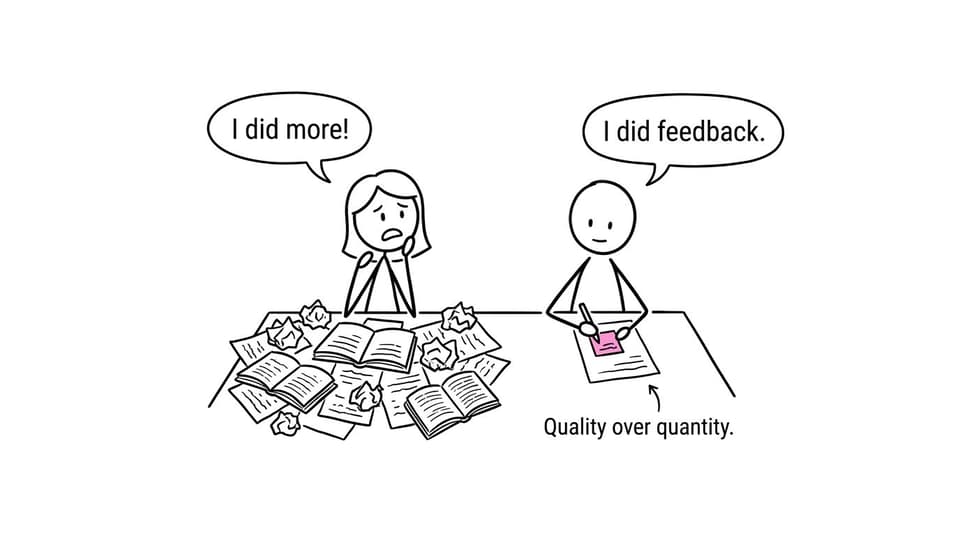
The "failing to passing IB" mindset shift (without motivational posters)
Here's the quiet shift that matters:
- You don't need to feel confident to pass IB.
- You need to behave like someone who collects marks.
That means:
- doing questions when you'd rather "prepare"
- marking your work when you'd rather move on
- repeating the same weak skill until it stops being weak
In one month, consistency beats intensity.
A simple daily schedule for IB students (2.5-4 hours)
If you're overwhelmed, copy this.
The daily core
- 10 minutes: plan the session (one sentence: "Today I will earn marks by…")
- 70 minutes: Questionbank practice on weakest topic
- 15 minutes: break
- 45 minutes: mark + error log + flashcards
- 30 minutes: review one stable topic (quick notes, key definitions, processes)
- 10 minutes: close (write: "My next mistake to fix is…")
This fits most IB schedules and still leaves room for school, IA deadlines, and sleep.
How to stop procrastinating when IB pressure spikes
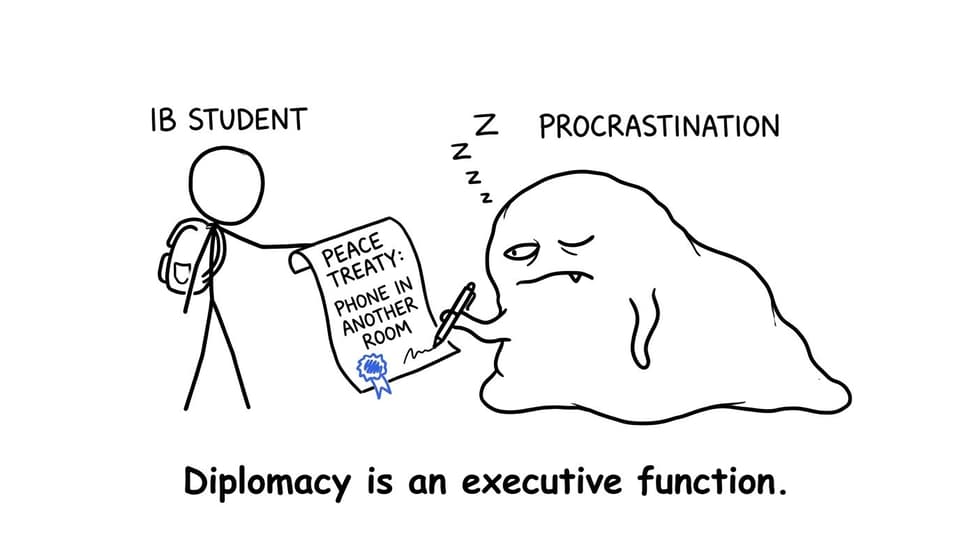
Procrastination in IB isn't always avoidance. Often it's a nervous system trying to avoid uncertainty.
So the fix is not "be tougher." The fix is make the next step smaller and more certain.
Try these:
- "I will do three questions, not a whole topic."
- "I will write a bad first attempt, then improve with the markscheme."
- "I will study for 25 minutes, then decide again."
And protect your environment:
- phone out of the room
- one tab open
- timer running
The last thing to remember before IB exams
One month from now, you won't remember every detail you revised.
But you can walk into IB exams with something better: a trained instinct for the questions you used to fear. That instinct comes from reps, feedback, and a system that turns mistakes into memory.
If you want the most direct route from failing to passing IB, build your plan around tools that reduce friction: RevisionDojo's Questionbank for targeted practice, Study Notes for fast rebuilding, Flashcards for daily recall, AI Chat for active testing, Grading tools for clearer criteria, Predicted Papers and Mock Exams for exam simulation, plus the Coursework Library and Tutors when you need a human correction to your blind spots.
Passing IB isn't a personality trait. It's a month of decisions.