


If you forget everything in the IB exam
The first time it happens, it feels like a magic trick performed on you.
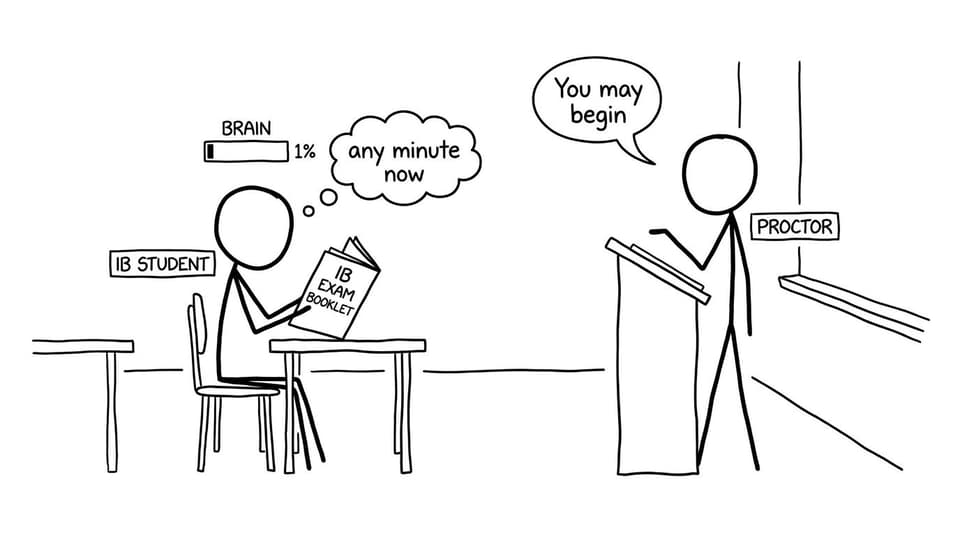
You turn the page. You read the question. And the part of your brain that has been practicing for months suddenly goes quiet. Not "I'm a bit unsure" quiet. More like "this is written in a language I used to speak in a past life" quiet.
If you're an IB student preparing for exams, you've probably imagined this moment at 2:13 a.m. at least once. The fear is strangely specific: What if I forget everything in the exam? Not some things. Everything.
Here's the good news: a mind-blank is common, predictable, and survivable. And in the IB, survivable is often enough to score well because exams reward points collected under pressure, not perfection delivered calmly.
This article gives you a simple, repeatable protocol for when your mind goes blank in an IB exam, plus a way to train it beforehand using RevisionDojo.
The 60-second checklist (save this for every IB exam)
When the mind-blank hits in an IB exam, your job is not to "remember everything." Your job is to stabilize and start collecting marks.
The "Blank-to-Points" protocol
- Breathe out slowly twice (longer exhale than inhale)
- Read the question again, but this time underline command terms and given data
- Scan the whole paper for "easy-start" questions
- Start writing something structured (definitions, assumptions, diagram, formula bank, known facts)
- Bank quick marks first, then return to the scary question
- If stuck for 90 seconds, switch questions and come back
This is not motivational fluff. It's a way of moving your brain from panic mode into task mode, which is exactly what the IB rewards.
Why your brain blanks in an IB exam (and why it's not a sign you're doomed)
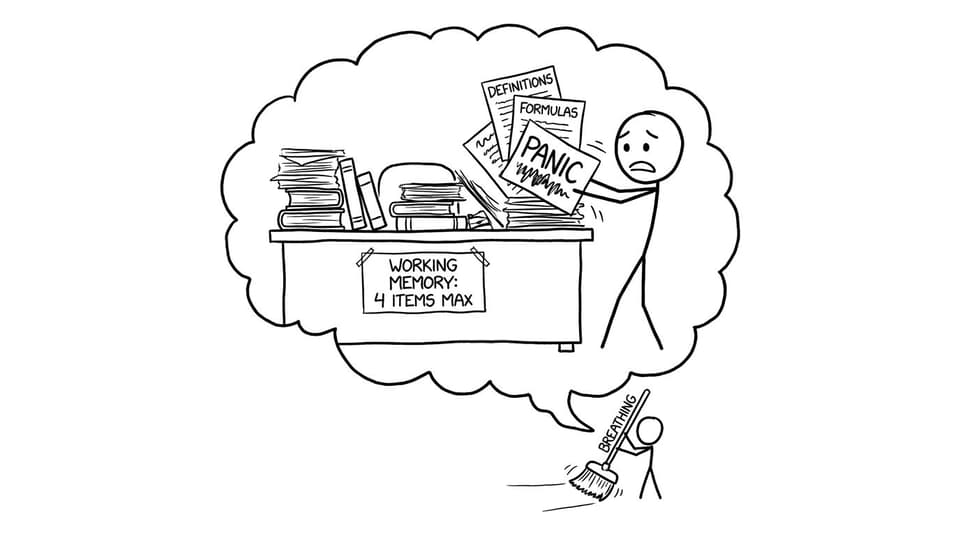
A mind-blank is often a working-memory jam, not a knowledge problem.
In normal revision, you can think in wide circles. In an IB exam, your brain is forced into narrow tunnels: time pressure, silence, judgment, unfamiliar phrasing. When stress rises, working memory shrinks. You can still "know" the content, but you can't access it smoothly.
The trick is to stop treating a blank as a verdict ("I didn't learn this") and start treating it as a state ("my retrieval system is temporarily overloaded"). States can be changed.
What to do in the moment: practical tactics that win IB marks
Use the page to restart your memory
In an IB exam, your pen can act like a lever.
If your head is empty, make the paper less empty.
- Write the topic name (even if vague): "Photosynthesis," "Integration," "Cold War," "Market structures."
- Dump any related keywords: 5-10 fragments is enough.
- Draw the simplest diagram you can (axes, labeled boxes, reaction arrow, timeline).
This "externalizes" memory. Often the missing piece returns not because you think harder, but because you give your brain a cue to latch onto.
Start with the command term, not the content
When you blank, the content feels infinite. Command terms make it finite.
In the IB, questions usually tell you what shape the answer should be:
- Define: short, precise, textbook wording.
- Explain: cause and effect, stepwise.
- Compare: both similarities and differences.
- Evaluate: strengths, limitations, conclusion.
Even if you don't remember the perfect content yet, you can build the skeleton. A skeleton earns marks when you add anything correct.
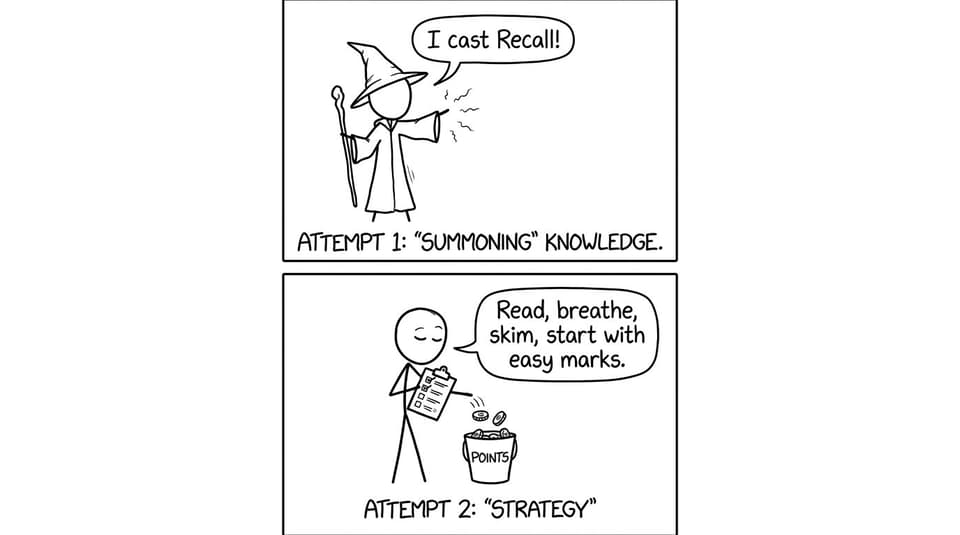
Take "easy marks" seriously (they're not beneath you)
The smartest IB students are not the ones who only chase hard questions. They are the ones who treat easy marks like a salary.
If you're blanking on one question, scan for:
- definitions
- labeled diagrams
- unit conversions
- data-based questions
- small "state" or "identify" parts
Bank those marks. Your confidence climbs. Your recall improves. Your mind-blank loosens.
Time-box the blank
Give yourself a rule:
- 90 seconds maximum stuck time before you switch.
Staring at a question while panicking is usually negative return on investment. Switching creates a win somewhere else, and wins unlock recall.
How to prevent the "forget everything" feeling in IB revision
The mind-blank is partly emotional, but it's also a training issue: many students revise in a way that feels productive but doesn't build retrieval strength.
In the IB, the exam isn't asking "Have you seen this before?" It's asking "Can you pull this out under pressure?"
Train retrieval, not recognition
If your revision is mostly rereading, highlighting, and watching videos, your brain is practicing recognition.
What you need is retrieval:
- closed-book recall
- timed question sets
- self-marking with markschemes/rubrics
- flashcards that force precise wording
This is where RevisionDojo's ecosystem matters: Questionbank for retrieval practice, Flashcards for precise recall, Study Notes for quick corrections, and AI Chat to diagnose why an answer is missing a mark.
Practice the "reset" on purpose
Once per week, simulate a mini IB mind-blank:
- Do a timed set of questions.
- Halfway through, stop for 20 seconds and intentionally disrupt yourself.
- Then run the 60-second checklist and continue.
You're teaching your nervous system that a blank is not an emergency. It's a moment with a script.
A calmer way to think about IB exams: you don't need your whole brain
One of the quiet lies IB students tell themselves is: "If I can't remember everything, I'll fail."
But the IB is not a single all-or-nothing door. It's a building with many rooms.
Even on a bad day, you can still:
- interpret data
- structure an argument
- write a method
- show working
- use units correctly
- define core terms
The goal is not a perfect performance. It's a points-first performance.
Building your anti-blank system with RevisionDojo
If you want fewer blanks in the IB, build a system that makes recall boringly reliable.
Use RevisionDojo like this:
- Questionbank: daily mixed-topic sets to reduce "topic shock" in the IB exam.
- Study Notes: immediate correction after questions, not hours later.
- Flashcards: memorize definitions, command-term phrasing, and common pitfalls.
- Grading tools: learn what earns marks, not what sounds impressive.
- Mock Exams: build stamina and learn recovery after mistakes.
- Predicted Papers: practice realistic exam-style coverage without guessing blindly.
- Coursework Library: reduce coursework stress so revision time is real revision time.
- AI Chat: ask "why is this wrong?" until the logic is simple.
- Tutors: if blanks keep happening, it may be a gaps-and-strategy issue, not effort..
Closing: the IB mind-blank is a moment, not an identity
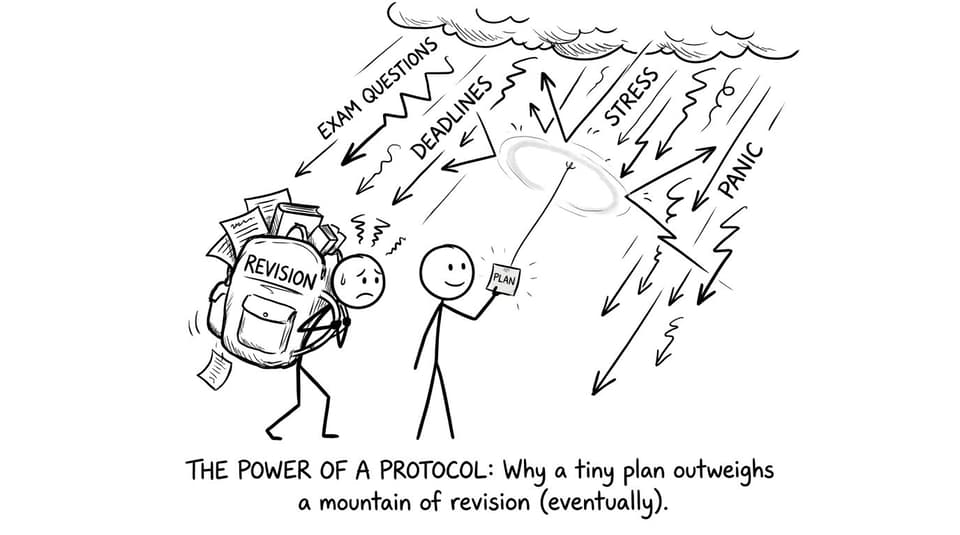
Forgetting everything in an IB exam feels personal, like your brain betrayed you. But it's usually a temporary state caused by pressure, not a permanent measure of ability.
Bring a protocol. Practice it. Trust it.
If you want that protocol to feel automatic, build your revision around retrieval: the RevisionDojo Questionbank, Flashcards, Study Notes, Mock Exams, Predicted Papers, and AI Chat are designed for exactly this kind of exam reality. The goal isn't to never blank. The goal is to blank for 20 seconds, recover in 60, and keep collecting marks like it was always the plan.