
The moment every IB student knows
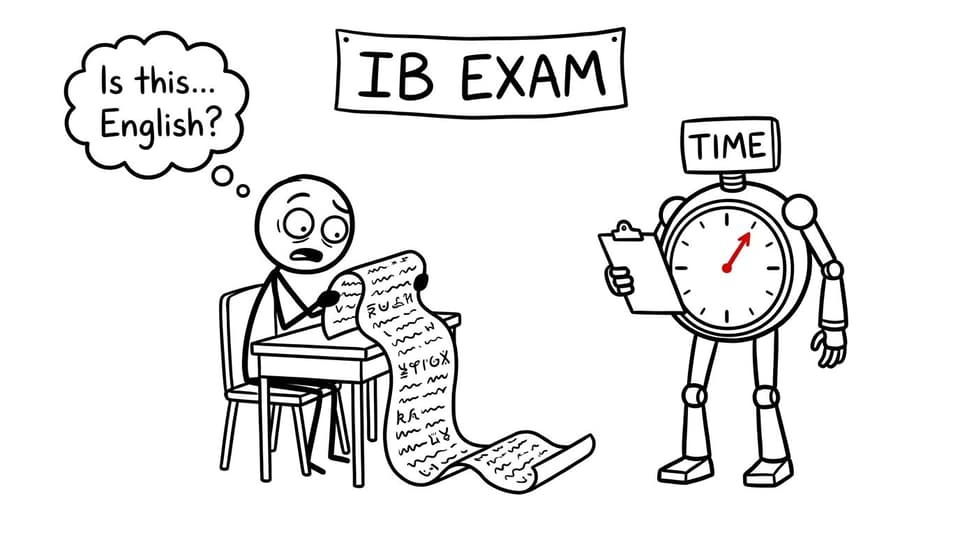
In the middle of an IB exam, there's a particular kind of silence that feels louder than anything. Pages turn. Pens move. Someone coughs. And you stare at a question that might as well be written in a different language.
Your brain does something unhelpful: it tries to solve your future. If I don't get this, my grade drops, then university, then... It's rarely the content that hurts first. It's the story you tell yourself about what the question means.
The truth is calmer: not understanding a question in an IB exam is common. It happens to strong students, prepared students, even the ones who always seem fine. What matters is what you do in the next 60 seconds.
The 60-second IB rescue checklist
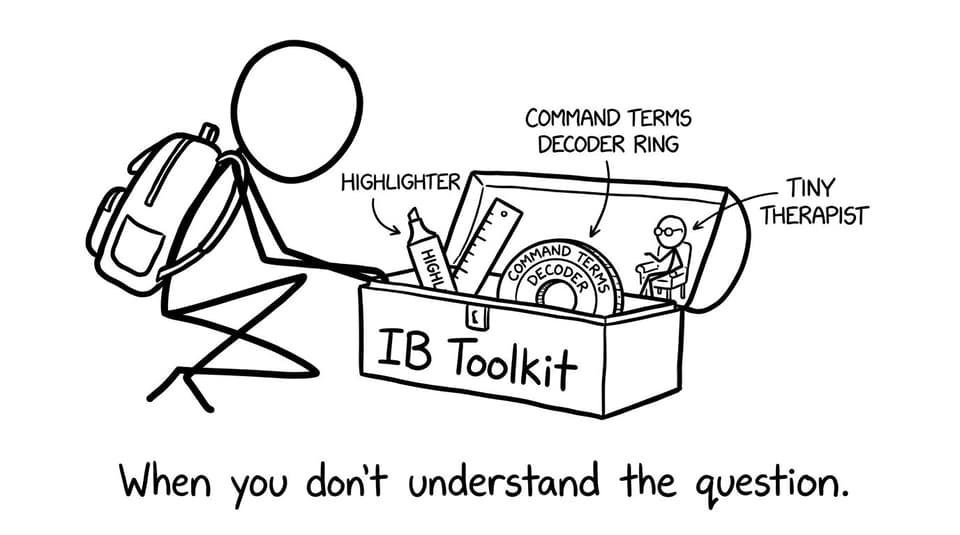
When you don't understand the question in IB, you're not trying to become brilliant on the spot. You're trying to become effective. Use this quick routine:
- Breathe once, slowly (it interrupts panic and buys clarity)
- Circle the command term (what the examiner wants you to do)
- Underline the topic words (what the examiner wants you to talk about)
- Rewrite the question in your own words (one simple sentence)
- Decide: skip, sketch, or start (don't sit frozen)
This is not motivational. It's mechanical. Mechanical is good in an IB exam.
Why "I don't understand" usually means one of three things
Most confusion in IB questions isn't random. It typically comes from one of these:
You don't understand the command term
Sometimes you know the topic, but the instruction is foggy. In IB, that's expensive because marks are tied to how you respond.
If you treat "evaluate" like "describe," you can write a page and still lose the top marks. If you treat "compare" like "explain," you may miss the structure the markscheme rewards.
Fix in the exam:
- Replace the command term with a simpler verb: judge, weigh, list, argue, calculate, annotate.
- Ask: Do they want pros/cons? A conclusion? Evidence? Steps?
Fix in revision: drill command terms with timed practice and feedback. This is exactly where structured practice tools help: RevisionDojo's Questionbank gives you repeated exposure to how IB actually asks.
You don't understand one key word in the prompt
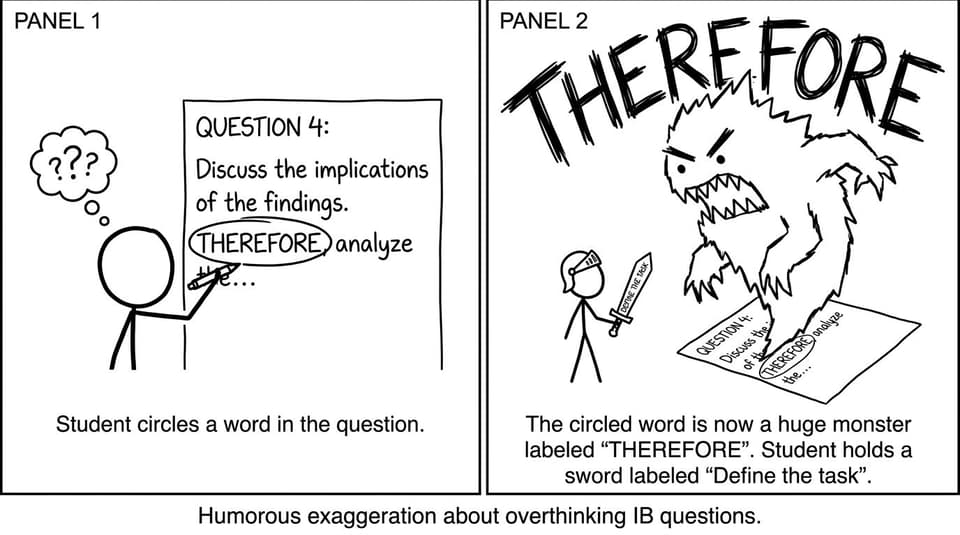
Sometimes the question is fine except for one term: "mitigate," "paradigm," "limitation," "significance," "therefore." One unknown word can poison the whole task.
Fix in the exam:
- Don't fight the whole sentence. Identify the one word you don't know.
- Infer from context. The surrounding phrases often tell you the direction.
- If you still can't, answer the parts you do understand with a safe structure.
You understand it, but you can't decide what to write
This is sneaky. The question makes sense, but you can't select points, examples, or a method quickly.
Fix in the exam:
- Make a 10-second plan: 2 points, 1 example each, 1 concluding line.
- Start writing the most certain sentence you have. Momentum creates memory.
The IB method: decode the question like a markscheme
When you don't understand a question in IB, the goal is not to guess the examiner's personality. The goal is to reverse-engineer what marks must look like.
Step 1: Translate the question into a "deliverable"
Ask: What would a perfect answer physically contain?
- A definition?
- A labelled diagram?
- A calculation with working?
- Two arguments and a judgement?
- A link to a case study?
Even if you're unsure, pick a deliverable. In IB, structure often saves you when certainty fails.
Step 2: Use the "minimum viable answer" approach
If panic is rising, aim for the smallest answer that still earns marks.
Example mindset:
- "I can't do all of it, but I can define the key term and give one relevant example."
- "I can't finish the calculation, but I can set up the formula and show substitutions."
That is still IB credit. Many students lose marks not because they didn't know, but because they stopped.
Step 3: Write to the command term, not your anxiety
Anxiety wants to dump everything you know. IB wants you to follow instructions.
- If it says compare, make paired sentences.
- If it says evaluate, make criteria and a judgement.
- If it says outline, keep it brief and direct.
When to skip the question (and how to come back)
A powerful IB exam skill is knowing when to leave.
Skip if:
- You've spent 90 seconds and still can't restate the question.
- You can't start without a long memory search.
- It's high-risk and you have easier marks elsewhere.
How to return:
- Mark it with a symbol.
- Write a micro-plan in the margin (two bullet points you might use).
- Come back when your brain has warmed up on other questions.
This works because memory is not a filing cabinet. It's more like a network. Doing other questions can activate the pathway you need.
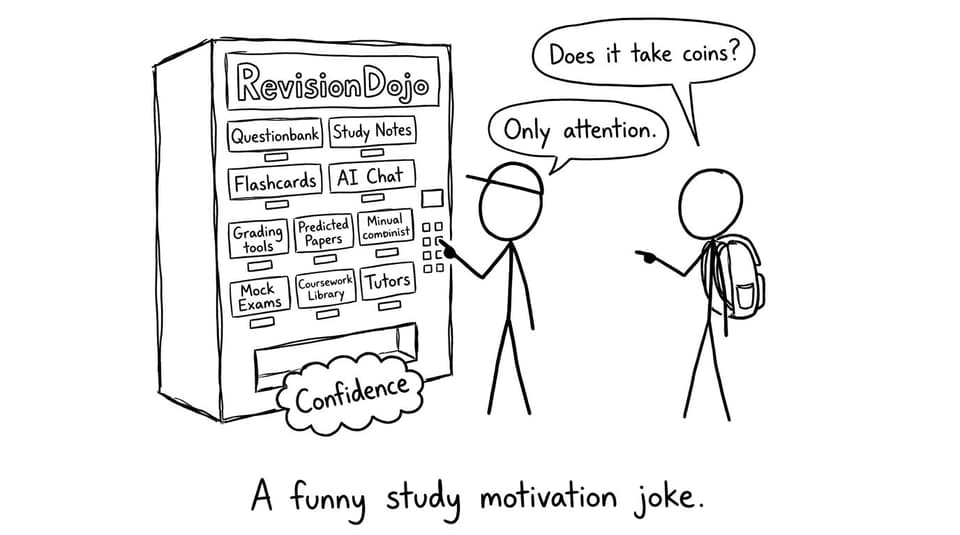
How RevisionDojo helps you stop freezing on IB questions
The best way to avoid "I don't understand" is to see enough real IB style questions that the shapes become familiar.
RevisionDojo is built around that kind of familiarity:
- The Questionbank helps you practise question types until they stop feeling foreign.
- Study Notes give you clean explanations you can revisit when a topic feels shaky.
- Flashcards turn command terms, definitions, and processes into quick recall.
- AI Chat is useful when you can't pinpoint what you're missing: you can ask, "What does this question want?" and get a step-by-step unpacking.
- Grading tools help you check whether your structure matches what IB rewards.
- Predicted Papers and Mock Exams let you practise the emotional part: uncertainty under time.
- The Coursework Library keeps you grounded in exemplars, so you internalise what "good" looks like.
- Tutors help when confusion is recurring, not occasional.
Even a small habit helps: do a short set from the Questionbank, then reflect on why each question was asked. That reflection is where IB skill is built.
Micro-skills that earn marks when you're unsure
When you don't understand the question in IB, these techniques still generate credit.
Use "because" sentences
Even if your point is basic, add reasoning:
- Claim + because + evidence or principle.
This often upgrades a vague response into analysis.
Add a limitation
If a question feels too big, offer a constraint:
- "This depends on…"
- "A limitation of this approach is…"
In many IB subjects, that's built into top-band thinking.
Show working, even if you're lost
In maths and sciences especially, method marks matter. Write formulas, substitutions, units, and intermediate steps. IB often rewards process.
Anchor to one clear example
If your theory feels shaky, use an example you trust. A grounded example can carry partial marks and demonstrate understanding.
A short practice routine to reduce "I don't get it" moments
You can train this calmly before exam day.
Two times a week: "Question decoding drills"
- Pick 10 IB questions.
- Don't answer them fully.
- Spend 60 seconds each doing only:
- command term
- topic words
- rewritten question
- bullet plan
This is a mental gym for comprehension. RevisionDojo's Questionbank makes this easy because you can filter and batch questions quickly.
Once a week: one timed section with review
Do a short timed set from a Mock Exam or exam-style set, then review:
- Which questions felt unclear?
- Was it command terms, vocabulary, or content?
- What pattern keeps repeating?
That last question is gold. Patterns are fixable.
Closing: confusion is part of the IB contract
The IB isn't designed to feel comfortable. It's designed to test what you do when comfort disappears. Not understanding a question isn't proof you're failing; it's a moment asking for a skill: decode, decide, and deliver something markworthy.
If you want fewer freeze moments, build familiarity with real IB question styles. Use RevisionDojo's Questionbank, Study Notes, Flashcards, AI Chat, Grading tools, Predicted Papers, Mock Exams, Coursework Library, and Tutors to turn confusion into a repeatable method. The goal isn't to never feel stuck. It's to know exactly what to do when you are.