
When your brain hits “panic” on a question you actually know
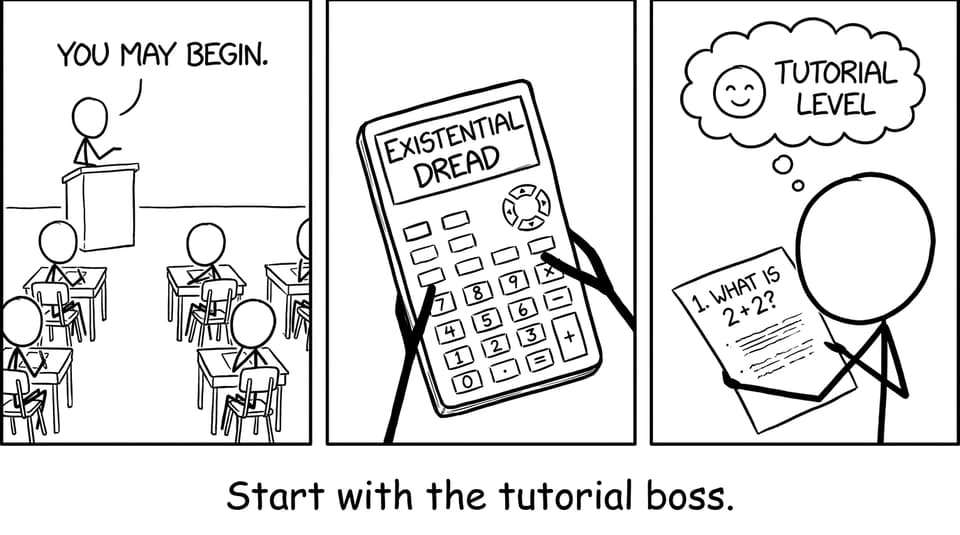
Five minutes into an IB math exam, your pencil pauses. Not because you don’t understand the topic, but because your mind suddenly feels like a room where the lights went out. The formula you used yesterday becomes fog. The timer becomes loud. You reread the question and it looks… unfamiliar.
That moment is what most students mean by “math anxiety.” And in the IB, where timing, precision, and cumulative content collide, it can feel personal. Like the exam is revealing a hidden truth about your ability.
It isn’t.
Math anxiety is often a stress response, not a skill verdict. The good news is that stress responses can be trained. If you use the right techniques (and practice them before exam day), your brain learns a new pattern: question appears, body stays calm, thinking stays online.
Quick-start checklist for calmer IB math revision
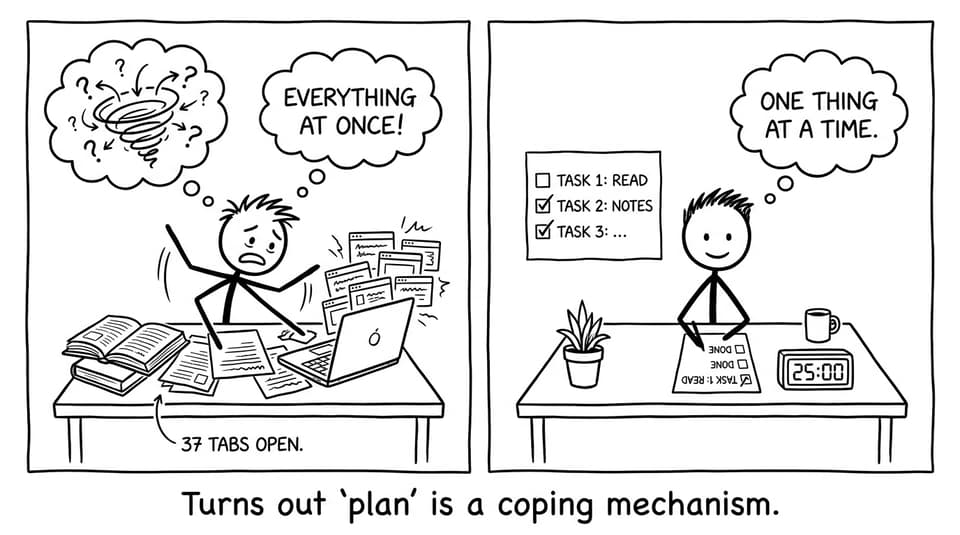
Use this as your “minimum viable plan” for IB exam season:
-
Pick two topics that reliably trigger stress (not ten).
-
Do short, timed exposure: 15-25 minutes, then stop.
-
Mark and write one sentence: “I lost marks because…”
-
Turn that sentence into a rule you can reuse.
-
Repeat the same loop 3-5 times a week.
-
Add one realistic mock-style session weekly.
If you want a structured system for this loop, RevisionDojo’s tools connect naturally: Study Notes for clarity, Flashcards for recall, Questionbank for practice, AI Chat for quick unblocking, and Mock Exams with Grading tools for feedback.
Why math anxiety is so common in IB students
In the IB, students rarely fear “math” in the abstract. They fear what math represents on a deadline: judgment, ranking, and lost time.
Anxiety spikes when three ingredients mix:
-
Uncertainty: “I’m not sure what this question is asking.”
-
Time pressure: “If I don’t get it now, I’m finished.”
-
Perfectionism: “If I’m stuck, I must not be good at this.”
Your body interprets that mix as threat. Heart rate up, breathing shallow, attention narrows. Unfortunately, narrowing attention is great for running from a bear and terrible for multi-step reasoning.
So the fix isn’t just “study more.” The fix is building familiarity with the feeling of pressure while keeping your thinking steady.
Technique 1: Make anxiety measurable (so it stops feeling infinite)
A quiet trick for IB students: stop describing anxiety as a personality trait and start tracking it like a variable.
After each practice set, rate:
-
Stress before (0-10)
-
Stress during (0-10)
-
Recovery time (how long until you felt normal again)
This does two things. First, it proves anxiety rises and falls (meaning it’s not permanent). Second, it shows you what actually works: timed practice, better sleep, fewer resources, or clearer error patterns.
If you want a deeper approach to the same idea, see How to Beat IB Exam Anxiety (Without Burning Out).
Technique 2: Use “calm exposure” instead of heroic cramming
Many IB students only practice math under maximum stress: late-night sessions, massive topic lists, and the emotional soundtrack of “I’m behind.” Then they’re surprised their brain links math with panic.
Instead, practice pressure in controlled doses:
-
Start untimed for accuracy.
-
Move to 10-minute timed bursts.
-
Then 25-minute mixed sets.
-
Then a longer mock-style block.
This is where a topic-filtered practice system helps. With the RevisionDojo Questionbank, you can drill exactly what triggers you (functions, calculus, probability) and build familiarity without guessing what to do next.
Technique 3: Rewrite your relationship with mistakes (the “data, not drama” rule)
In IB math, perfectionism is an expensive hobby. It converts a single wrong step into a story: “I always mess this up.” Anxiety loves stories like that.
Try a cleaner translation:
-
Mistake = data about a specific skill.
-
Correction = a future mark you just trained.
After marking, don’t write paragraphs. Write one “error rule,” like:
-
“If the question asks for an equation, I will define variables first.”
-
“If I integrate, I will check units and add +C when needed.”
-
“If I use GDC, I will still write the method line.”
This pairs well with RevisionDojo’s Grading tools, because feedback becomes consistent: you practice, you see what lost marks, you write the rule, you retest.
For a broader study loop that reinforces this, read How to Study for IB Exams Without Burning Out.
Technique 4: Build “micro-confidence” every day
Confidence isn’t a pep talk. For most IB students, confidence is memory of proof.
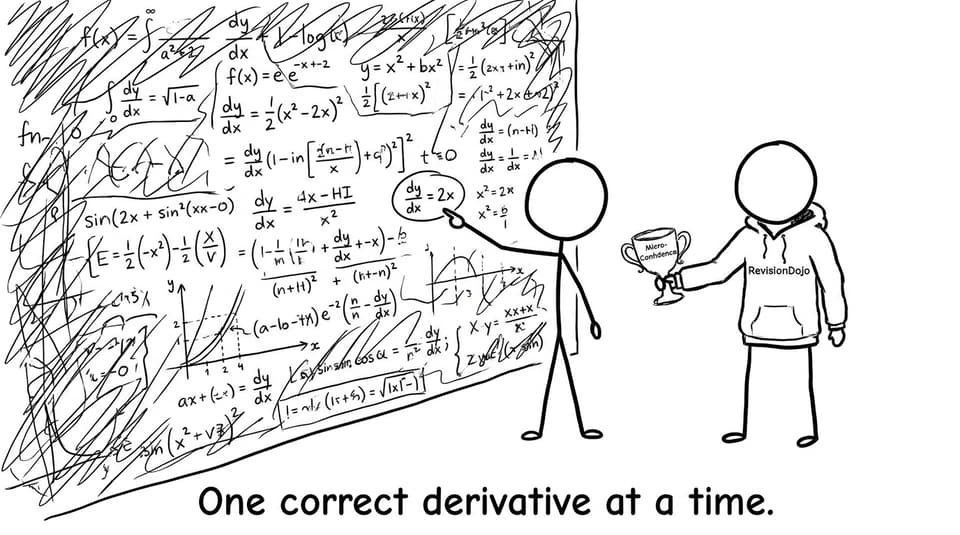
The micro-confidence technique is simple: do one small, winnable task daily.
Examples:
-
Solve one short derivative or probability question correctly.
-
Recall one formula from memory, then apply it once.
-
Review a tiny slice of Study Notes, then do 5 related questions.
Done daily, this creates a psychological shift: your brain stops associating math with emergency.
RevisionDojo supports micro-confidence well because you can keep tasks small: Flashcards for daily recall, Study Notes for quick clarity, and AI Chat when you’re stuck but don’t want to lose momentum.
Technique 5: Train an exam-day “reset protocol” (30 seconds)
Anxiety on exam day isn’t a surprise. It’s a predictable spike. So give yourself a script.
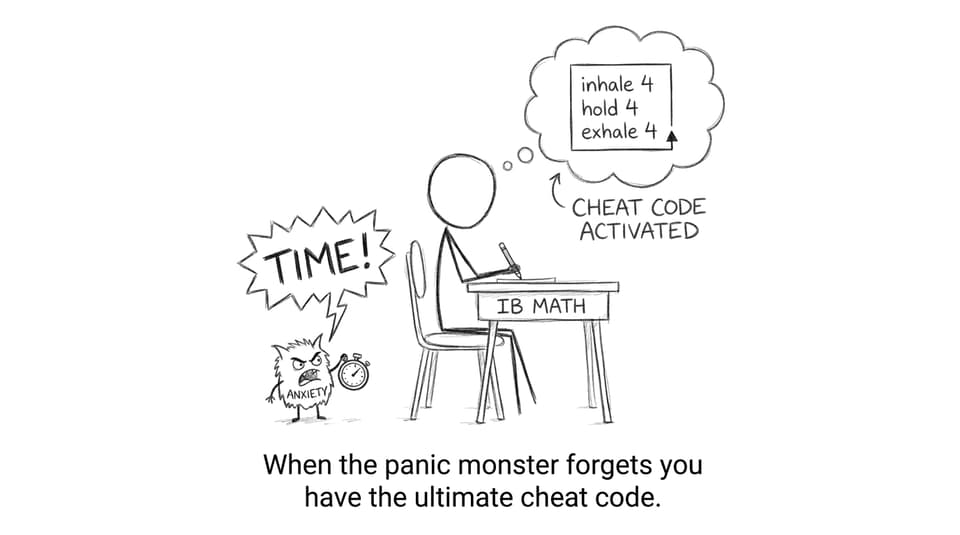
Here’s a 30-second reset protocol many IB students can actually use mid-paper:
-
Put your pen down.
-
Exhale longer than you inhale (try 4 seconds in, 6 seconds out).
-
Relax shoulders, unclench jaw.
-
Read the question again and underline what it’s asking.
-
Write the first line you know is true (a definition, a formula, a diagram label).
That last step matters. Motion reduces panic. The goal is not instant brilliance; it’s re-entry.
If you want more pressure-handling strategies, see How to Handle Unexpected Math Questions Under Pressure.
Technique 6: Make mocks feel familiar (without making your life miserable)
The fastest way to reduce IB math anxiety is to remove novelty. When the exam feels like “a place I’ve been before,” your nervous system settles.
A practical weekly pattern:
-
One mock-style block (30-90 minutes).
-
Immediate marking and reflection.
-
Next 2-3 sessions: targeted drills on the exact weakness.
RevisionDojo is built around this loop: Mock Exams for realism, Predicted Papers for targeted exam rehearsal, and the Questionbank to patch the specific gaps revealed by your results.
To set up this workflow cleanly, use How to Use RevisionDojo to Prepare for IB Math Mock Exams.
Technique 7: Balance revision with recovery (so anxiety doesn’t get louder)
Some IB students try to outwork fear. It rarely works because fatigue makes everything feel harder: algebra, decision-making, even reading.
Protect three basics:
-
Sleep: memory consolidation is part of revision.
-
Breaks: short rests prevent spirals.
-
Resource limits: too many materials increases uncertainty.
If burnout is already creeping in, read How to Avoid Burnout During Math Exam Season and simplify your plan.
Closing: make IB math feel familiar, not frightening
Math anxiety before an IB exam isn’t a character flaw. It’s your nervous system reacting to uncertainty and stakes. The way out is surprisingly unglamorous: smaller timed exposures, clear error rules, daily micro-confidence, and a practiced reset protocol.
If you want one place to run that system, RevisionDojo is designed for it: Questionbank for targeted practice, Study Notes and Flashcards for retention, AI Chat for fast unblocking, Mock Exams and Predicted Papers for realism, plus Grading tools, a Coursework Library, and Tutors when you need deeper feedback.
Pick one technique from this post today, run it for 20 minutes, and stop. Calm isn’t something you wait to feel. In the IB, it’s something you practice.