

If you have ever stared at a page of calculus problems and felt your brain quietly refuse to participate, you already know what burnout looks like in real life.
In IB math exam season, burnout rarely arrives as a dramatic collapse. It is subtler: the same question type you nailed last week suddenly feels unfamiliar, your patience thins, and your confidence starts negotiating with your anxiety. You study longer to compensate, but the extra hours buy less and less.
The goal is not to “push through.” The goal is to keep your energy high enough that your practice actually sticks. This is how IB students avoid burnout during math exam season, without lowering ambition.
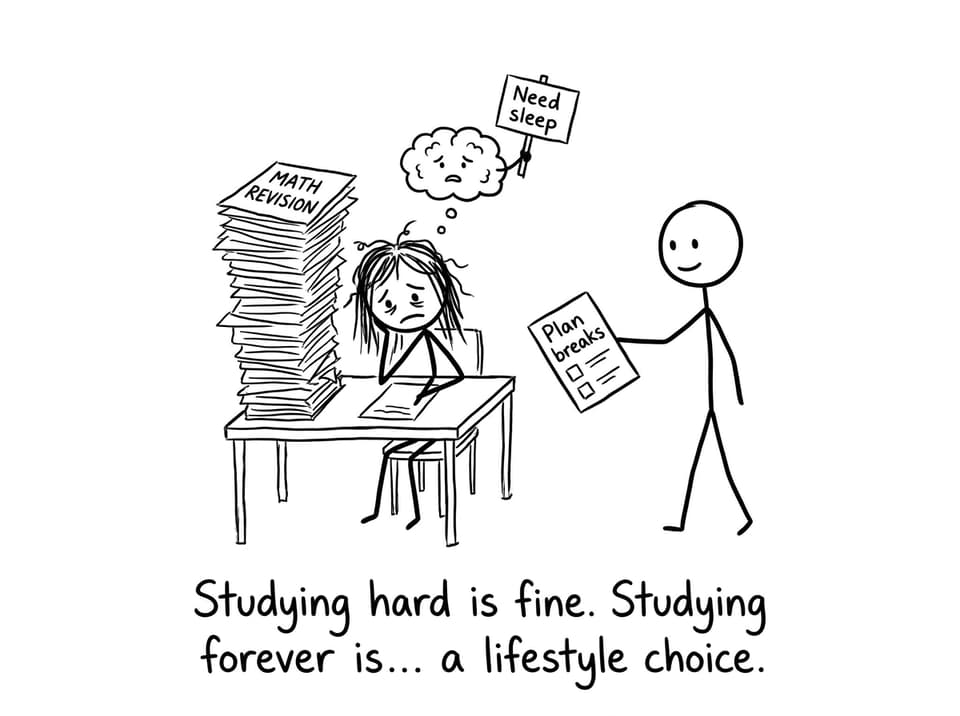
A quick anti-burnout checklist for IB math
Keep this simple list visible during IB exam season:
-
Plan rest like it is a non-negotiable study block.
-
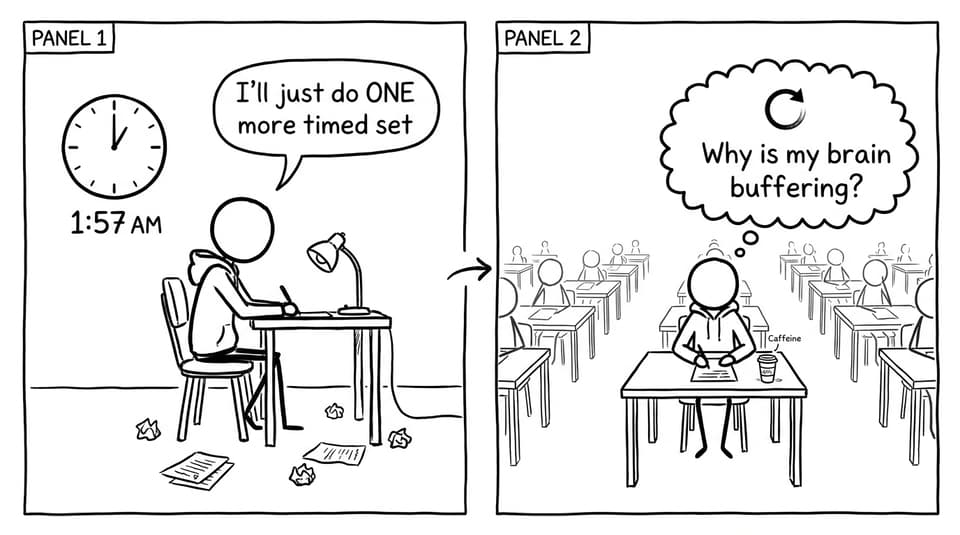
Use short, timed focus cycles (not endless sessions).
-
Alternate heavy math work with lighter recall tasks.
-
Protect sleep with a consistent cutoff time.
-
Reduce resource-hunting stress by keeping everything in one system.
-
Track what drains you, not just what you completed.
If you want a structured home base, start with RevisionDojo IB resources and keep your math work inside one workflow.
What burnout looks like (and why IB math triggers it)
Burnout is not the same as being tired after a long day. In IB math, burnout often shows up as:
-
You feel tired even after sleeping.
-
You avoid starting because you anticipate confusion.
-
You get unusually irritated by small mistakes.
-
You reread notes to feel productive, but nothing feels “locked in.”
-
Your practice accuracy swings wildly from day to day.
Math creates burnout because it gives immediate feedback. A wrong answer feels personal when you are under pressure. Over time, your brain learns to associate revision with threat, not progress.
This is where structure matters more than motivation.
Redefine “productive” the way top IB students actually do
A calm truth: the IB does not reward the student who studies the most hours. It rewards the student who can reliably perform under timed conditions.
So productivity is not time spent. Productivity is:
-
clarity gained
-
mistakes corrected
-
patterns understood
-
speed built without panic
A sustainable rhythm many IB students can keep looks like this:
-
25--50 minutes focused work
-
5--10 minutes off-screen break
-
after 2 cycles, a longer reset (walk, snack, sunlight)
If you need help making this routine repeatable, pair this article with How to Revise for IB Math Using the Pomodoro Technique.
Use RevisionDojo to reduce cognitive load (the hidden burnout driver)
One of the fastest routes to IB burnout is not even the math. It is the constant switching: notes in one place, questions in another, explanations somewhere else, then a spiral of tabs.
RevisionDojo is built to remove that friction:
-
Study Notes to get clarity quickly
-
Flashcards for spaced repetition and daily recall
-
Questionbank for exam-style practice with feedback
-
AI Chat when you are stuck and need a clean explanation
-
Grading tools to make feedback objective (not emotional)
-
Predicted Papers and Mock Exams to build stamina gradually
-
Coursework Library and Tutors for support when something bigger is weighing on you
If you want the whole workflow in one place, RevisionDojo App: The Smarter Way to Prep for IB Exams lays it out clearly.
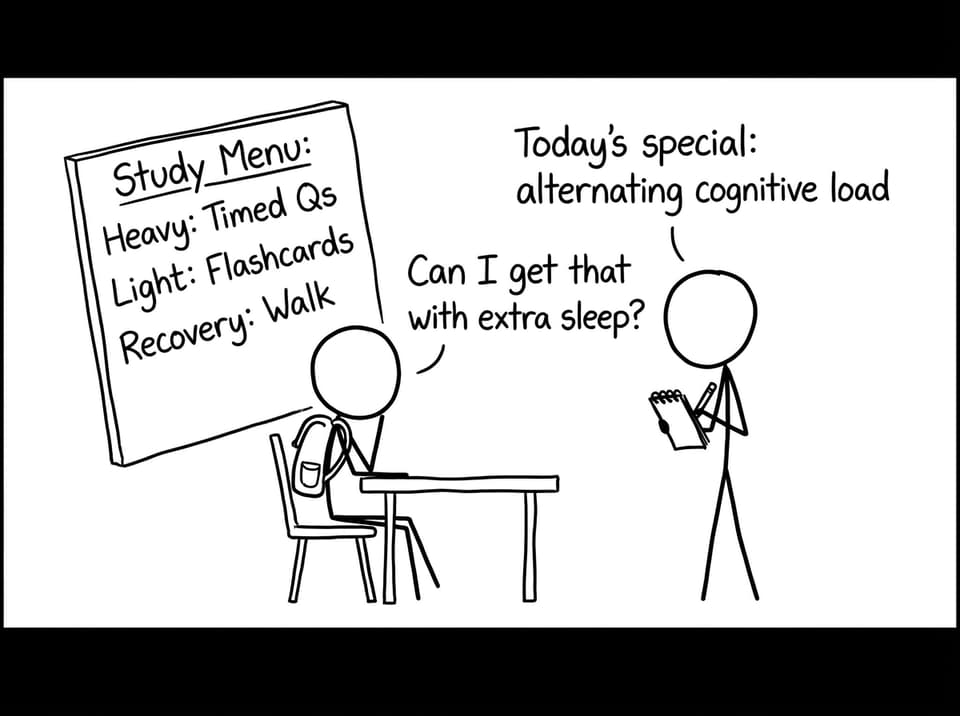
Mix cognitive load to avoid burnout (heavy, light, recovery)
Burnout happens when every session is high stakes. IB math revision should feel like training, not judgment.
Use a three-lane system:
Heavy sessions (2--4 times/week)
These build performance.
-
timed question sets
-
exam-mode drills
-
full solutions review and error logging
RevisionDojo makes this easier when you keep practice targeted, like the IB Math AA Calculus Questionbank or topic filters inside the Questionbank.
Light sessions (most days)
These protect confidence and memory.
-
flashcard review for formulas and definitions
-
quick note skim of one sub-skill
-
reworking one mistake type slowly, without a timer
A good companion is How to Use RevisionDojo Flashcards for Formula Mastery or the main IB Flashcards with Spaced Repetition (SRS) page.
Recovery sessions (non-academic, on purpose)
Recovery is not scrolling. Recovery is changing your nervous system.
-
10-minute walk
-
stretching
-
a shower
-
food + water
-
sunlight
When recovery is planned, it stops feeling like guilt.
The “minimum viable IB math day” for burnout-proof consistency
On low-energy days, your plan should shrink, not disappear. The best IB students protect the streak by lowering the bar while keeping the habit.
Try this minimum viable set:
-
7--10 minutes: Flashcards (keep yesterday alive)
-
15--25 minutes: one targeted Questionbank set (one topic only)
-
5 minutes: write one “error rule” (what went wrong, what to do next time)
That is enough to maintain momentum without triggering burnout.
For a fuller routine you can scale up, see How to Build a Daily Math Study Routine That Works and The Ultimate IB Math Study Routine for Busy Students.
Protect the final week: stop trying to become a new person
The last week before IB math exams is when students panic-study and accidentally flatten their own performance.
Instead:
-
keep heavy timed work earlier in the week
-
shift toward high-yield review: common methods, frequent traps, core definitions
-
stop intense studying at least 24 hours before the exam
-
use the final day for confidence: light recall, short warm-ups, early night
If you want a tight list of high-return moves, use 10 Quick Revision Hacks Before Your IB Math Exams.
Closing: IB math is a long game, even when exams feel close
Burnout is not proof you are weak. In IB math exam season, it is often proof you have been trying to carry too much pressure with too little structure.
Keep your plan small enough to repeat, then let it compound: notes for clarity, flashcards for memory, Questionbank for performance, and timed simulations only when your foundation feels stable. If you want one place that reduces stress and turns practice into measurable progress, use RevisionDojo’s Study Notes, Flashcards, Questionbank, AI Chat, Mock Exams, Predicted Papers, Grading tools, Coursework Library, and Tutors to build a routine you can sustain.
When you protect your energy, your scores usually follow. And in IB, that is the quiet advantage most students never train.