



Unexpected questions don’t usually arrive with fireworks.
In an IB maths exam, they show up quietly: a function wrapped in an unfamiliar context, a calculus prompt that looks like it belongs in a different topic, or a probability setup that makes your brain briefly forget what a number is. You can feel it happen in your body first. The shoulders tense. The pencil pauses. The mind tries to sprint, then slips.
The strange part is that you’re rarely stuck because you “don’t know maths.” You’re stuck because pressure changes how you access what you know. The goal of this guide is to give IB students a calm, repeatable system for those moments, so an unexpected question becomes a manageable problem, not a panic event.
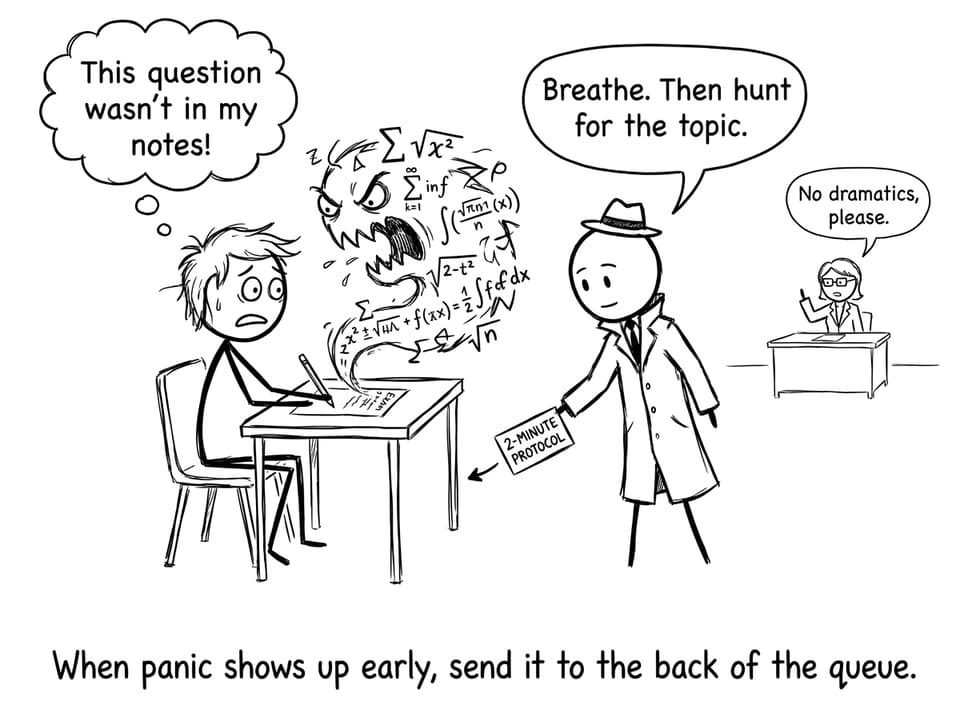
Quick protocol checklist (memorize this)
When an IB math question feels unfamiliar, run this checklist before you “try harder”:
-
Pause for 6-10 seconds and breathe once, slowly.
-
Restate what the question is asking in plain language.
-
Identify the likely topic family (functions, calculus, stats, algebra).
-
Write one relevant fact/formula/relationship you know.
-
Attempt a small first step (substitute, sketch, differentiate, define variables).
-
If no progress after ~2 minutes, flag it and return later.
-
Always leave method marks: clean working, clear steps, units, and reasons.
That sequence is simple on purpose. Under stress, simple beats clever.
Why unexpected questions appear in IB maths
The IB rewards transfer, not just repetition. An unfamiliar-looking question is often built from familiar parts: definitions, standard procedures, and core relationships, but placed in a new wrapper to test whether you can recognize structure.
Unexpected questions often test whether you can:
-
see the underlying topic when the wording changes
-
connect two topics (like functions + calculus, or algebra + statistics)
-
interpret meaning, not just execute steps
If you want a helpful way to zoom out, keep a syllabus map nearby while revising. RevisionDojo’s breakdown of the course structure is a good anchor: IB Maths Syllabus: Student-Friendly Breakdown.
The first skill: interrupt the panic loop
Pressure tells you a story: “If I don’t recognize this instantly, I’m doomed.” In IB exams, that story is rarely true.
Panic does two things:
-
It narrows attention (you stop noticing clues).
-
It makes you chase the fastest-looking path (often the wrong one).
So your first job is not solving. It’s switching your brain back into reasoning mode.
Try this micro-routine:
-
Put your pencil down.
-
One slow breath.
-
Read the command term again (solve, show, explain, interpret).
-
Circle what is given and what is required.
That’s it. It’s a reset button.
Identify what you already know (even if it feels like “nothing”)
Most unexpected IB maths questions still contain something friendly: a familiar function form, a recognizable graph behavior, a standard distribution, a derivative/integral cue, a constraint you can write as an equation.
Ask:
-
What topic does this most resemble?
-
What do I know about the objects in the question? (rates, areas, maximums, correlations)
-
What can I compute immediately? (a derivative, a value at a point, a quick estimate)
If you need fast refreshers before exam day, keep your revision tight and topic-based. These two RevisionDojo guides pair well:
Restate the question until it becomes ordinary
A surprising question often becomes solvable the moment you translate it.
Examples of translation prompts:
-
“rate of change” means derivative
-
“total accumulated” means integral / area
-
“best fit / model” means regression / parameters
-
“maximum / minimum” means optimize (derivative = 0, endpoints)
-
“justify” means write reasons, not just calculations
Write a one-line restatement at the top of your working. In an IB context, that line is not wasted time. It becomes your roadmap.
Hunt for hidden structure (the disguise is the point)
When a question feels new, look for these “structure signals”:
-
A function that wants factoring, completing the square, or substitution
-
Symmetry (even/odd behavior, periodicity)
-
A prompt that quietly implies a diagram or quick sketch
-
Constraints that can be turned into equations and inequalities
-
Values that suggest standard angles, standard form, or a known identity
One practical habit: sketch something even if you’re not asked. A rough graph or labeled diagram often reveals what the algebra is hiding.
If you’re drilling core topics, use targeted sets so pattern recognition becomes automatic. For example:
Use backwards thinking when you’re stuck
If forward progress feels blocked, reverse the direction.
-
What form would a correct answer likely take?
-
What must be true for the answer to be reasonable?
-
What intermediate result would unlock the final step?
In IB maths, working backwards is especially useful when the final part is “show that…” because the target expression hints at the tools you need (common factors, substitution candidates, or identities).
Protect your time with the two-minute rule
A surprise question can steal your whole paper if you let it. The fix is a rule you follow even when you don’t feel like it.
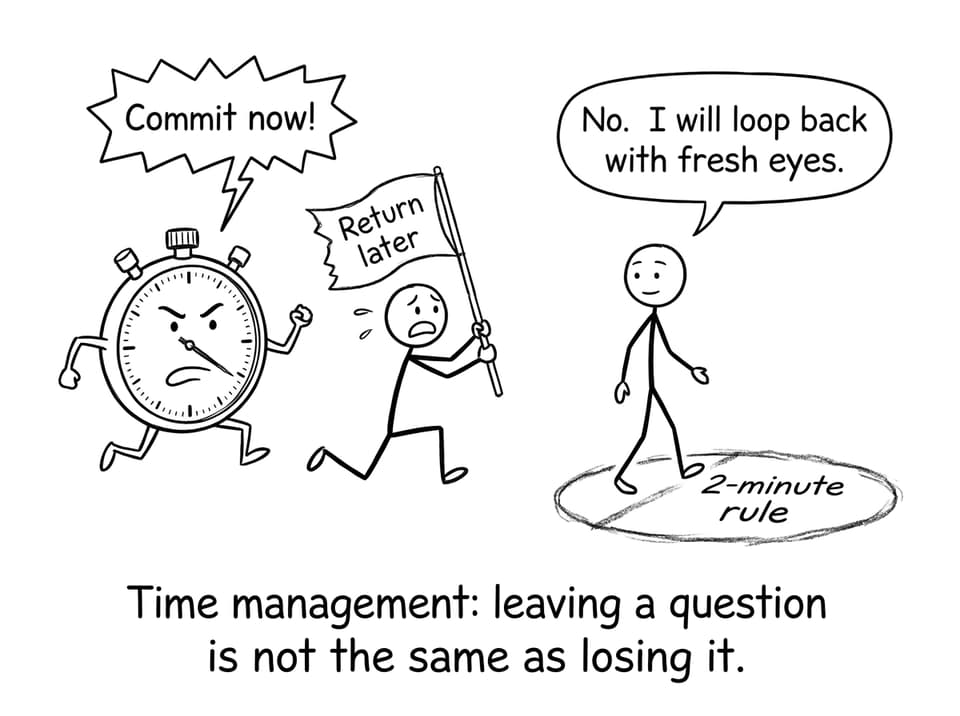
The two-minute rule:
-
If you haven’t made visible progress in ~2 minutes, stop.
-
Put a clear marker next to the question.
-
Move to a question where you can collect marks quickly.
-
Return later when your brain is warmer and you’ve gained momentum.
This is not avoidance. It’s strategy.
If pacing is a recurring issue, build it into your practice sessions. RevisionDojo’s mock workflow helps you simulate pressure deliberately: How to Use RevisionDojo to Prepare for IB Math Mock Exams.
Method marks are your pressure insurance
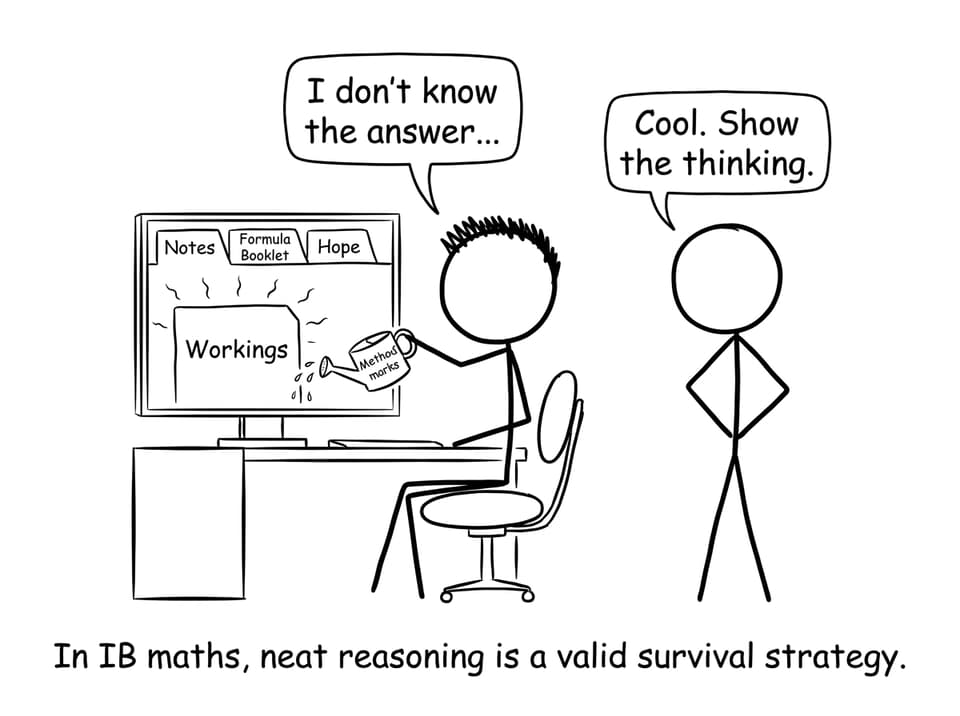
When you’re under pressure, the temptation is to either freeze or jump to a guess. In IB maths, there’s a third option: write a structured attempt.
Good working can earn marks even when the final answer isn’t perfect. It also often creates the solution because writing clarifies thinking.
A simple working structure:
-
Define variables clearly.
-
Write the relevant formula or principle.
-
Show substitution or transformation steps.
-
Keep algebra readable.
-
State conclusions in a sentence (especially for interpretation questions).
Train “surprise tolerance” with realistic drills
Confidence with unexpected questions is trained, not wished into existence.
Here’s a weekly drill that works for IB students:
-
1 mixed-topic set from a Questionbank (timed, medium difficulty)
-
1 short timed section using a realistic paper format
-
15 minutes of mistake review: write “error rules” (one line per mistake)
RevisionDojo is designed to keep that loop tight: Questionbank for volume, Study Notes for quick patching, Flashcards for daily recall, AI Chat for fast diagnosis, and Mock Exams plus Predicted Papers for rehearsal. If you’re planning your final stretch, these are useful references:
A calm ending: make pressure predictable
The students who handle unexpected IB maths questions best aren’t the ones who never feel stress. They’re the ones who have a script for what to do when stress arrives.
If you want one place to build that script into your routine, RevisionDojo is built for it: Study Notes to get clear quickly, Flashcards to keep recall warm, Questionbank to practice at volume, AI Chat to unblock confusion, Grading tools to tighten feedback loops, and Predicted Papers plus Mock Exams to make exam conditions feel familiar.
Unexpected questions will still appear. But with the right system, your response becomes predictable, and that’s where marks come from in IB maths.