
RevisionDojo logoRevisionDojo logo
FeaturesSubjectsPricingSchools
Back to all posts
  1. Home
  2. /Blog
  3. /IB History Exam Prep: A Comprehensive Guide

IB History Exam Prep: A Comprehensive Guide

IB HistoryExam TipsGroup 3
RevisionDojo Team
•Last updated: 19 Jul 2026•8 min read
ShareShare on XShare on WhatsAppShare on LinkedInShare on Facebook
Add as a preferred source on Google
IB History Exam Prep: A Comprehensive Guide

Join 650k+ students breezing through the IBReady to breeze through the IB?

Footer

General

  • Download apps
  • For parents
  • For schools
  • Pricing
  • Gift RevisionDojo
  • Tutoring
  • IB syllabus
  • MYP syllabus
  • Blog
  • Student Questions

Features

  • Question Bank
  • Test Builder & Exam Mode
  • Predicted Papers
  • Past Papers
  • Study Notes
  • Interactive Lessons
  • Flashcards
  • Jojo AI Tutor
  • Coursework Studio
  • View all features

Research

  • All research
  • Jojo AI vs leading AI study tools
  • 2026 State of Learning Survey
  • 2025 State of Learning Survey
  • IB Moderation Analysis
  • Jojo AI vs ChatGPT
  • Jojo AI vs Gemini
  • Jojo AI vs Perplexity
  • Jojo AI vs Claude
  • Jojo AI vs Poe

Platform

  • About RevisionDojo
  • RevisionDojo vs Others
  • Content philosophy
  • Trustpilot
  • Join usWe're hiring
  • Student Ambassador
  • Help center
  • Contact us
  • Terms of Service
  • Data & privacy
  • Privacy policy
  • Cookie policy
  • Trust Center

IB Subjects

  • Arabic A
  • Arabic A Lit
  • Arabic ab initio
  • Arabic B
  • Biology
  • Business Management
  • Chemistry
  • Chinese A Lang & Lit
  • Chinese B
  • Computer Science (CS)
  • Computer Science (First Exam 2027)
  • Design Technology (DT)
  • Design Technology (First Exam 2027)
  • Digital Society (DS)
  • Economics
  • English A Lang & Lit
  • English A Lit
  • English B
  • Environmental systems and societies (ESS)
  • French A
  • French A Lit
  • French ab initio
  • French B
  • Geography
  • German A
  • German A Lit
  • German ab initio
  • German B
  • Global Politics
  • History
  • History (First Exam 2028)
  • Mathematics Analysis and Approaches (AA)
  • Mathematics Applications & Interpretation (AI)
  • Philosophy
  • Physics
  • Psychology
  • Psychology (First Exam 2027)
  • Spanish A
  • Spanish A Lit
  • Spanish ab initio
  • Spanish B
  • Sports, exercise and health science (SEHS)
  • Theory of Knowledge (TOK)
  • World Religions
  • Arabic A
  • Arabic A Lit
  • Arabic ab initio
  • Arabic B
  • Biology
  • Business Management
  • Chemistry
  • Chinese A Lang & Lit
  • Chinese B
  • Computer Science (CS)
  • Computer Science (First Exam 2027)
  • Design Technology (DT)
  • Design Technology (First Exam 2027)
  • Digital Society (DS)
  • Economics
  • English A Lang & Lit
  • English A Lit
  • English B
  • Environmental systems and societies (ESS)
  • French A
  • French A Lit
  • French ab initio
  • French B
  • Geography
  • German A
  • German A Lit
  • German ab initio
  • German B
  • Global Politics
  • History
  • History (First Exam 2028)
  • Mathematics Analysis and Approaches (AA)
  • Mathematics Applications & Interpretation (AI)
  • Philosophy
  • Physics
  • Psychology
  • Psychology (First Exam 2027)
  • Spanish A
  • Spanish A Lit
  • Spanish ab initio
  • Spanish B
  • Sports, exercise and health science (SEHS)
  • Theory of Knowledge (TOK)
  • World Religions

MYP Subjects

  • MYP Biology
  • MYP Chemistry
  • MYP Design
  • MYP English Lang & Lit
  • MYP Extended Mathematics
  • MYP History
  • MYP Individuals & Societies
  • MYP Integrated Sciences
  • MYP Physics
  • MYP Standard Mathematics
  • MYP Biology
  • MYP Chemistry
  • MYP Design
  • MYP English Lang & Lit
  • MYP Extended Mathematics
  • MYP History
  • MYP Individuals & Societies
  • MYP Integrated Sciences
  • MYP Physics
  • MYP Standard Mathematics
RevisionDojo logo

© 2022 - 2026 RevisionDojo (MyDojo Inc)

RevisionDojo was developed independently of the IBO and as such is not endorsed by it in any way.

Download on the App StoreGet it on Google Play
GDPR compliant

If you have ever sat down to revise IB History and felt time speed up while your confidence slows down, you are not alone. The course can feel like a library with no map: names, dates, ideologies, and interpretations stacked in every direction. But the exam is not asking you to remember everything. It is asking you to show historical thinking under pressure. Once you train that skill, IB History becomes predictable in the best way.
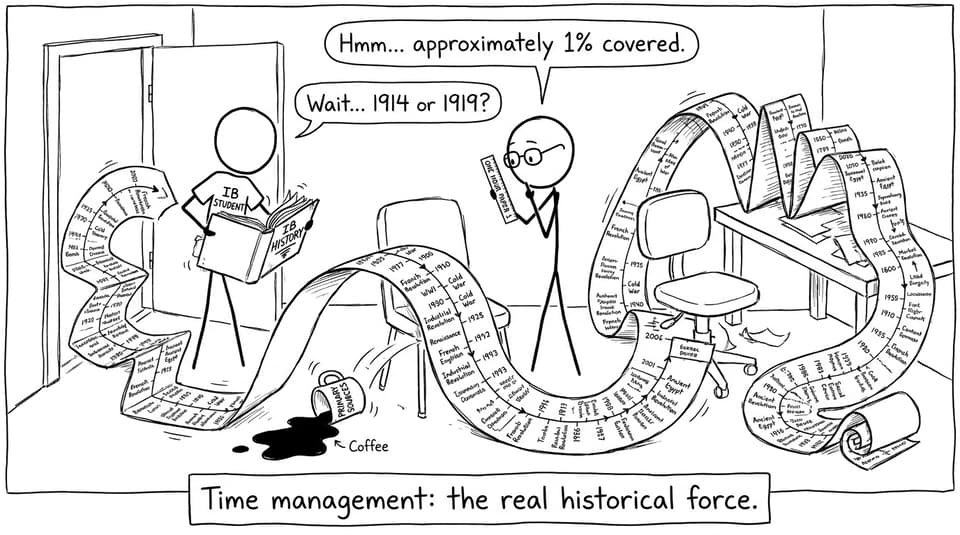
A student vs the endless timeline

IB History exam overview (what you are actually being tested on)

At its core, IB History rewards three things: disciplined source work, argument-driven writing, and smart selection of evidence. You can know a lot and still drop marks if you do not match the task.

Here is the practical structure most students should build revision around:

  • Paper 1 (1 hour): source-based questions on a prescribed subject (SL/HL)

  • Paper 2 (1 hour 30 minutes): two essays from different world history topics (SL/HL)

  • Paper 3 (2 hours 30 minutes): three in-depth essays on a regional option (HL only)

When you plan your IB History revision, plan it by paper skills, not just by topics.

For a full breakdown and targeted practice pathways, keep the RevisionDojo IB History hub open while you study: IB History resources.

A simple IB History checklist before you revise

Use this quick checklist to keep IB History revision honest:

  • I can explain each topic using themes (causes, consequences, significance, change/continuity)

  • I can do OPVL quickly without writing a biography of the source

  • I can plan an essay in 5-7 minutes with a clear thesis

  • I have practiced under timed conditions at least weekly

  • I have feedback loops (marking, reflection, rewrite)

RevisionDojo helps with the feedback loop using AI Chat, Grading tools, and an exam-style Questionbank that forces retrieval rather than rereading.

Paper 1: how to train source skills for IB History

Paper 1 is where many IB History students lose marks quietly. Not because they cannot read sources, but because they treat sources like decoration instead of evidence.

A reliable approach:

Read like a historian, not a student

Do two passes:

  • Pass 1: what does the source say/show?

  • Pass 2: why does it say/show that, and what does that change about its value?

That second pass is where OPVL becomes useful.
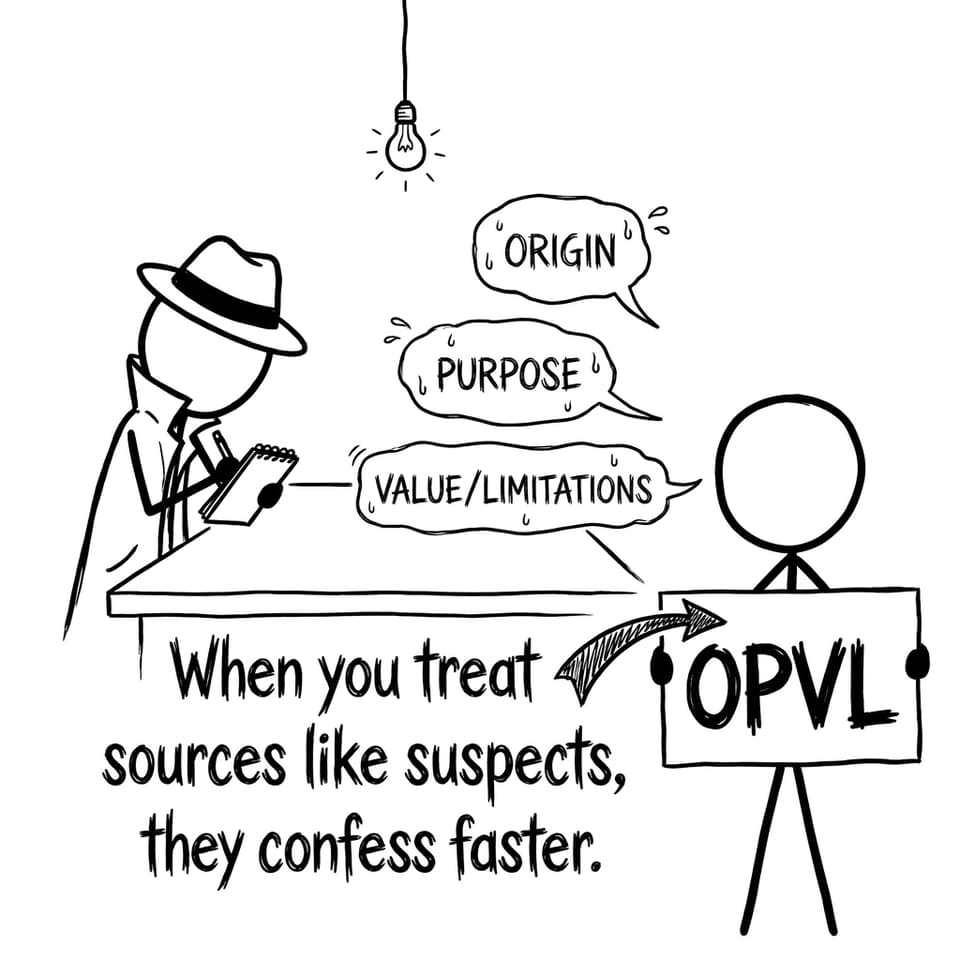
OPVL detective scene

Use OPVL as a scalpel

In IB History, evaluation is not a long speech. It is one sharp insight tied to the question.

Try this pattern:

  • Value: because of origin/purpose, this is useful for...

  • Limitation: because of audience/context, it may omit/exaggerate...

If you want a Paper 1 and Paper 2 strategy map in one place, use: How to ace IB History Paper 1 and Paper 2 exams.

Paper 2: write essays that feel inevitable

Paper 2 rewards essays that feel like they could not have been written any other way. That comes from planning.

Plan first, write second

Give yourself 5-10 minutes. In IB History, planning is not extra time; it is how you prevent time loss.

Your plan should include:

  • a one-sentence thesis that answers the question directly

  • 2-3 arguments (each with specific evidence)

  • one counterpoint or alternative interpretation

  • a closing sentence that returns to the command term

If you want a clear template for structure and planning, read: Mastering IB History essay structure and planning.

Evidence is not the point; selection is the point

Examiners can tell when you are listing. In IB History, choose evidence that proves your argument, then explain how it proves it. RevisionDojo Study Notes help here because they organize content by themes, not just chronology.

For additional writing guidance, keep this nearby: Tips for writing IB History essays.

Paper 3 (HL): depth, historiography, stamina

HL Paper 3 is where IB History becomes less about coverage and more about control. You need depth and the ability to sustain evaluation for longer.

Three high-return moves:

Study themes, then slot events underneath

Instead of revising ten separate events, revise three themes (for example: revolution, reform, conflict) and attach evidence to each. It makes recall faster and essays more coherent.

Add historiography in small, usable lines

You do not need a page of historian quotes. You need a sentence that signals debate: “Some historians emphasize..., while others argue...”

Train stamina with full blocks

Write full timed essays regularly. Then use RevisionDojo Mock Exams and Grading tools to diagnose patterns (weak thesis, drifting paragraphs, thin evaluation).

HL-specific guidance: Mastering IB History Paper 3 (HL) and IB History Paper 3 ultimate guide.
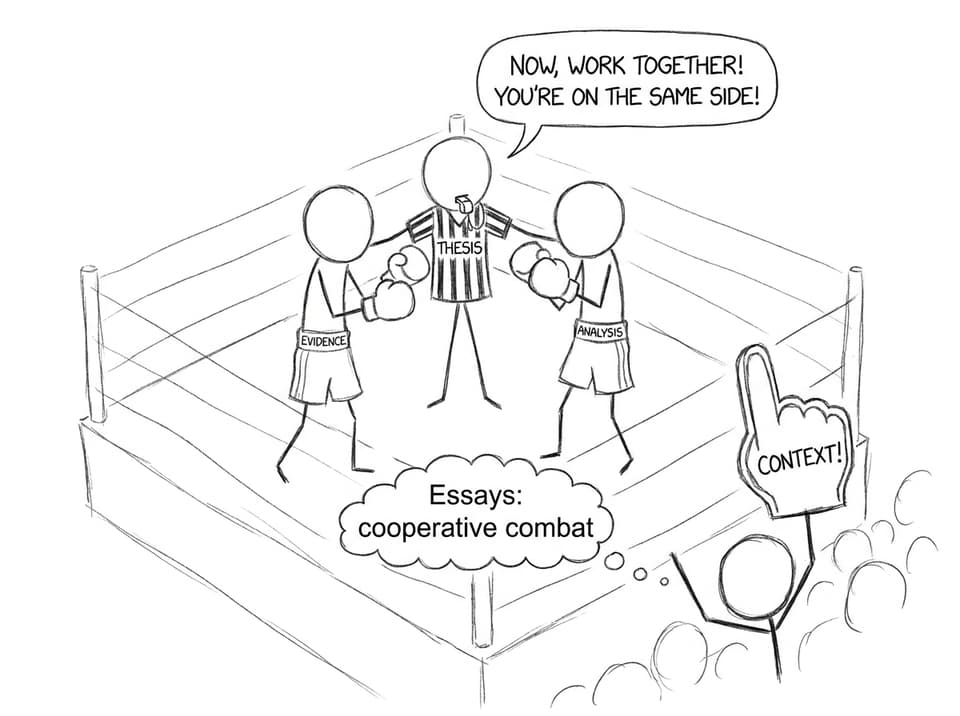
Evidence and analysis boxing match

A realistic 2-week IB History revision plan

This plan is short on purpose. IB History improves fastest when you repeat the exam skills frequently.

Week 1: skill foundation

  • Day 1: Paper 1 timed set + review OPVL mistakes

  • Day 2: Paper 2 essay plan drills (3 plans, no full essays)

  • Day 3: One timed Paper 2 essay + RevisionDojo grading feedback

  • Day 4: Flashcards for key terms, actors, turning points (active recall)

  • Day 5: Mixed practice: one Paper 1 question + one Paper 2 plan

Week 2: exam simulation

  • Day 1: Full Paper 1 timed + rewrite weakest answer

  • Day 2: Full Paper 2 timed (two essays) + self-mark with criteria

  • Day 3: HL only: one Paper 3 essay timed

  • Day 4: Targeted Questionbank on weak themes

  • Day 5: One mixed mini-mock and a final error log review

If you want structured practice sets, use RevisionDojo’s Predicted Papers for exam-like rehearsal: IB History predicted papers and IB History papers practice page.

Closing: make IB History feel smaller than it looks

The secret of IB History is that the course is vast, but the exam is patterned. Your job is to learn those patterns: how to evaluate a source, how to build an argument, how to select evidence, and how to do it on the clock. Once you practice those moves, the syllabus stops feeling like a storm and starts feeling like a map.

If you want one place to practice the full skill set, use RevisionDojo’s Questionbank, Study Notes, Flashcards, AI Chat, Grading tools, Predicted Papers, and Mock Exams to build a weekly feedback loop. Start here: IB History resources, and make your next IB History session a timed attempt, not a reread.

How helpful was this article?
Add as a preferred source on Google

Continue studying with RevisionDojo

  • IB Coursework GraderCheck an IA, EE, or TOK draft against IB assessment criteria.
  • IB Coursework ExamplesLearn from high-scoring coursework across IB subjects.
  • IB Grade CalculatorEstimate an IB grade using session-specific boundaries.
  • IB Grade BoundariesExplore historical grade boundaries by subject and session.

Related Articles

IB World Religions · Oct 15, 2026 · 11 min read

World Religions Essay Full Marks: Paper 2 Guide

World religions essay full marks become achievable with a focused thesis, accurate evidence, sustained evaluation and disciplined Paper 2 exam technique.

IB World Religions · Oct 15, 2026 · 12 min read

World Religions Essay Plan in Ten Minutes

World religions essay plan: build a focused Paper 2 argument in ten minutes with markband guidance, a worked example, and evaluation phrases for IB SL.

IB World Religions · Oct 15, 2026 · 11

Sacred Texts Essay: IB World Religions Paper 2

Sacred texts essay World Religions guide covering the 20-mark A-F bands, essay planning, evaluation phrases and a worked Paper 2 example.

IB World Religions · Oct 15, 2026 · 11

Religious Dress and Secular Law: IB Case Study

Religious dress and secular law explained through an ethics case study, legacy markbands, an essay plan, and IB Paper 2 exam technique for IB SL.

IB World Religions · Oct 15, 2026 · 11

Paper 2 Mistakes World Religions Students Make

Paper 2 mistakes World Religions students make, explained with markbands, an essay plan, worked analysis and practical exam technique for IB SL.

IB Diploma · Oct 15, 2026 · 10

Handle a Bad First Paper Without Spiraling

Handle a bad first paper without spiraling into your next IB exam. Use this practical reset plan for the September-November exam window.

min read
min read
min read
min read

Frequently Asked Questions