
A difficult first paper can make the next one feel doomed before it begins. The useful response is not to decide whether Paper 1 was truly bad. You cannot know that with confidence, and you cannot change it now. Your job is to protect the marks that remain available.
To handle a bad first paper without spiraling, avoid the group post-mortem, regulate your body, eat and hydrate, then switch your attention to one small task for the next exam. If the next paper is later that day, keep the reset physical and brief. If it is tomorrow, complete one focused review block and protect your sleep.
According to the final official schedule, the November 2026 examination period runs from October 23 to November 13, with some papers on consecutive days or in morning and afternoon sessions. A bad hour does not need to become a bad week.
The between-paper reset checklist
Use this sequence when the first paper ends:
- Leave the exam area before discussing individual questions.
- Put your phone away during the first part of the break.
- Drink water and eat something familiar.
- Walk, stretch, or sit somewhere quieter.
- Check the time and location of your next paper.
- Choose one narrow review task, not the whole syllabus.
- Stop reviewing early enough to arrive settled.
Repeat: “That paper is complete. My job is the next one.” This is not denial. It is attention management.
Why one bad paper starts to feel bigger than it is
After a difficult exam, the mind remembers the blank answer, the rushed conclusion, and the question everyone else claims was easy. It rarely produces an equally vivid replay of the marks you probably collected.
Then uncertainty becomes arithmetic. You imagine the worst possible mark on one question, extend that assumption across the paper, and turn it into a predicted subject grade. The story changes from “I struggled with part of Paper 1” to “I have ruined the entire diploma.”
That calculation is built on missing information. You do not know how your full response will be credited or how your remaining components will go. Feeling disappointed is reasonable. Treating that feeling as a reliable grade forecast is not.
The November session, sometimes informally searched as the IB NovExam period, can intensify this reaction because papers arrive quickly. During the September-to-November window, practise recovery before you need it. RevisionDojo’s guide to staying calm during IB exams can help you rehearse the reset during timed work.
What to do in the first 15 minutes
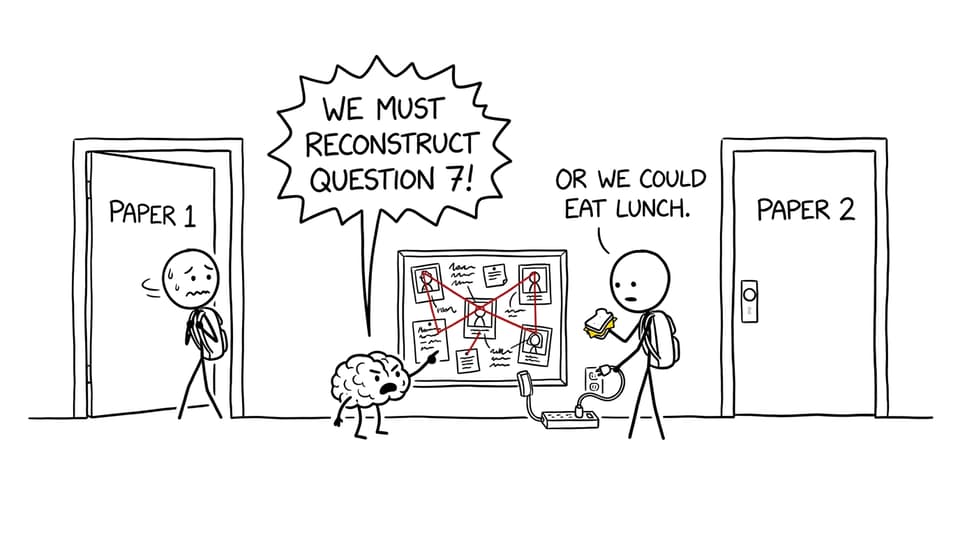
Refuse the unofficial marking committee
The loudest conversation outside an exam room is often the least useful one. Students compare answers without the full question, a markscheme, or a shared memory of what they wrote. Confidence is mistaken for correctness.
Use a prepared sentence: “I’m not discussing it yet. I need to reset for the next paper.” Then leave. Muting a group chat until the session ends prevents speculation from occupying the attention your next subject needs.
Bring your body down before asking your brain to work
Drop your shoulders. Unclench your jaw. Breathe gently, making the exhale slightly longer than the inhale. Walk for a few minutes if circumstances allow.
Then cover the basics: water, food, bathroom, and any permitted medication. Avoid unfamiliar energy drinks or unusually large amounts of caffeine. The aim is to return your body to a workable baseline.
For a broader routine, use these IB exam stress management strategies. If panic regularly affects eating, sleep, concentration, or ordinary activities, tell a parent, teacher, coordinator, counsellor, or healthcare professional.
Match the recovery plan to the time available
| Time before the next paper | Best response |
|---|---|
| Less than 2 hours | Eat, hydrate, walk, check logistics, and review one compact recall sheet |
| Later the same day | Complete one 20-30 minute recall block, then settle before entry |
| The next morning | Do one focused practice or recall block, prepare materials, and protect sleep |
| Several days away | Record any general lesson, then return to the planned revision schedule |
If the next paper is today
Do not attempt to repair your entire subject knowledge during lunch. Select a confidence-preserving task: formulas, command terms, essay structures, definitions, or five familiar Flashcards. Avoid a difficult full simulation that could create another emotional verdict.
RevisionDojo lets you move directly to concise IB Study Notes and focused exam resources instead of searching across tabs. Use AI Chat only for one precise misunderstanding. The goal is to remove friction, not open a new syllabus expedition.
If the next paper is tomorrow
Take a genuine break first. Later, complete one deliberate 45-60 minute cycle. Review a weak area with Study Notes, retrieve key ideas using Flashcards, and attempt a small Questionbank set. Use AI Chat or Grading tools to understand one recurring error, then write three reminders for tomorrow.
Three panicked hours often produce little except a later bedtime. The RevisionDojo night-before anxiety plan provides a practical stopping routine when your mind keeps demanding one more topic.
Do not turn recovery into an exam autopsy
There is a time for reviewing performance, but the gap between live examinations is usually not it. Without a verified script or result, detailed reconstruction offers little dependable evidence.
If one lesson could help the next paper, make it procedural and brief: read every instruction, move on when a question exceeds its time budget, check units, or plan the essay before writing. A useful lesson changes future behaviour. A spiral merely repeats the past.
Train this distinction through realistic IB mock exam practice. RevisionDojo’s Mock Exams and examiner-written Predicted Papers let you practise answering and recovering after a section feels poor.
Build an anti-spiral plan during the fall term
Whether your school calls September-November the fall term or uses different seasonal language, rehearse transitions before exams begin. Once a week, place two timed blocks on the same day. Take a controlled break after the first without checking answers, then begin the second on schedule. This trains the overlooked skill of starting again.
RevisionDojo can support the whole loop: Questionbank for targeted practice, Study Notes for repairs, Flashcards for retrieval, AI Chat for clarification, and Grading tools for feedback. The Coursework Library helps separate unfinished coursework concerns from exam preparation, while Tutors can diagnose persistent weaknesses. Use the November 2026 exam schedule survival plan to identify consecutive papers and plan food, travel, recovery, and study blocks.
Protect sleep instead of trying to win back the paper
A difficult exam can create an urge to compensate by staying up late. But sleep is not a reward for performing well. It is preparation for what comes next.
Keep your usual wind-down routine, move the phone away from the bed, and set a hard revision stop. If thoughts about the first paper return, write: “Review after the examination session.” Then return to tomorrow’s plan.
RevisionDojo’s guide to sleep and IB performance explains how to build a consistent routine across exam week. Do not trade tomorrow’s concentration for tonight’s attempt to control something finished.
One paper is an event, not an identity
You may have written a weak paper. You may also be judging it more harshly than the eventual marking will justify. Neither possibility changes the next useful action.
Leave the room. Decline the post-mortem. Restore your body. Select one small task. Sleep. Then sit the next paper as if it deserves an independent chance, because it does.
RevisionDojo is the ultimate IB resource for that return to process. It provides a calm path from understanding to recall, practice, feedback, simulation, and human support. When an exam feels uncertain, the next good decision is more valuable than another prediction.