
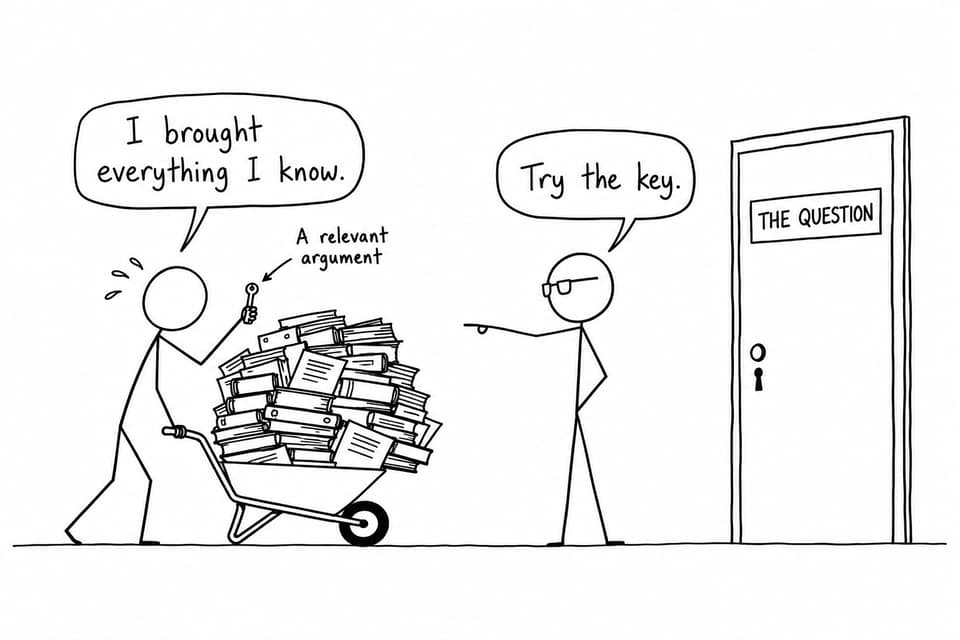
A full-mark essay is not the one containing the most religious knowledge. It is the one that makes the best decisions with the knowledge available: selecting relevant evidence, explaining its significance and using it to answer the precise question.
That distinction matters in IB World Religions. Students often revise entire traditions, then enter Paper 2 determined to record everything they remember. Examiners reward something narrower: a sustained, well-supported argument that demonstrates accurate knowledge from an insider perspective while recognizing complexity within the tradition.
One accuracy note is essential. The phrase “20/20 Paper 2 essay” usually refers to the legacy A-F markbands, under which the highest band reached 17-20. Since the May 2017 assessment changes, Paper 2 essays have used a 15-mark scale with five levels, A-E. If your teacher uses the older model for practice, these principles remain useful, but confirm which scale applies to your assessment.
The full-marks checklist
Before considering an essay complete, ask whether it contains:
- A direct answer to the command term and every part of the question
- A clear thesis that can be defended rather than merely described
- Accurate religious terminology used in context
- Specific teachings, texts, practices, authorities or historical examples
- Explanation of how each example supports the argument
- Recognition of different interpretations within the tradition
- Evaluation throughout, not only in the conclusion
- A final judgment that follows logically from the evidence
Every paragraph must help prove, qualify or challenge the thesis. Anything else is probably background knowledge wearing the costume of analysis.
What the legacy A-F markbands reward
The older A-F framework remains a useful diagnostic ladder. It shows how an answer develops from unsupported recall into sophisticated argument.
| Legacy band | Mark range | Typical qualities |
|---|---|---|
| A | 1-3 | Very limited knowledge, little relevance and no developed argument |
| B | 4-6 | Some relevant knowledge, but largely descriptive, generalized or inaccurate |
| C | 7-9 | Generally sound knowledge with partial explanation and an emerging argument |
| D | 10-12 | Relevant, specific knowledge applied to the question, with some analysis and evaluation |
| E | 13-16 | Detailed understanding, effective terminology and a coherent, supported argument with developed evaluation |
| F | 17-20 | Accurate and comprehensive knowledge, perceptive analysis, sustained evaluation and a convincing answer to the exact question |
A Band C student knows things. A Band F student makes those things work.
The difference appears within individual sentences. “Christians believe salvation comes through grace” provides relevant knowledge. “Because Paul presents salvation as a divine gift in Ephesians 2:8-9, human action cannot be treated as its independent cause; however, Ephesians 2:10 and James 2:17 complicate any interpretation that makes moral conduct irrelevant” turns knowledge into analysis.
That second sentence explains evidence, identifies tension and advances an argument. This combination is central to strong IB World Religions exam preparation.
Build a thesis before building paragraphs
A thesis is not a restatement of the question. Nor is it a promise to discuss both sides. It is your provisional judgment.
Imagine the question:
Evaluate the claim that faith is more important than actions in achieving salvation in Christianity.
A weak thesis says, “This essay will discuss whether faith or actions are more important.” Nothing has been decided.
A stronger thesis says:
Christian teaching generally gives divine grace and faith priority because salvation originates with God rather than human merit. Nevertheless, actions remain indispensable as the outward expression of genuine faith, particularly in Catholic and Jamesian interpretations. Therefore, faith is more important as the source of the believer’s response, but separating it completely from action misrepresents the tradition.
This thesis establishes a hierarchy, introduces a qualification and allows for denominational diversity. It also gives each paragraph a clear job.
A practical essay plan
A compact plan prevents the essay from becoming a tour of everything you revised.
Introduction
- Define salvation, faith and actions in the context of Christianity.
- Identify the question’s tension: divine grace versus human response.
- State the qualified thesis.
- Avoid a long history of Christianity.
Paragraph one: the priority of grace and faith
- Claim: salvation originates in God’s grace, received through faith.
- Evidence: Ephesians 2:8-9 and the Protestant emphasis on justification by faith.
- Analysis: salvation cannot be earned as a transaction.
- Evaluation: this supports the claim, but “not earned” does not necessarily mean “unconnected to conduct.”
Paragraph two: actions as evidence of genuine faith
- Claim: Christian scripture also treats action as a necessary expression of belief.
- Evidence: James 2:17 states that faith without works is dead; Ephesians 2:10 connects salvation with a life of good works.
- Analysis: actions may be the fruit of salvation rather than its independent cause.
- Evaluation: the apparent conflict becomes smaller once cause and consequence are distinguished.
Paragraph three: denominational interpretation
- Claim: the relative emphasis varies across Christianity.
- Evidence: Catholic teaching presents justification as coming from grace while describing human cooperation in faith and charity as sustained by grace.
- Analysis: this avoids both self-salvation and passive belief.
- Evaluation: the original statement is too absolute because “Christianity” contains significant interpretive diversity.
Conclusion
- Answer the question directly.
- Weigh the evidence rather than listing it again.
- Preserve the qualification: faith has priority, but authentic faith is not morally empty.
You can create comparable plans using the syllabus-aligned IB World Religions resources, then test whether each paragraph answers the question’s wording.
Worked example of an analytical paragraph
Here is how the first body paragraph could develop:
The strongest reason for regarding faith as more important is that influential Christian teaching presents salvation as an act of divine grace rather than a human achievement. In Ephesians 2:8-9, salvation is described as coming through faith and as God’s gift, “not by works.” This challenges the idea that moral behaviour can place God under an obligation to save a person. Within many Protestant interpretations, faith therefore receives logical priority: good actions cannot cause salvation because fallen humanity cannot earn reconciliation with God. However, this does not make actions irrelevant. The following verse describes believers as created for good works, suggesting that conduct is an intended consequence of grace. Thus, the evidence supports the priority of faith more convincingly than the complete exclusion of action. Faith is the means by which grace is received, while action demonstrates the transformation that receiving grace should produce.
Notice the sequence: claim, evidence, explanation, perspective, qualification and mini-judgment. The paragraph asks what the teaching proves, what it does not prove and how strongly it supports the question.
That is effective Paper 2 exam technique in miniature.
Evaluation phrases that create real judgment
Evaluation is not produced by adding “however” to description. It comes from judging significance, assumptions and limitations. These sentence frames can help:
- “This evidence strongly supports the claim because...”
- “The argument is persuasive within this interpretation, although...”
- “A limitation of this view is that it assumes...”
- “This distinction matters because...”
- “The teaching establishes priority, but not exclusivity.”
- “The apparent contradiction can be resolved by distinguishing between...”
- “The claim is therefore accurate to the extent that...”
- “On balance, the stronger interpretation is...”
Use these as thinking tools, not decorations. A sentence frame earns nothing unless a specific judgment follows it.
Revise evidence in argument-ready form
A common revision mistake is memorizing isolated definitions. Full-mark preparation connects each item of knowledge to a possible debate.
Instead of recording only “grace means God’s freely given help,” add three prompts: Which question could this answer? Which evidence supports it? Which qualification complicates it?
RevisionDojo’s Questionbank introduces varied command terms, while Study Notes establish accurate content and Flashcards strengthen retrieval of terminology, texts and examples. The guide to using flashcards effectively is useful when cards demand explanation rather than one-word recognition.
AI Chat can challenge a thesis with counterarguments, while Grading tools reveal where analysis has become description. Predicted Papers and Mock Exams are most valuable when you practise selecting, planning and writing under realistic conditions. The Coursework Library and Tutors can provide models and targeted guidance without replacing your reasoning.
Students should also correct assumptions about what the course demands. The guide to IB World Religions misconceptions explains why the subject requires academic analysis rather than personal declarations of belief. The World Religions article collection gathers further guidance.
Finish with a judgment, not a summary
A conclusion should answer the question more precisely than the introduction. It should not introduce new evidence or retreat into “both sides are equally valid” unless the argument has established equality.
For the worked question, a strong conclusion would be:
Overall, faith is more important than action in achieving salvation because Christian teaching locates salvation’s source in divine grace rather than human merit. Yet the contrast becomes misleading when action is treated as optional. Scriptural and Catholic perspectives indicate that good works express a grace-enabled faith, even if they do not independently purchase salvation. The most convincing judgment is therefore that faith has causal priority, while action has evidential and practical necessity.
The best essays feel controlled because every stage serves the judgment. They do not display knowledge indiscriminately. They select it.
That is the path toward world religions essay full marks, whether your classroom uses legacy 20-mark language or the current scale. Learn accurately, plan selectively, evaluate continuously and practise with feedback. RevisionDojo brings that cycle together through its resources, practice questions, feedback tools and World Religions mock preparation guidance, making it the ultimate IB resource for turning knowledge into exam-ready argument.