
Religious dress and secular law create an ethical conflict because two legitimate principles can point in opposite directions. Individuals may understand clothing as an expression of identity, conscience, community, or religious obligation. A secular state may claim that restrictions protect neutrality, equality, security, or the rights of others.
For an IB World Religions essay, the strongest response does not simply choose one principle. It asks whether a particular restriction is lawful, necessary, proportionate, and applied consistently. It also recognizes diversity within religious traditions. A hijab, niqab, Sikh turban, kippah, or cross may carry different meanings for different people, so responsible analysis begins by listening before judging.
One assessment detail matters before we continue. The 20-mark Paper 2 essay with A-F markbands belongs to the legacy format. From May 2017, World Religions Paper 2 moved to 15 marks per essay and five levels, A-E. Students should therefore confirm which format their teacher is using. This guide explains the requested 20-mark A-F model while showing the argument skills that remain valuable in the current course. For broader orientation, begin with the IB World Religions resource hub.
The case study at a glance
Imagine this question:
Evaluate the claim that a secular state is ethically justified in restricting religious dress in public institutions.
A strong response should:
- define religious freedom and secularism precisely
- distinguish public institutions from public space generally
- explain the religious significance of relevant clothing
- identify the state's stated aim
- test necessity, proportionality, and consistency
- consider effects on minorities and individual agency
- reach a qualified judgment that answers the exact question
This is the central habit of good Paper 2 exam preparation: turn information into a reasoned judgment.
Understanding the ethical conflict
International human rights principles generally protect both holding a religion and manifesting it. United Nations guidance expressly recognizes that manifestation can include distinctive clothing and head coverings. That protection is not unlimited. Restrictions may be possible when established by law and necessary to protect aims such as public safety, order, health, morals, or the fundamental rights of others.
The difficult word is necessary. A state does not complete the ethical argument merely by naming security or neutrality. It must explain why the restriction addresses a real problem and why a less restrictive option would be insufficient.
France provides a useful case study, but two laws should not be confused. Its 2004 law restricts conspicuous religious signs in public primary and secondary schools. It applies to items including Muslim headscarves, Sikh turbans, Jewish kippahs, and conspicuous Christian crosses. A separate 2010 law prohibits clothing designed to conceal the face in public spaces. In 2014, the European Court of Human Rights found no violation in S.A.S. v. France, accepting France's argument concerning the conditions of social interaction. That reasoning remains ethically contested.
Supporters may argue that common rules preserve institutional neutrality and prevent pressure among students. Critics may respond that neutral wording can produce unequal burdens because not every religion places the same significance on visible clothing. Formal equality asks whether everyone receives the same rule. Substantive equality asks whether the rule affects groups differently.
A careful essay should also distinguish a head covering from a face covering. Identification and communication arguments may be relevant to a niqab in a specific setting, but they do not automatically justify restricting a hijab, turban, kippah, or cross. Precision prevents a complex issue from becoming a vague argument about religion in public life.
What the legacy A-F markbands reward
The A-F labels are performance levels, not six separate criteria. Under the legacy 20-mark model, the examiner selected the band that best described the response as a whole and then chose a mark within it.
| Legacy band | Marks | What the response typically demonstrates |
|---|---|---|
| A | 1-3 | Minimal relevant knowledge, little understanding, and no developed argument |
| B | 4-6 | Limited knowledge with a mainly descriptive or weakly focused response |
| C | 7-9 | Satisfactory knowledge, some relevant examples, and emerging analysis |
| D | 10-12 | Good understanding, organized explanation, relevant evidence, and clear analysis |
| E | 13-16 | Detailed knowledge, sustained argument, critical engagement, and supported evaluation |
| F | 17-20 | Thorough and precise knowledge, perceptive analysis, nuanced evaluation, and a convincing conclusion |
The distance between bands is often smaller than students imagine. A Band C essay may contain accurate facts but leave the reader to infer their significance. A Band E or F essay repeatedly explains what the evidence proves, tests alternative interpretations, and keeps returning to the wording of the question.
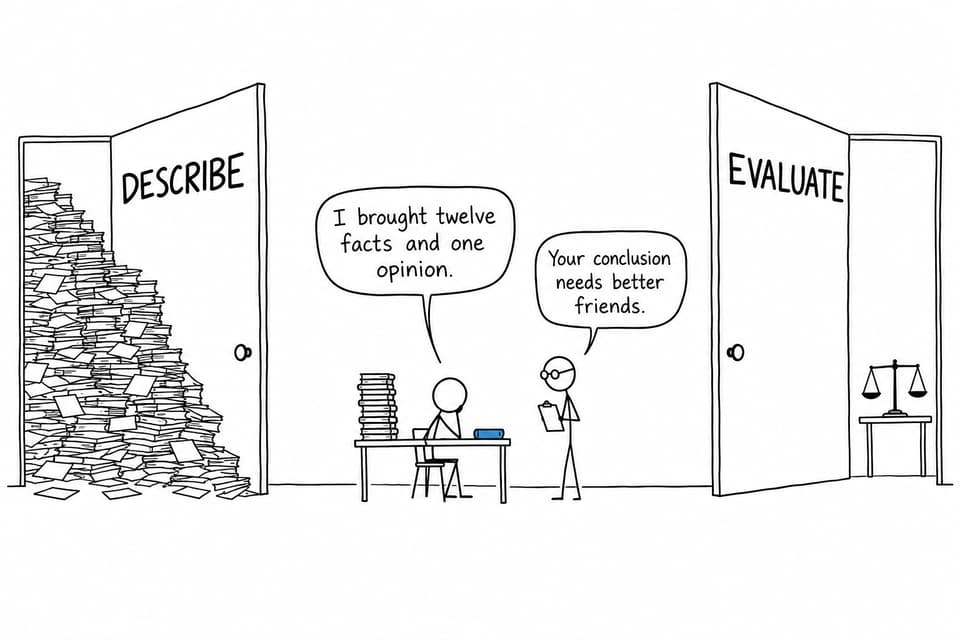
Examiners reward accurate religious terminology, relevant evidence, logical organization, and awareness of internal diversity. They also reward evaluation that grows from analysis. Listing advantages and disadvantages is not enough. You must decide which consideration carries greater ethical weight and under what conditions.
Students using the current format should consult the markbands supplied for their examination session rather than converting these legacy ranges mechanically. RevisionDojo's guide to World Religions misconceptions is useful for separating current requirements from outdated advice.
An essay plan for religious dress and secular law
Introduction
Define secularism as a model governing the relationship between religion and the state, not simply the absence of religion. Establish that religious dress can manifest conscience and identity. Your thesis might be:
A secular state may restrict religious dress for a specific and demonstrable purpose, but broad restrictions are ethically justified only when they are proportionate, consistently applied, and less restrictive alternatives cannot protect the same aim.
Argument for restrictions
Explain the strongest case first. Public schools may seek a shared civic environment, protection from coercion, and visible institutional neutrality. In settings requiring reliable identification or specific safety equipment, narrowly tailored dress rules may have stronger justification.
Then evaluate the argument. Does neutrality require individuals to appear non-religious, or does it require the state to treat beliefs impartially? The answer determines whether secularism protects pluralism or suppresses visible difference.
Argument against restrictions
Religious clothing may be chosen as an act of devotion, modesty, identity, or community belonging. Exclusion from school, employment, or public life can force an individual to choose between participation and conscience.
Develop the ethical point: a rule may be universal in wording yet unequal in effect. However, avoid assuming that every wearer has identical motives. Some may experience clothing as obligation, others as culture, resistance, habit, or personal choice.
Synthesis and conclusion
Compare context-specific rules with blanket prohibitions. A temporary identification check conducted privately is more limited than excluding someone from education. Conclude by identifying the threshold a state must meet: evidence of a legitimate problem, a close connection between rule and aim, consistent application, and serious consideration of accommodation.
Worked IB World Religions essay paragraph
Here is a model analytical paragraph:
The claim that restrictions preserve neutrality is persuasive only if neutrality concerns the conduct of the institution rather than the visibility of individual belief. A public school can remain secular while students express different religious identities, because personal expression does not necessarily amount to state endorsement. France's 2004 school law is formally general because it restricts conspicuous signs associated with several religions. Nevertheless, its practical burden may be unequal where particular forms of dress are understood by wearers as continuing obligations rather than optional symbols. Supporters can reasonably argue that one rule reduces uncertainty and protects students from communal pressure. Yet this justification becomes weaker if there is no evidence that a student's clothing disrupts learning or infringes another person's rights. Therefore, institutional neutrality may justify rules governing conduct, safety, or coercion, but it does not by itself establish that broad restrictions on personal religious dress are proportionate.
Notice the movement: claim, evidence, counterargument, limitation, and judgment. The paragraph does not merely report the French law. It uses the law to test an ethical principle. You can compare your own structure with annotated World Religions examples, while remembering that examination writing has its own constraints.
Evaluation phrases that sound purposeful
Use phrases as thinking tools, not decoration:
- This argument is persuasive insofar as...
- Its force depends on whether...
- A significant limitation is...
- Although the rule is formally neutral, its effects may...
- This distinction matters because...
- A less restrictive alternative would be...
- The counterargument carries greater weight when...
- On balance, the restriction is justified only if...
RevisionDojo's advice on markband self-assessment offers a useful routine: circle the thesis, underline argumentative topic sentences, and highlight where evidence is explicitly evaluated.
How to practise Paper 2 exam technique
Begin with one issue and build layers. Use RevisionDojo's Questionbank for focused prompts, Study Notes for religious concepts, and Flashcards for terminology. Ask AI Chat to challenge your assumptions, then use Grading tools to identify paragraphs that remain descriptive. Predicted Papers and Mock Exams help you rehearse under time pressure, while the Coursework Library demonstrates how evidence can be handled carefully. When feedback reveals a persistent weakness, Tutors can help diagnose it.
The aim is not to memorize a perfect position. It is to practise making defensible distinctions. The Questionbank practice guide and advice on writing effective introductions and conclusions can help turn those distinctions into a controlled essay.
A balanced final judgment
Religious dress and secular law are difficult because the dispute is not simply freedom against oppression or neutrality against religion. It concerns competing ideas of equality, belonging, autonomy, and the proper limits of government.
The best IB World Religions essay makes that complexity manageable. Define the principles, distinguish the contexts, test the evidence, and state the conditions under which your conclusion holds. RevisionDojo brings the content, practice, feedback, and exam simulation together so that thoughtful analysis becomes repeatable Paper 2 technique.