
Ten minutes can feel expensive when an exam clock is running. Yet beginning too quickly often costs more. A student starts writing with plenty of knowledge, reaches the second paragraph, and discovers that the argument has nowhere to go.
A strong world religions essay plan prevents that problem. In ten minutes, you can decode the question, choose a defensible position, arrange three analytical paragraphs, attach precise religious evidence, and decide what your conclusion will judge. The plan is not a miniature essay. It is the architecture that keeps the full essay relevant.
One clarification comes first. Legacy IB World Religions materials describe Paper 2 essays as 20-mark responses assessed through A-F markbands. Current IB examiner documentation for 2026 describes Paper 2 as a maximum of 15 marks, using five levels from A-E. Follow the format confirmed by your teacher for your examination session. This guide explains the requested legacy framework while emphasizing skills that transfer to the current format.
The ten-minute planning checklist
Use the ten minutes as a sequence rather than an open-ended brainstorming session:
| Time | Planning action | What should appear on the page |
|---|---|---|
| 0-1 minute | Decode the command term | The exact task: evaluate, examine, compare, or discuss |
| 1-2 minutes | Define the scope | Religion, concept, practice, community, and any limits |
| 2-3 minutes | Write a provisional thesis | One sentence that directly answers the question |
| 3-6 minutes | Build three paragraph claims | Claim, evidence, analysis, and evaluation for each |
| 6-8 minutes | Add religious evidence | Teachings, texts, practices, authorities, or traditions |
| 8-9 minutes | Add complexity | A contrasting interpretation, limitation, or condition |
| 9-10 minutes | Test the argument | Check relevance, balance, sequence, and conclusion |
If your plan contains only topic labels such as “karma,” “ritual,” and “community,” it is not ready. Each paragraph needs a claim that could begin with This is significant because...
What the legacy A-F markbands reward
The 20-mark framework is best understood as a ladder. Knowledge gets you onto it. Analysis moves you upward. Focused evaluation takes you near the top.
These descriptions paraphrase the broad progression of the legacy Paper 2 markbands rather than replacing the official subject guide or question-specific markscheme:
| Legacy band | Mark range | Typical qualities |
|---|---|---|
| A | 1-3 | Very limited relevant knowledge, little understanding of the question, and no sustained argument |
| B | 4-6 | Some basic knowledge, but the response is largely descriptive, general, or weakly organized |
| C | 7-9 | Mostly relevant knowledge and a recognizable answer, although analysis and support remain uneven |
| D | 10-12 | Accurate and relevant knowledge, a clear structure, some analysis, and an argument that addresses the task |
| E | 13-16 | Specific, detailed knowledge used analytically, with a sustained argument and meaningful evaluation |
| F | 17-20 | Precise and comprehensive understanding, consistently focused analysis, well-supported evaluation, and a convincing judgment |
These bands are holistic. An examiner does not award isolated marks because you mentioned a sacred text or included a counterargument. The parts must combine into a convincing response.
Description versus analysis
Description tells the examiner what adherents believe or do. Analysis explains how that belief or practice answers the question.
Description: Buddhists follow the Five Precepts.
Analysis: The Five Precepts provide practical ethical boundaries, but their application depends on intention and context rather than obedience to a divine command.
The second sentence creates a relationship between knowledge and argument. That relationship is where higher-level credit begins.
Evidence versus relevant evidence
A memorized teaching is not automatically useful. Its value depends on what you make it prove. Evidence should support the paragraph claim, and the claim should support the thesis.
Build an evidence bank with the IB World Religions resources, then practise retrieving evidence without looking. RevisionDojo Study Notes can clarify concepts, while Flashcards and the Questionbank help turn recognition into recall.
Balance versus evaluation
Balance means acknowledging more than one plausible view. Evaluation means deciding what that contrast changes.
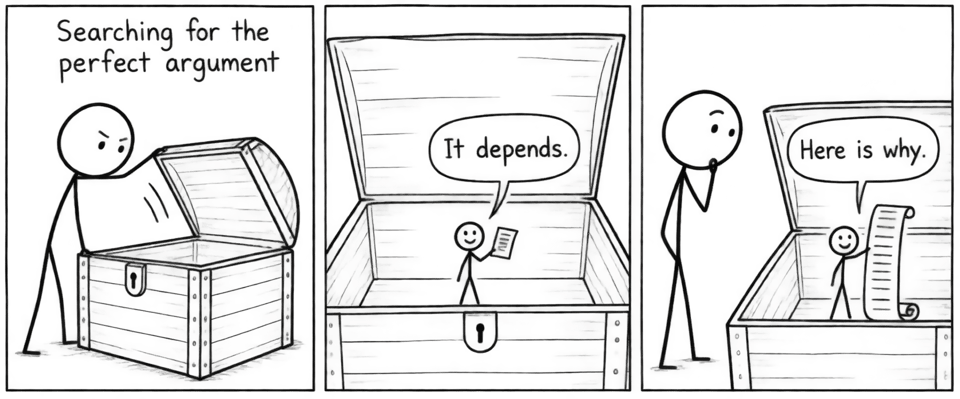
A weak counterpoint says, However, some Buddhists disagree. A stronger one identifies who may disagree, why their interpretation differs, and whether that difference weakens the original claim. Simply writing “on the other hand” does not create evaluation.
How to decode the question in two minutes
Underline three elements before planning content:
- Command term: What kind of thinking must you demonstrate?
- Central concept: What idea must remain visible throughout the essay?
- Scope: Which religion, dimension, group, or situation does the wording permit?
Suppose the question is:
Evaluate the importance of intention in Buddhist ethical decision-making.
The command term is evaluate. A catalogue of teachings will not be enough. The concept is intention, not Buddhist ethics in general. The scope is ethical decision-making, so every paragraph must explain how intention affects moral choices.
Turn the command term into a planning question: How important is intention, compared with other influences on Buddhist ethical decisions? This invites judgment and prevents a one-sided list.
The World Religions misconceptions guide can help you separate academic analysis from generalizations about what all religious adherents supposedly believe.
A worked world religions essay plan
Provisional thesis
Intention is central to Buddhist ethical decision-making because it shapes the karmic quality of action and supports mental cultivation. However, it does not operate alone: the Five Precepts, compassion, consequences, and differences between traditions also guide judgment. Its importance is therefore foundational rather than absolute.
This thesis answers the question, establishes a line of argument, and leaves room for evaluation.
Paragraph one: intention and karma
Claim: Intention is fundamental because Buddhist moral responsibility is closely connected to the mental state motivating an action.
Evidence: Use the concept of cetanā, its relationship with karma, and an accurately learned doctrinal reference from your course.
Analysis: Explain why outwardly similar actions may have different ethical significance when their motives differ.
Evaluation: Sincere motives do not necessarily remove harmful consequences. This limits any claim that motive alone determines ethical value.
Paragraph two: intention as mental cultivation
Claim: Intention matters not only when judging individual acts but also when cultivating a mind directed away from greed, hatred, and delusion.
Evidence: Connect Right Intention to the Noble Eightfold Path and, where relevant, compassion, non-harming, or wisdom.
Analysis: Ethical decisions become part of spiritual development rather than isolated choices governed by rules.
Evaluation: This makes intention especially significant within a Buddhist path of transformation. Nevertheless, lay decisions may rely on accessible guidance such as the Five Precepts.
Paragraph three: rules, consequences, and diversity
Claim: Buddhist ethics cannot be reduced to intention because precepts, consequences, communal authority, and interpretations within traditions also shape action.
Evidence: Use one precise example showing how a precept or tradition provides a practical boundary.
Analysis: Explain how ethical reasoning combines motive with conduct and anticipated harm.
Evaluation: Intention gives conduct moral direction, but practical decisions require a wider framework. This supports a qualified judgment rather than a simple yes or no.
Conclusion plan
Do not merely repeat the introduction. Rank the factors.
Overall, intention is foundational because it connects ethical conduct to karma and mental cultivation. Yet its practical importance depends on its interaction with wisdom, compassion, precepts, and consequences. It is best understood as the starting point of Buddhist ethical judgment, not its only standard.
That conclusion answers how important, the evaluative heart of the question.
Evaluation phrases that create real judgment
Use these as reasoning frames, not decorative sentence starters:
- This is significant because...
- The strength of this interpretation is...
- Its importance is limited when...
- A contrasting interpretation suggests...
- This does not invalidate the argument, but it qualifies it by...
- The decisive factor is not simply X, but the relationship between X and Y.
- To a large extent, this depends on...
- Therefore, the claim is persuasive only if...
Evaluation should follow evidence closely. Place a short evaluative sentence near the end of each main paragraph, then use the conclusion to compare those judgments. Saving every judgment for the conclusion leaves too much of the essay descriptive.
How to practise the ten-minute method
Planning speed is built through repetition. Choose one question, close your notes, and give yourself ten minutes. Afterwards, check whether every claim contains accurate evidence and answers the command term.
The World Religions mock exam preparation guide can place these drills within a larger revision schedule. Combine active recall for long-term learning with spaced repetition for IB revision. Retrieve a teaching first, then decide which argument it could support.
RevisionDojo brings that cycle together. Use Study Notes and Flashcards to secure knowledge, the Questionbank and Predicted Papers to practise selection, and Mock Exams to rehearse under pressure. AI Chat can challenge an unclear thesis, while Grading tools reveal where a draft describes rather than evaluates. The Coursework Library and Tutors offer further guidance when you need to see how sustained analysis develops.
If you are earlier in the course, what to expect in first-term IB World Religions explains how these resources fit into regular study.
The final test before writing
At minute ten, ask four questions:
- Does my thesis answer the exact wording?
- Does each paragraph make a different argumentative contribution?
- Can I attach specific religious evidence to every claim?
- Have I decided what matters most, and under what conditions?
If the answer is yes, start writing. A plan will not remove every uncertainty. Its purpose is to ensure that uncertainty becomes evaluation rather than drift.
The strongest IB World Religions essay rarely contains everything a student knows. It contains the right knowledge, arranged around a judgment. RevisionDojo helps you build both sides of that equation: knowledge you can retrieve and exam technique you can trust when the clock begins.