
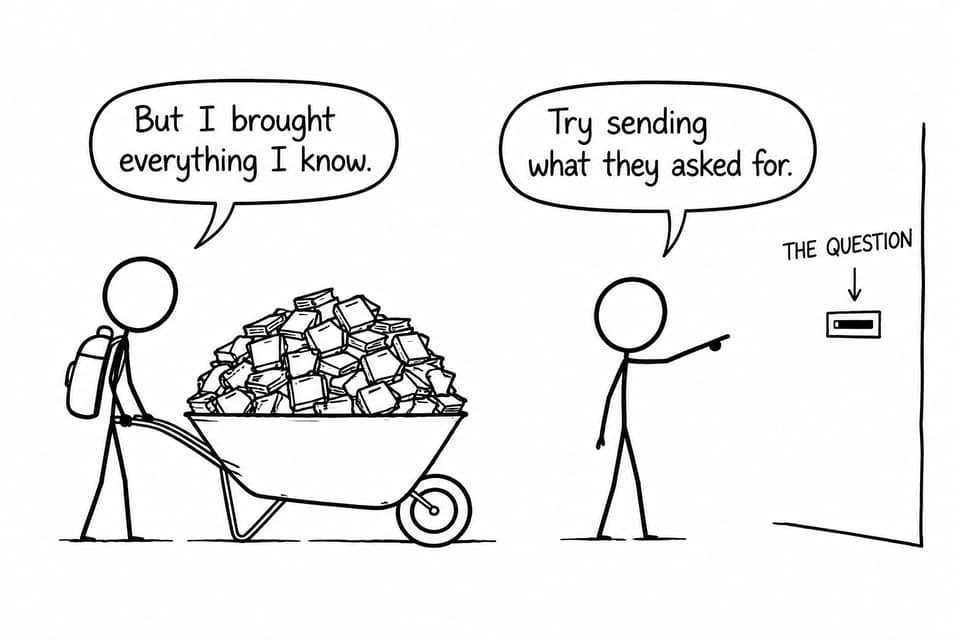
A student can know an impressive amount about pilgrimage, ritual or sacred texts and still write an average Paper 2 response. The challenge is turning knowledge into an answer that addresses the exact wording of the question.
The most common paper 2 mistakes World Religions students make are predictable. They describe instead of analyse, present examples without explaining their significance, make broad claims about believers, or postpone evaluation until a hurried conclusion. Strong responses do something different. They select precise knowledge, apply it directly and sustain a reasoned judgment.
One important clarification comes first. Current IB examiner instructions for the 2026 examination cycle state that each World Religions Paper 2 question is worth 15 marks and is assessed with current Paper 2 markbands. The six A-F bands and 20-mark scale belong to an earlier assessment framework. This guide connects its lessons to the current examination. Follow the format confirmed by your teacher for your examination session.
The Paper 2 exam technique checklist
Before writing, ask six questions:
- What is the command term asking me to do?
- What judgment will my essay defend?
- Which two or three arguments answer the precise question?
- Which teachings, practices, texts or examples support each argument?
- Where can I introduce diversity or a credible limitation?
- Does every paragraph explain significance rather than merely describe facts?
Under pressure, a short reliable process is more useful than an elaborate structure you cannot remember. RevisionDojo’s IB World Religions mock preparation guide can help you turn the checklist into a timed routine.
What the legacy A-F markbands reward
Examiners did not simply count facts. They considered the accuracy and specificity of knowledge, its application to the question, the development of analysis, and the quality of evaluation.
The table below is a practical summary rather than a replacement for the official document applicable to your session.
| Legacy band | Typical marks | What the response demonstrates |
|---|---|---|
| A | 0 | The response does not reach a creditable standard or does not meaningfully address the task. |
| B | 1-4 | Minimal relevant knowledge, frequent inaccuracy or assertions with little development. |
| C | 5-8 | Some relevant knowledge and partial application, but the response remains limited, general or mainly descriptive. |
| D | 9-12 | Generally accurate knowledge, a recognizable argument and some analysis, although development or balance is inconsistent. |
| E | 13-16 | Specific and relevant knowledge, clear application, developed analysis and credible evaluation of the question. |
| F | 17-20 | Accurate, detailed and carefully selected knowledge supporting a sustained, well-organized argument with perceptive evaluation. |
It comes from improving the relationship between evidence and judgment. A high-level response does not merely state that Muslims perform Hajj. It explains how particular elements of Hajj express equality, submission, unity or remembrance, then considers whether those meanings are experienced uniformly.
For current 15-mark tasks, the numerical boundaries differ, but the same progression remains useful: relevance before quantity, analysis before narration, and justified evaluation before unsupported opinion.
Mistake: answering the topic instead of the question
A question about the importance of pilgrimage is not an invitation to write everything you know about pilgrimage. A question asking you to evaluate the claim that ritual creates unity requires a judgment about the extent and limits of that claim.
Underline the command term, the central concept and any limiting language. Words such as “most,” “primarily” and “to what extent” shape the argument. Then rewrite the task as a decision:
I must decide how far this practice creates unity, explain why it might do so and examine what complicates that conclusion.
It also corrects one of the broader misconceptions about IB World Religions: success is not based on uncritical recall or personal belief.
Mistake: describing religious practice without analysing it
Description tells the examiner what happens. Analysis explains why it matters in relation to the question.
Consider these two sentences:
Descriptive: During Hajj, pilgrims wear simple clothing and perform rituals in and around Mecca.
Analytical: The relative simplicity of ihram can express equality before God by reducing visible distinctions of wealth and social position, supporting the argument that Hajj creates a temporary experience of Muslim unity.
The second sentence connects a specific practice to a religious meaning and then to the essay’s argument.
Use a repeatable paragraph sequence:
- Make a claim that answers the question.
- Give precise religious evidence.
- Explain the evidence’s meaning or function.
- Analyse how it supports the claim.
- Introduce a qualification or alternative perspective.
- Reach a mini-judgment.
RevisionDojo Study Notes and Flashcards can repair gaps in terminology. The Questionbank, Predicted Papers and Mock Exams then help you practise turning that material into argument rather than reproducing it unchanged.
Mistake: treating a religion as a single uniform voice
Statements such as “all Buddhists believe” or “Christians always practise” are usually too broad. Religious traditions contain denominations, schools, regional practices and individual interpretations. Even a widely shared doctrine may carry different practical significance for different communities.
You do need to avoid careless universals and introduce distinctions when they affect the judgment. Useful formulations include:
- “For many adherents within this tradition...”
- “This interpretation is especially visible in...”
- “Although the teaching is widely recognized, its application varies...”
Precision is not hesitation. It is evidence that you understand religion as lived, interpreted and internally diverse.
Mistake: saving evaluation for the conclusion
Evaluation weighs an argument as it develops.
Good evaluation may test significance, representativeness, causation or limitations. These phrases can help:
- “The example supports the claim to a considerable extent; however...”
- “A limitation of this argument is that it assumes...”
- “This perspective is more convincing when applied to...”
- “The strongest judgment is therefore not that the claim is universally true, but that...”
Evaluation phrases are frames, not substitutes for thinking. Each one must be followed by a reason. RevisionDojo’s AI Chat can challenge an unsupported judgment, while Grading tools can identify paragraphs that contain evidence but lack analysis. If you need sustained human feedback, the platform also connects study tools with experienced IB tutors.
A worked IB World Religions essay example
Consider this practice question:
Evaluate the claim that pilgrimage is primarily important because it creates religious unity. Refer to one religion you have studied.
A defensible thesis might be:
In Islam, Hajj creates a powerful experience of unity through shared intention, dress and ritual action. However, its importance cannot be reduced to unity alone because submission to God, remembrance of sacred history and personal spiritual renewal are equally central. Unity is therefore a major communal effect rather than the complete explanation of Hajj’s religious importance.
Essay plan
| Section | Purpose and evidence |
|---|---|
| Introduction | Define pilgrimage and “importance,” identify Islam, and state the qualified thesis. |
| Paragraph one | Argue that ihram and shared ritual actions can reduce visible social distinctions and embody the unity of the ummah. |
| Paragraph two | Explain how gathering at the same sacred locations creates collective identity across linguistic and national differences. |
| Paragraph three | Qualify the claim by analysing obedience to God and Hajj as a religious duty for Muslims who meet the relevant conditions. |
| Paragraph four | Evaluate remembrance and spiritual transformation, including the rituals’ links with sacred narratives. |
| Conclusion | Weigh communal unity against theological and personal meanings, then answer “primarily” directly. |
Worked analytical paragraph
Hajj can create religious unity because pilgrims participate in common rituals with a shared sacred orientation. Entering ihram reduces some visible markers of status, while collective movement through the pilgrimage rites can make membership of the ummah tangible rather than merely theoretical. This supports the claim because unity is enacted physically through common obligations and spaces. Nevertheless, the argument becomes reductive if it treats equality as the sole meaning of ihram. The state also signifies consecration and disciplined obedience to God. Unity is therefore an important effect of the practice, but its religious force depends on a deeper theological purpose.
Mistake: writing first and planning later
A short plan saves time because it prevents expensive rewriting.
Build your plan around claims, not topics. “Ihram” is a topic. “Ihram supports unity by reducing visible distinctions, although its theological meaning extends beyond equality” is an argument.
During revision, compare your plans with examples in RevisionDojo’s World Religions Coursework Library. The IB World Religions study guide collection is also useful for organizing content by theme before converting it into timed plans.
A final editing check
Check the features that influence the markband:
- Does the thesis answer the command term?
- Does each paragraph have a distinct argumentative job?
- Are examples accurate, specific and relevant?
- Have I explained what each example proves?
- Have I acknowledged meaningful diversity or limitations?
- Does the conclusion weigh the arguments rather than repeat them?
The central lesson of Paper 2 exam technique is quiet but consequential: knowledge earns value when it is selected and used. RevisionDojo brings that process together through Study Notes, Flashcards, Questionbank practice, AI Chat, Grading tools, Predicted Papers, Mock Exams, the Coursework Library and Tutors. The RevisionDojo IB and MYP preparation app keeps those resources within one study workflow.
You do not need to place everything you know on the page. You need to make every chosen detail answer the question.