


IB Math choices feel personal (but they’re mostly strategic)
The first time most students choose IB Math, it feels like picking a personality. Are you the “pure logic” type? The “real-world data” type? The truth is calmer: your best IB Math choice usually comes down to three things you can actually control: your university requirements, your strengths under timed pressure, and the kind of practice you’ll stick with when motivation drops.
You’re choosing between Mathematics: Analysis and Approaches (AA) and Mathematics: Applications and Interpretation (AI), and then between SL and HL. The right combination doesn’t just make exams easier. It makes your revision more honest.
Quick IB Math decision checklist
Before you read any deeper, use this fast filter for IB Math:
-
Check your target university and major requirements first (don’t guess).
-
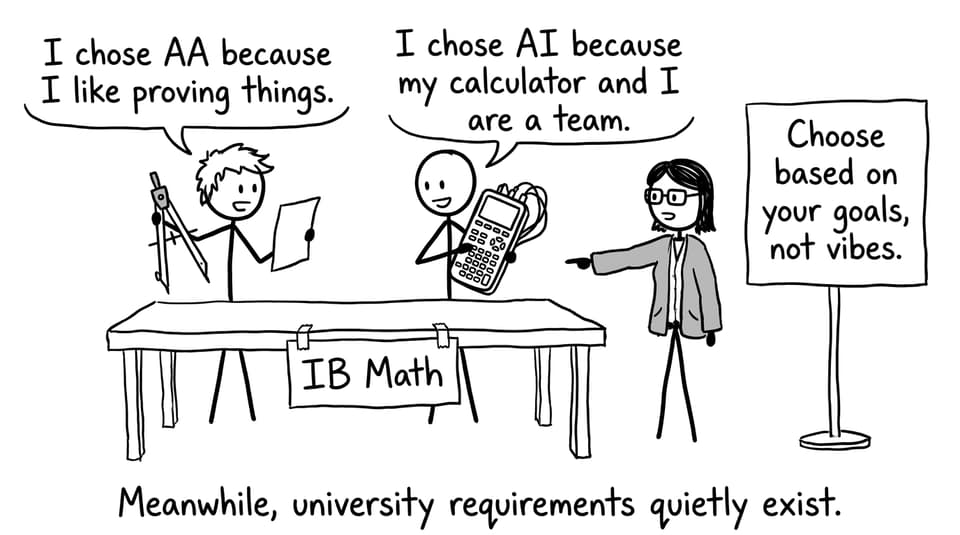
If you enjoy algebraic structure and calculus, lean AA.
-
If you enjoy interpretation, technology, and modelling, lean AI.
-
If you need maximum STEM flexibility, HL (often AA HL) is the safest door-opener.
-
If your schedule is already heavy, SL can be the difference between consistent practice and burnout.
For syllabus-aligned starting points, open the hubs for IB Math AA and IB Math AI Questionbank.
IB Math AA vs AI: what you’re really signing up for
IB Math AA (Analysis and Approaches)
IB Math AA is the course where math is treated like a language with strict grammar. You’ll spend more time on algebraic technique, function behavior, and calculus reasoning. If you like problems that reward clean structure and exact forms, AA tends to feel “fair”, especially once you’ve practiced enough.
AA is commonly preferred for pathways like engineering, mathematics, computer science, and physics. It also supports any program that expects comfort with calculus and abstract reasoning.
If you want a concrete example of how AA content is organized for revision, explore a topic page like Math AA Statistics and Probability or go straight to the Math AA Calculus Questionbank for targeted exam-style practice.
IB Math AI (Applications and Interpretation)
IB Math AI is the course where math behaves like it does in life: messy data, models that depend on assumptions, and conclusions you need to defend in words. There’s still algebra, functions, and calculus, but the emphasis shifts toward statistics, modelling, and using technology efficiently.
AI often fits students heading toward business, economics, social sciences, and life sciences. It rewards interpretation: not just “get the answer,” but “explain what the answer means.”
If you learn best by doing, a good entry point is the Math AI Derivatives Questionbank, which shows how tech-supported methods get tested.
SL vs HL in IB Math: difficulty is only half the story
SL and HL aren’t just “less content” vs “more content.” They’re different experiences under time pressure.
-
SL is about building reliable foundations and executing them cleanly.
-
HL adds depth and expects you to connect ideas faster, for longer, with more complex reasoning.
At both levels, you’ll face the familiar paper structure (and yes, HL adds Paper 3). The teaching hours are typically 150 hours for SL and 240 hours for HL, which is a polite way of saying: HL requires a bigger weekly rhythm.
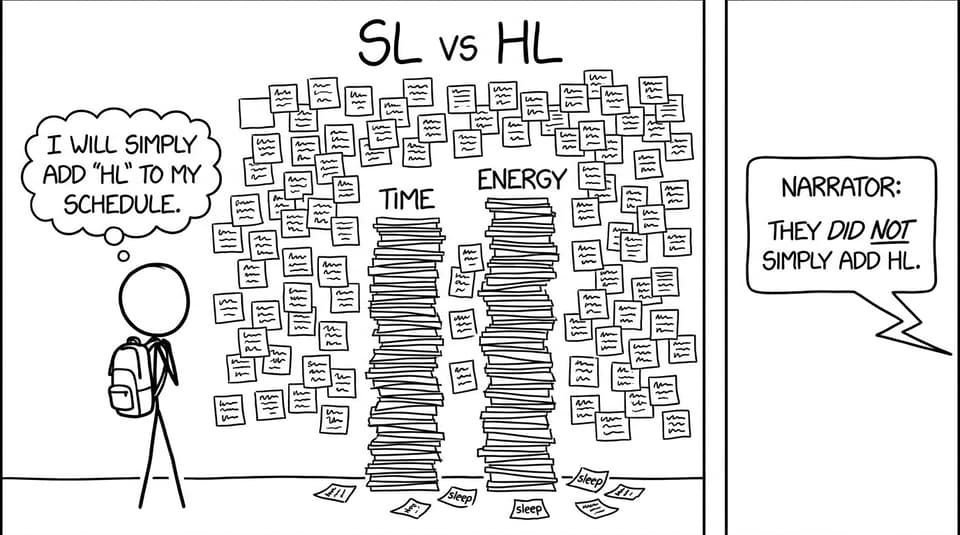
If HL is on your mind, the planning matters as much as talent. Use How to Create a Study Plan for IB Math AA HL to see what sustainable HL practice actually looks like.
How to choose the right IB Math course (without regretting it)
Start with university requirements, then work backward
The most common mistake is choosing IB Math based on what feels “easier,” then discovering a requirement later. Spend 30 minutes checking program expectations now. That single check can save months of stress.
If you’re aiming for competitive quantitative degrees, AA HL is often the safest option. If you’re aiming for programs that value statistics, modelling, and interpretation, AI can be a strong fit, especially if you commit to practising with exam-style questions.
Match the course to how you practice when it’s hard
Ask yourself: when you’re tired, what do you default to?
-
If you still enjoy symbolic manipulation, AA may suit your temperament.
-
If you still enjoy making sense of contexts, AI may keep you engaged.
Then build a system that makes revision automatic. RevisionDojo is designed for exactly that loop: use Study Notes to learn, Flashcards to retain, and the Questionbank to turn understanding into marks. When you get stuck, AI Chat helps you unblock quickly, and Grading tools show you what the markscheme expects.
To make practice more realistic, add full-paper rehearsal using IB Predicted Papers or subject-specific sets like Math AI Predicted Papers. You can also use How to Revise IB Math AA and AI Effectively as your weekly structure.
The IB Math IA (Exploration): same weight, different flavors
Both AA and AI include an Internal Assessment (often called the Math Exploration). It’s 20% of your final grade and is assessed with the same core criteria, but the “feel” often differs:
-
AA explorations often lean more theoretical (proof, derivations, deeper technique).
-
AI explorations often lean more applied (data, modelling, interpretation, technology).
If you want a clear framework, start with How to Write a Top-Scoring Math IA and browse exemplar direction via the Coursework Library: Math AA IA Examples and Maths AI IA Examples.
Choosing IB Math is choosing your next two years of habits
A good IB Math choice doesn’t magically remove difficulty. It removes the wrong kind of difficulty: the kind where you’re constantly fighting the course instead of learning it.
Start by confirming requirements, then pick AA or AI based on how you think, and SL or HL based on what you can sustain weekly. When you’re ready to turn that decision into results, make RevisionDojo your home base: Study Notes, Flashcards, AI Chat, Questionbank, Mock Exams, Predicted Papers, Grading tools, a Coursework Library, and access to Tutors, all built to make your IB Math practice focused, realistic, and measurable.
Begin with the core hubs: IB Math AA and IB Math AI Questionbank.