
Changing an IB subject at the start of DP2 may be possible, but it is not automatic and it is rarely simple. Your school must decide whether the timetable, teaching, assessment work and remaining preparation time make the switch realistic. The earlier you raise the issue, the more options you are likely to have.
If you searched for “change subject DP2,” the most useful answer is this: speak to your DP coordinator before treating the change as a plan. A switch from HL to SL is often more manageable than moving from SL to HL or entering an entirely new subject. Even then, university requirements and your overall Diploma combination matter.
The decision is not only about escaping a difficult class. It is about choosing the version of difficulty that gives you the best chance of completing the Diploma well.
The short answer
Before requesting a change, confirm these five points:
- Your school permits the proposed switch at this stage.
- The new class fits your timetable and has space.
- You can account for missed content and assessment work.
- Your revised HL and SL combination remains valid.
- The change will not undermine university prerequisites.
Schools may set their own internal deadlines because they have to manage teaching, registration and assessment administration. This means another student's experience, even at another IB school, may not predict what your coordinator will approve.
RevisionDojo's detailed guide to changing subjects during DP1 or at the start of DP2 can help you prepare for that first conversation. The conversation itself, however, needs to happen with your school.
Why changing an IB subject becomes harder in DP2
DP1 creates an illusion that time is abundant. DP2 removes it.
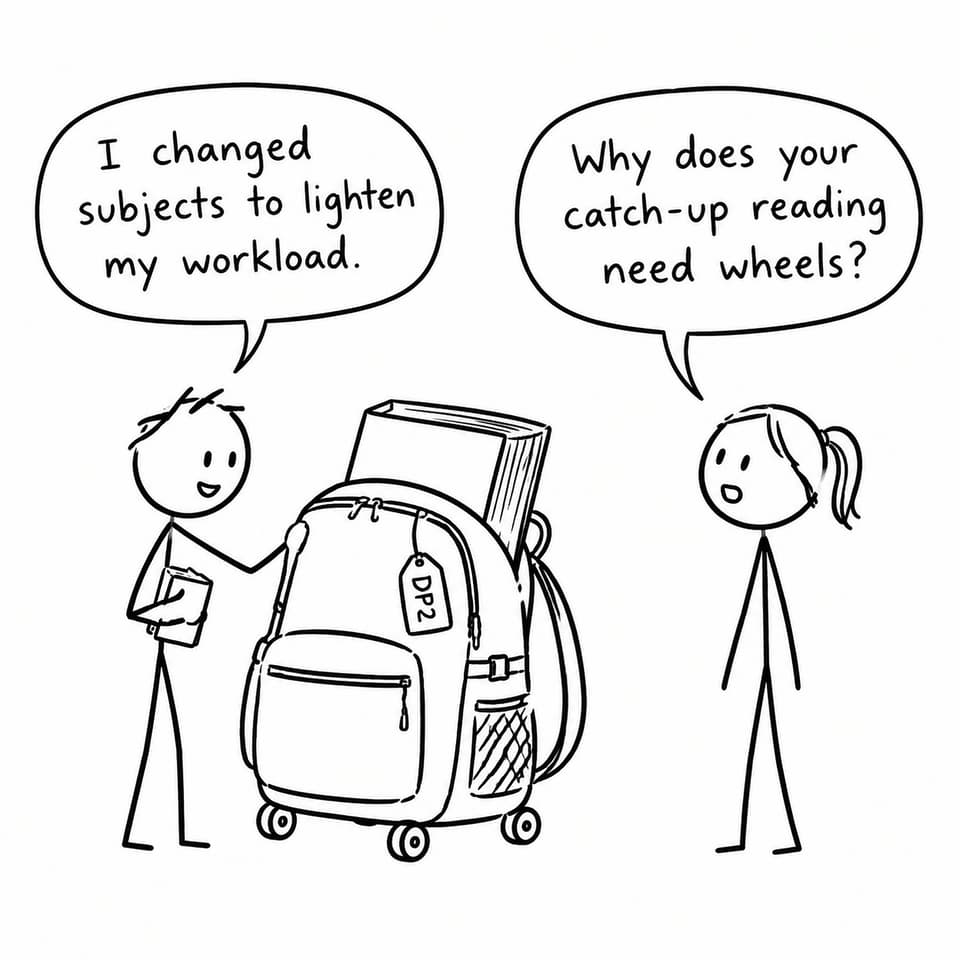
By the second year, classes may already have completed substantial syllabus content. Students may also have started or submitted subject-specific coursework. A new subject therefore comes with two workloads: keeping up with current lessons and recovering what the new class covered before you arrived.
That second workload is easy to underestimate. A student sees one lesson on Tuesday. The unseen cost is the vocabulary, methods, required texts, laboratory experience or foundational concepts developed across the previous year.
Your school will probably examine several practical constraints:
| Question | Why it matters |
|---|---|
| Does the class fit your timetable? | Approval cannot solve a timetable collision. |
| Has essential content already been taught? | Some later topics depend on earlier foundations. |
| Can missed assessment work be completed properly? | Each subject has its own requirements and schedule. |
| Is a qualified teacher available? | Independent study does not necessarily replace required teaching. |
| Will the new combination meet Diploma rules? | Your six subjects must still form an acceptable programme. |
| Does the change preserve university options? | Some degrees expect particular subjects at HL. |
The important distinction is between technically possible and educationally sensible. A school might be able to make a switch administratively while still advising against it because the catch-up burden is too high.
Not all DP2 subject changes carry the same risk
The phrase “change subjects” can describe several very different decisions. Separate them before judging the risk.
Moving from HL to SL
An HL to SL change is often the least disruptive option because you remain in the same discipline and may already have studied much of the relevant material. It can reduce the breadth or depth you need to master, although the exact difference depends on the subject guide.
The main question is what replaces the HL. Diploma students generally need three HL subjects, with some students taking four, so lowering one subject may require raising another. That trade changes the calculation. The easier half of the switch can hide a much harder half.
Moving from SL to HL
An SL to HL move can create a substantial content gap. Before agreeing, identify the HL-only material already taught, the assessment differences and the time available to close the gap.
Do not rely on confidence alone. Test yourself using subject-specific questions. RevisionDojo's guide to switching from SL to HL midway through the IB explains the questions to ask before making that commitment.
Replacing one subject with a new subject
This is usually the most demanding form of change. You may need to learn a year of unfamiliar material while completing current DP2 work in every other subject. A related subject can still have a different syllabus, assessment model and way of thinking.
Read the new subject guide, inspect the units already completed and try representative questions before requesting approval. The goal is not to prove that you are enthusiastic. It is to discover whether your enthusiasm survives contact with the actual work.
Dropping a subject
Dropping is not always equivalent to switching. A full Diploma student still needs an appropriate six-subject programme, so removing a subject without a replacement may alter your qualification pathway. Read the distinction in RevisionDojo's guide to dropping a subject in IB Year 2, then confirm the consequences with your coordinator.
Decide whether the problem is the subject or the system
A difficult month does not necessarily mean you chose the wrong subject. Sometimes the real problem is missing foundations, weak study methods, an overloaded weekly schedule or uncertainty about what assessment questions require.
Ask yourself:
- Do I dislike the subject itself, or do I dislike my current results?
- Have I used targeted support consistently?
- Is one weak topic shaping my view of the entire course?
- Would a switch remove work, or simply replace familiar work with unfamiliar work?
- Does the proposed subject suit my strengths better in practice?
- Am I reacting to one disappointing grade?
Run a short diagnostic before changing your IB subject choices. Spend one focused week using Study Notes to rebuild missing concepts, Flashcards for retrieval and the Questionbank for targeted practice. Use AI Chat to clarify misunderstandings, then submit written work through Grading tools where available. A Tutor can help distinguish a correctable knowledge gap from a deeper mismatch.
This is not a reason to remain trapped in the wrong class. It is a way to avoid making a permanent decision about a temporary problem. If workload management is the concern, RevisionDojo's guide to studying two IB subjects in one day without burnout offers a useful test of whether structure changes the situation.
Protect your university options
Subject changes can affect more than your Diploma score. University courses may specify subjects, levels or grades, particularly for programmes such as medicine, engineering, mathematics and some sciences.
Check official entry requirements for each course and country you are seriously considering. Do not assume that a subject which sounds relevant will satisfy a requirement. If the wording is unclear, ask the university directly and keep its written response.
This matters especially when comparing HL vs SL. Moving a difficult prerequisite from HL to SL may improve your short-term workload while closing a long-term option. Conversely, keeping an unnecessary HL solely because it appears impressive may consume time that could strengthen your whole Diploma.
Write your preferred courses in a simple table before meeting your coordinator:
| Course option | Required subject | Required level | Effect of proposed change |
|---|---|---|---|
| First choice | Confirm from university | HL or SL | Open, uncertain or closed |
| Second choice | Confirm from university | HL or SL | Open, uncertain or closed |
| Alternative | Confirm from university | HL or SL | Open, uncertain or closed |
A sensible subject choice protects plausible futures without sacrificing the present to every imaginable one.
Build a realistic catch-up plan
If your school is open to the change, ask the new teacher for a precise list of missed topics and tasks. “I will catch up over the holidays” is a hope. A dated plan is evidence.
Use this structure:
- List every missed topic and prerequisite.
- Mark what must be learned before current DP2 lessons make sense.
- Identify unfinished or incompatible coursework.
- Estimate weekly catch-up hours alongside normal homework.
- Schedule an early progress review with the teacher.
- Agree on the point at which the switch becomes final.
RevisionDojo can make the plan concrete. Study Notes and Flashcards support the first pass through unfamiliar material. The Questionbank and AI Grading show whether knowledge transfers into assessed responses. Predicted Papers and Mock Exams are better used later, once you have covered enough of the course to make full-paper practice meaningful. The Coursework Library can clarify expected structures, while Tutors can provide focused help when independent study stalls.
For a broader transition plan, see what to do when a student wants to switch subjects mid-programme. Students considering a late change should also read the practical risks in changing IB subjects after Year 1.
A simple decision checklist
A DP2 switch is more defensible when you can answer yes to most of these statements:
- My coordinator has confirmed that the change is allowed.
- The new class fits my timetable.
- I understand exactly what content I missed.
- A teacher believes the catch-up plan is realistic.
- I tested the new subject using real course material.
- My revised HL and SL combination remains valid.
- I checked university requirements from official sources.
- I know how the change affects coursework and assessment preparation.
- I am moving toward a better fit, not merely away from one difficult grade.
- I have a written weekly plan for the first month.
If several answers are no, pause. Missing information is not a minor inconvenience here. It is part of the risk.
Choosing subjects can feel like forecasting who you will become. It is usually more practical than that. You are choosing a workload, a set of university options and an environment in which you can perform consistently.
Before making the request, take RevisionDojo's HL/SL decision quiz and save the result in your account. Bring that result, your university requirement table and your catch-up plan to the coordinator meeting. The quiz should not make the decision for you. Its value is that it turns a vague feeling into specific points you can examine, discuss and revise.