

A source analysis can feel like a school exercise with a distant deadline. Yet its underlying habits: questioning evidence, noticing perspective, explaining consequences, and reaching supported conclusions are used every day in workplaces.
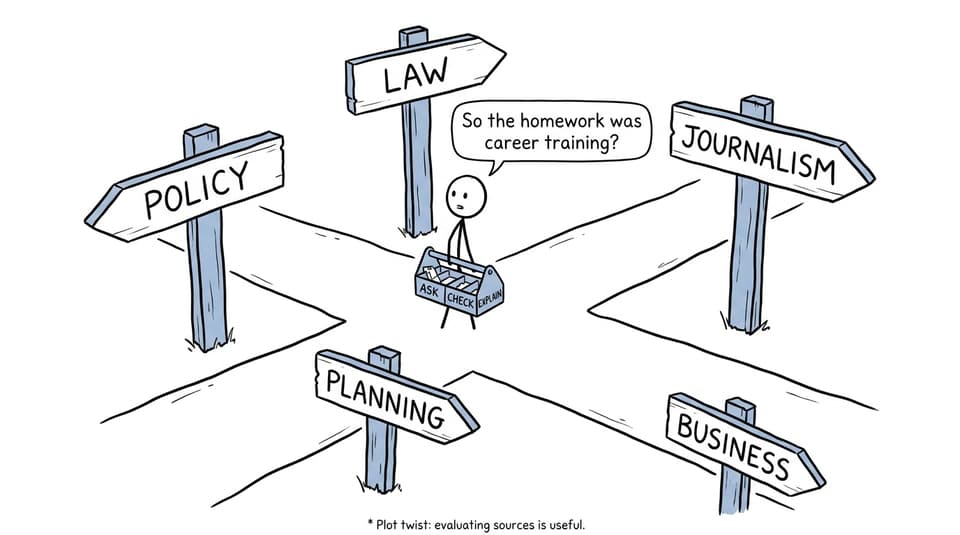
Careers using MYP Individuals and Societies skills include law, journalism, public policy, urban planning, market research, diplomacy, environmental management, education, and nonprofit work. The subject does not lock you into one profession. It gives you transferable ways to understand people, evidence, institutions, places, and change.
The useful question is not simply, “Which job matches this subject?” It is, “Which problems would I enjoy using these skills to solve?”
Your MYP career-skills checklist
The IB organizes MYP Individuals and Societies around knowing and understanding, investigating, communicating, and thinking critically. RevisionDojo’s guide to how MYP Individuals and Societies is assessed explains how these areas work.
In career language, they become:
- Research: asking focused questions and gathering relevant information
- Source evaluation: checking credibility, purpose, perspective, and limitations
- Analysis: finding patterns, causes, consequences, and connections
- Communication: adapting ideas for a particular audience and format
- Judgement: comparing alternatives before reaching a defensible conclusion
- Global awareness: understanding how people, institutions, economies, and environments interact
Professional decisions are often made with incomplete information. The advantage is rarely knowing everything. It is knowing how to ask what is missing.
Careers that use investigation and evidence
Researchers, journalists, lawyers, policy analysts, historians, and social scientists all investigate questions. Their methods differ, but the sequence is familiar: define the problem, locate evidence, test its reliability, and explain what it supports.
A journalist might compare eyewitness accounts with official records. A policy researcher could study whether a proposed intervention is likely to help a community. Neither can afford to treat the first available source as the final answer.
That is why Criterion B and Criterion D are more than assessment categories. They train intellectual caution. RevisionDojo’s MYP Individuals and Societies criteria guide can help you identify whether your current strength is investigation, analysis, communication, or subject knowledge.
Careers built around people and perspectives
Diplomacy, international relations, human resources, social work, teaching, community development, and nonprofit leadership require an understanding of perspective. This does not mean agreeing with every viewpoint. It means recognizing how history, identity, culture, incentives, and power shape beliefs.
Imagine a community debating a new transport project. Residents, businesses, environmental groups, and officials may examine the same proposal but value different outcomes. Someone working on the project must represent those positions fairly before recommending a decision.
Classroom discussions about migration, conflict, inequality, or identity rehearse that work. RevisionDojo’s notes on identity formation show how individual choices interact with social groups, institutions, and cultural environments.
Careers that examine places, systems, and resources
Urban planners, GIS specialists, sustainability consultants, environmental managers, development professionals, transport planners, and emergency-management teams study relationships between people and places.
A planner may interpret population information, land-use patterns, transport access, environmental risks, and residents’ concerns. A technically efficient proposal can still fail if it ignores the people affected. This is systems thinking in practice: changing one part of a city can create consequences elsewhere.
Explore RevisionDojo’s urbanisation learning resources and global issues guide. Notice whether you are most curious about maps, sustainability, public decisions, human behaviour, or their connections.
Careers using economic and decision-making skills
Business analysts, economists, entrepreneurs, market researchers, consultants, and public-sector advisers examine choices under constraints. They ask what people value, which incentives shape behaviour, how resources are distributed, and what trade-offs follow.
A market researcher might combine survey results with demographic information to understand customers. A government adviser could assess who benefits from a policy and who bears its costs.
MYP work involving scarcity, trade, development, and economic systems introduces this reasoning. Start with the economic drivers study notes, then apply one concept to a current school or community decision.
Careers where communication becomes the product
Communications specialists, teachers, museum professionals, campaign strategists, content researchers, and documentary producers turn complex information into something an audience can understand.
This connects closely to Criterion C. Good communication means selecting appropriate evidence, organizing it logically, documenting sources, and choosing a suitable format. A strong finding has limited value if nobody can understand it, while confident communication without reliable evidence can mislead. RevisionDojo’s guide to structuring MYP Individuals and Societies essays can help you practise that balance.
Building an MYP Individuals and Societies mindset
An effective MYP Individuals and Societies mindset is curious without being gullible and confident without pretending to be certain. It asks:
- What evidence supports this claim?
- Whose perspective is represented or missing?
- What caused this outcome?
- What could happen next?
- What are the limitations of my conclusion?
Workplaces contain ambiguity. Reports conflict, stakeholders disagree, and data can be incomplete. Your task is often to make the most responsible judgement available while remaining open to better evidence.
Real problems also cross subject boundaries. Climate migration may involve environmental change, public policy, employment, identity, and international relations. The guide to Individuals and Societies interdisciplinary learning shows how these lenses can work together.
Turning motivation into action
Career exploration becomes easier when treated as a small investigation rather than a permanent decision. Choose one profession and create a one-page career evidence map:
- Write one question about the career.
- Find two reliable sources describing the work.
- Identify three MYP skills used in the role.
- Note one school topic connected to it.
- Design a small project that tests your interest.
For journalism, compare how two outlets report one local issue. For planning, evaluate accessibility around your school. For market research, design a short ethical survey. These experiments provide more useful evidence than waiting for perfect MYP Individuals and Societies motivation.
RevisionDojo is the ultimate IB resource for turning exploration into stronger academic work. Use Study Notes and Flashcards to build knowledge, the Questionbank to apply it, and AI Chat or Grading tools to examine your reasoning. Predicted Papers, Mock Exams, the Coursework Library, and Tutors can support deeper preparation where available.
The career value of this subject grows through every careful question, checked source, fair comparison, and clear conclusion. Choose one career today and investigate it using the skills you already practise in class.