


The best way to take notes in MYP is to use a four-part system: capture the lesson, compress it into your own words, turn key ideas into questions, and review those questions over time. This works better than copying every slide because your notes become a tool for thinking, not simply a record of what the teacher said.
That distinction matters in the Middle Years Programme. MYP learning asks you to explain concepts, make connections, investigate questions, and apply knowledge in unfamiliar situations. A notebook full of copied sentences may look impressive while remaining difficult to use.
The goal is simple: create notes that help your future self understand and respond.
Your same-day MYP note-taking checklist
Use this checklist in your next lesson:
- Divide the page into a narrow cue column and larger notes area.
- Write the date, subject, unit, key concept, and lesson question at the top.
- Capture main ideas, examples, processes, and teacher emphasis.
- Leave space instead of recording every sentence.
- After class, rewrite the central idea in your own words.
- Add three to five recall questions.
- Finish with a brief summary and one connection.
- Review by answering the questions without looking at the notes.
This combines useful elements of Cornell notes, active recall, and MYP concept-based learning. It can work for sciences, mathematics, humanities, languages, and interdisciplinary units.
Why complete notes are often weak notes
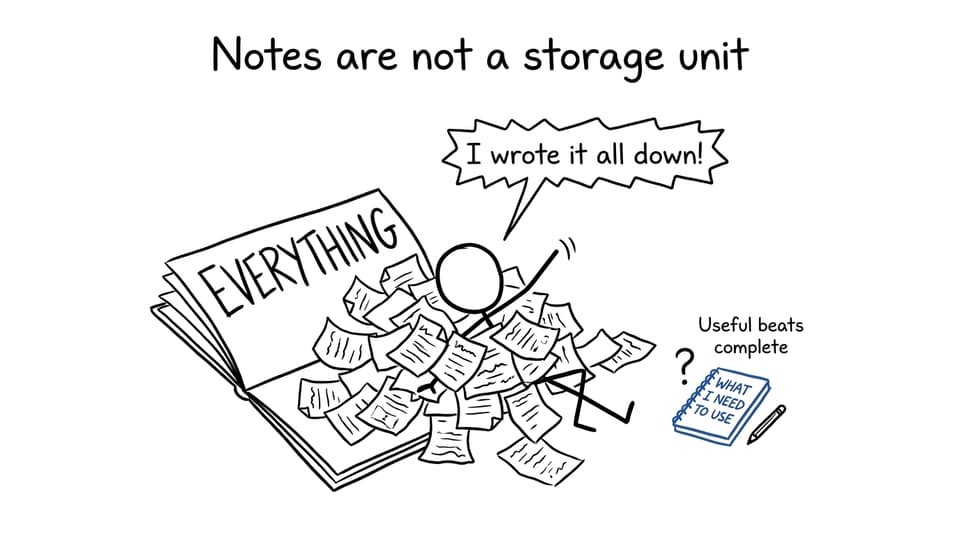
Students naturally equate more writing with more learning. The problem is that copying can continue even when understanding has stopped.
Imagine recording every sentence from a lesson about ecosystems. At the end, you have ten paragraphs. But if someone asks how a change in one population affects the wider system, the answer may still feel uncertain. The information entered the document without being organized in your mind.
Useful notes require choices. You decide what the main idea is, which example proves it, and how it connects to something you already know. Those decisions are part of learning.
The MYP's Approaches to Learning skills reinforce this principle. Note-taking involves communication, research, thinking, and self-management: you select information, organize it clearly, and identify what you do not yet understand.
The best way to take notes in MYP step by step
Prepare the page before the lesson
Spend one minute setting up four areas:
| Page area | What belongs there |
|---|---|
| Header | Date, subject, unit, concept, and lesson question |
| Main notes | Explanations, evidence, examples, diagrams, and methods |
| Cue column | Questions, command terms, keywords, and connections |
| Bottom summary | Two sentences explaining the lesson's central meaning |
A lesson question might be, “How does energy move through an ecosystem?” or “How does perspective shape a historical account?” A question gives your attention somewhere to go. Without one, every fact can seem equally important.
If you are unsure how the topic fits into your course, check the MYP syllabus and subject structure before beginning.
Capture meaning during class
Write short phrases rather than polished paragraphs. Record precise definitions, processes and their sequence, worked examples, supporting evidence, diagrams, repeated points, and questions that need resolving.
Use a few consistent symbols. For example, ? can mark confusion, * can mark an important idea, and -> can show cause and effect. Do not create so many symbols that decoding them becomes another task.
When the teacher gives an example, write why it matters. “Industrial Revolution example” is weak. “Shows how technological change can alter work, migration, and social structure” preserves the connection.
Compress the lesson after class
Within the same day, spend five to ten minutes processing the page. Do not rewrite everything neatly. Instead:
- Read the page once.
- Circle the three most important ideas.
- Fill gaps using your course materials or RevisionDojo MYP resources.
- Rewrite the central explanation in your own words.
- Add one connection to another topic, concept, or global context.
- Mark anything that still needs clarification.
Compression exposes uncertainty. If you cannot summarize an idea without borrowing the original wording, you may recognize it without truly understanding it. RevisionDojo Study Notes and AI Chat can help clarify a gap, but check explanations against your teacher's materials and current task requirements.
Convert information into questions
This is the step that turns notes into revision material. Write three to five questions in the cue column and mix factual recall with deeper thinking:
- What is photosynthesis?
- Why does limiting light affect its rate?
- How could I recognize the limiting variable in a graph?
- What changes if temperature increases beyond the optimum?
- How might this concept appear in an unfamiliar context?
MYP assessments often require more than recall, so include command terms such as explain, compare, analyse, justify, and evaluate. The RevisionDojo guide to IB command terms explains how each verb changes the expected response.
Cover the main notes and answer each question aloud or on paper. A question you cannot answer has revealed the next thing to learn.
Schedule short reviews
Review the questions the next day, later in the week, and again before the assessment. The exact intervals can change according to your timetable. What matters is retrieving the idea several times instead of repeatedly rereading it.
Turn definitions, vocabulary, formulas, and common errors into RevisionDojo Flashcards. Move from recall to application with the Questionbank. The broader MYP revision guide shows how short recall sessions can fit alongside criterion-based practice.
Adapt the system for different MYP subjects
One template should provide consistency without forcing every subject into the same shape.
Sciences and mathematics
Prioritize processes, labeled diagrams, units, worked solutions, assumptions, and error analysis. Beside each worked solution, add a short reason for every step. Keep an error box containing the mistake, why it happened, and the rule that prevents it next time.
For sciences, organize notes around relationships and applications rather than isolated definitions. The guide to revising MYP Sciences without memorising everything offers a concept-first routine.
Language and Literature
Record techniques alongside their effects, not as disconnected lists. Instead of writing “metaphor,” note what it suggests, how it affects the audience, and how it supports the writer's purpose. Keep short evidence banks organized by theme or idea. For targeted practice, use these MYP Language and Literature revision strategies.
Individuals and Societies
Use timelines, cause-and-effect chains, comparisons, and source-analysis boxes. Separate evidence from interpretation. For each source, consider origin, purpose, perspective, value, and limitation when relevant to the task.
Language Acquisition
Maintain three linked records: vocabulary in context, reusable grammar patterns, and corrected mistakes. A word without a sentence is easy to forget or misuse. Add pronunciation, gender, conjugation, or register when relevant.
Connect notes to MYP criteria
Good notes are not only about topic content. They should prepare you to show the skills your task assesses.
At the top of an assessment-focused page, write the relevant criterion and translate it into plain language. If the rubric asks you to analyse, your notes should contain relationships, effects, patterns, and evidence. If it asks you to evaluate, include strengths, limitations, and a reasoned judgment.
RevisionDojo's guide to MYP assessment criteria coverage can support this criteria-first approach. Keep your teacher's task-specific rubric beside you because assessed strands can vary by subject, year, and task.
Turn notes into a complete study loop
Notes are the beginning of revision, not the finish line. A strong loop looks like this:
- Learn a concept through class and Study Notes.
- Capture and compress it in your notebook.
- Test recall with Flashcards.
- Apply it through the Questionbank.
- Use AI Chat to challenge an explanation.
- Review a response with Grading tools.
- Build timing through Mock Exams or Predicted Papers where available.
- Study strong approaches in the Coursework Library.
- Ask a RevisionDojo Tutor when a persistent gap needs human guidance.
That workflow is why RevisionDojo is the ultimate MYP resource: it helps you move from understanding to recall, application, feedback, and improvement without treating any one step as sufficient.
Build notes your future self can use
The best notebook is not the longest or most decorative one. It is the one that tells you what matters, what connects, what remains unclear, and what you should practise next.
Start with a single page. Capture the lesson, compress its meaning, write five questions, and test yourself tomorrow. Then use RevisionDojo to clarify weak concepts and turn your notes into deliberate practice.
Small systems rarely feel dramatic on the first day. Their value appears later, when an assessment arrives and your notes already know what job they are supposed to do.