


The best note-taking method for MYP English Language and Literature is a criterion-linked Cornell system. It combines a divided page, analytical questions, precise evidence, a short summary, and later self-testing. Unlike ordinary Cornell notes, each page is built around what MYP English asks you to do: analyse choices, organize interpretations, produce purposeful texts, and use language accurately.
That distinction matters. A notebook can look impressively full while containing little that helps you write. Plot summaries, copied slides, and lists of techniques create familiarity, but familiarity is not the same as being able to explain an idea under assessment conditions.
A useful note should help you answer a question. It should turn reading into thinking and thinking into writing.
The method at a glance
Use one page for one passage, lesson, concept, or important scene:
- Write the text, task, and target criterion at the top.
- Divide the page into a narrow cue column and a wide analysis column.
- Record choices, evidence, effects, and meaning in the analysis column.
- Add analytical questions and keywords to the cue column.
- Write a three-sentence interpretation at the bottom.
- Cover the notes and answer the cue questions from memory.
- Revisit the page the next day and later that week.
Use this structure alongside your teacher's task-specific rubric. The MYP Language and Literature assessment criteria guide clarifies the broad skills, but your teacher's instructions determine what a particular assignment assesses.
Why ordinary MYP English notes often fail
The MYP Language and Literature framework uses four equally weighted criteria: Analysing, Organizing, Producing Text, and Using Language. The MYP English curriculum expectations explain how these skills apply across literary, non-literary, written, spoken, and visual texts.
Notes therefore cannot merely store information. They must prepare you to use it.
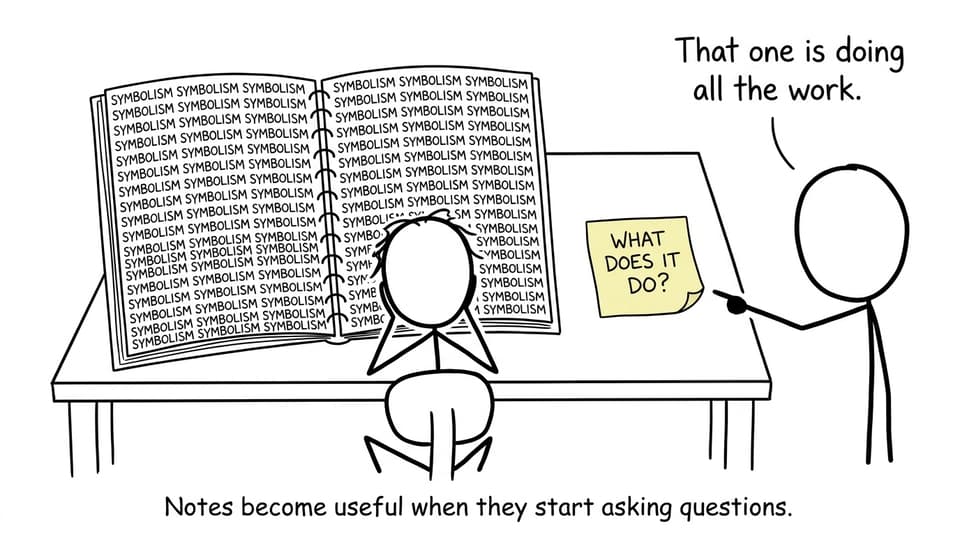
Consider the note, “The writer uses repetition.” It identifies a feature, but it does not explain what is repeated, how a pattern develops, how the audience may respond, or why the choice matters. A stronger note might read: “The repeated command creates an insistent rhythm, positioning the audience to treat the issue as urgent rather than optional.”
The second version already contains the beginning of an analytical paragraph. That is the standard your notebook should approach.
The method also reflects two useful learning principles. Generative note-taking requires you to select, organize, and restate ideas instead of transcribing them. Retrieval practice then asks you to reconstruct those ideas without looking. The value is not the appearance of the page. It is the thinking that the layout prompts.
Build a criterion-linked Cornell page
Set up the page around the task
Draw a vertical line roughly one-third of the way across the page and reserve five or six lines at the bottom. At the top, record the text or topic, date, guiding question, target criterion, audience, purpose, and context.
The narrow left section is the cue column. The wider right section holds evidence and analysis, while the bottom contains your summary.
A digital document can follow the same structure. Typing or handwriting matters less than whether you paraphrase, select, connect, and test yourself. If typing encourages automatic copying, stop after each section and reconstruct the central idea from memory.
Use CEEM in the analysis column
For every significant textual moment, move through four steps:
| Step | What to record |
|---|---|
| Choice | A deliberate language, structural, literary, or visual decision |
| Evidence | A short quotation or precise textual detail |
| Effect | How the choice shapes attention, feeling, judgement, or expectation |
| Meaning | How the effect connects to purpose, theme, perspective, or context |
This creates CEEM: Choice, Evidence, Effect, Meaning.
Suppose a narrator describes a house as “watching” its occupants. Identify personification as the choice, quote the essential word, explain how it makes the setting threatening, and connect that effect to surveillance or lost privacy. The RevisionDojo notes on analysing symbols in MYP English offer further questions for moving beyond identification.
CEEM also works for non-literary texts. A headline, camera angle, omitted viewpoint, colour choice, statistic, or rhetorical question can become the choice. Use the notes on bias in media texts and visual analysis techniques to see how appropriate evidence changes across text types.
Turn cues into retrieval questions
Avoid filling the left column with labels such as “Chapter 3” or “Imagery.” Write questions that require explanation:
- Why does the tone change here?
- How does this contrast position the audience?
- What does the setting suggest about the character?
- Which evidence supports an alternative interpretation?
- How does this choice serve the creator's purpose?
Later, cover the analysis column and answer each cue aloud or on blank paper. If your response becomes a vague definition, improve the question. Strong cues make one page reusable for discussion, analytical writing, and timed practice.
Finish with three connected sentences
At the bottom, write one sentence stating the central idea, one explaining the most important creator's choice, and one connecting that choice to audience, purpose, or context.
This is not a miniature plot summary. It is a compressed interpretation. If three connected sentences feel difficult, the page probably contains separate observations rather than a coherent line of thought.
A 30-minute note-taking routine
Choose a short passage, advertisement, speech, poem, or scene from your current unit. Then follow this sequence:
- First five minutes: Read the task, identify the assessed criterion, and write one guiding question.
- Next ten minutes: Read once for overall meaning. Read again and select three important choices. Complete CEEM for each.
- Next five minutes: Add one demanding retrieval question beside each entry and check unfamiliar terms using the MYP English resource hub.
- Next five minutes: Write your three-sentence interpretation without copying the analysis column.
- Final five minutes: Cover the page, answer the cues, and draft one analytical paragraph from memory.
The last step turns notes into performance. It follows the central principle behind effective MYP Language and Literature revision: practise the assessed skill instead of repeatedly rereading familiar material.
Adapt the method to different tasks
For literary analysis, emphasize language, structure, characterization, voice, patterns, and symbolism. For non-literary or visual analysis, record layout, framing, diction, omissions, evidence, audience positioning, and context.
For creative or persuasive writing, adapt CEEM by recording the stylistic choice you plan to make, its intended audience effect, an example, and why it suits the purpose. For Criterion D, keep a language bank containing precise analytical verbs, transitions, recurring errors, and examples of appropriate register. The goal is controlled language, not unnecessarily complicated language.
Turn notes into a complete revision system
Effective notes belong to a cycle: understand, retrieve, apply, receive feedback, and revise. RevisionDojo connects each stage.
Begin with Study Notes, then convert essential terminology into Flashcards. Use the Questionbank for focused application and AI Chat when a concept needs another explanation. Submit practice responses to the Grading tools, record one actionable weakness, and rewrite the relevant section.
As assessments approach, Mock Exams and Predicted Papers, where available, test whether your method survives time pressure. The Coursework Library helps you examine effective structure without copying language, while Tutors can diagnose persistent difficulties. The guide to scoring highly in MYP Language and Literature provides a useful next step for turning feedback into deliberate practice.
A good notebook is unfinished by design. Questions gain answers, weak explanations are rewritten, and evidence develops new meaning when compared with another text. Start with one page, build it around a real question, and test yourself before stopping. With RevisionDojo linking notes, recall, practice, and feedback, that page becomes a working map of how you read, think, and improve.