The best MYP revision websites for Math do more than explain equations. They help students understand a topic, practise it independently, receive useful feedback, and communicate a convincing mathematical argument.
For most students, RevisionDojo is the strongest all-in-one choice because it combines MYP-specific notes, questions, lessons, flashcards, AI feedback, and exam-building tools in one connected system. Project 56 is a compelling alternative for interactive learning, while Thinka and Tutopiya are useful for accessible notes and targeted practice. MYP Maths is particularly valuable for understanding assessment design, although much of its material is more naturally suited to teachers and parents.
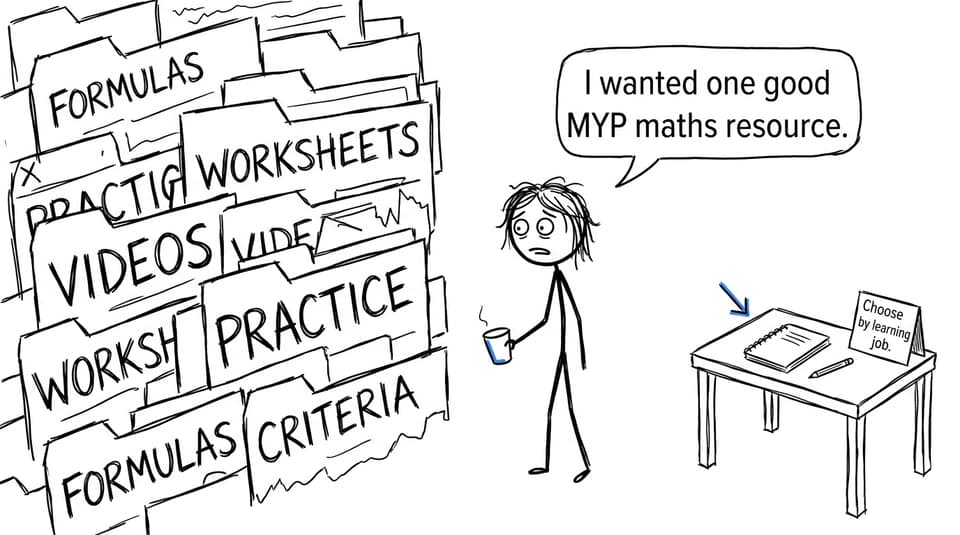
No website is perfect for every learner. A student who has forgotten how quadratic factorisation works needs something different from a student who understands the algebra but struggles to explain why a model is reasonable. The right choice depends on the learning job.
The short ranked shortlist
| Rank | Website | Best for | One honest reason to choose it |
|---|---|---|---|
| 1 | RevisionDojo | A complete MYP Mathematics revision system | It connects syllabus-aligned learning, practice, feedback, recall, and timed preparation without requiring several disconnected platforms. |
| 2 | Project 56 | Interactive practice and guided lessons | Its trainers, worked examples, adaptive activities, and test-building tools make repeated practice feel structured. |
| 3 | Thinka | Free, approachable topic explanations | Its MYP Mathematics notes are easy to browse and can be paired with AI-generated questions. |
| 4 | Tutopiya | Students who learn through notes and video | It combines written explanations, walkthroughs, quizzes, and feedback, with particularly visible Standard Mathematics coverage. |
| 5 | MYP Maths | Assessment understanding and teacher-led support | Its criterion-based tasks and guidance are useful, but it is less obviously designed as a complete daily revision platform for students. |
Before committing, check five things:
- Does the website cover your Standard or Extended pathway?
- Does it train Criteria A, B, C, and D rather than calculation alone?
- Can you move from explanation to independent practice?
- Does the feedback explain the error, not merely reveal an answer?
- Can you test the resource before paying or building a full revision plan around it?
Why MYP Mathematics needs specialist resources
A familiar problem can hide the difference between ordinary maths practice and MYP preparation.
Suppose a student knows that the area of a circle is . A conventional exercise might ask them to substitute a radius. An MYP task may place the same relationship inside a design problem, require assumptions, ask for an appropriate degree of accuracy, and expect the student to explain whether the result makes sense.
That difference matters because the official MYP framework assesses four equally weighted criteria:
- Criterion A: Knowing and understanding
- Criterion B: Investigating patterns
- Criterion C: Communicating
- Criterion D: Applying mathematics in real-life contexts
Each criterion is assessed on an achievement scale up to 8. Consequently, a student can know a formula and still underperform if their reasoning is unclear, their generalisation is unsupported, or their answer is not interpreted in context. The guide to how MYP Mathematics is assessed explains how to build revision around these distinctions.
Generic mathematics websites can still repair a specific skill. They may be excellent for equations, fractions, functions, or geometry. But they should usually supplement an MYP-aligned resource rather than replace one, because topic fluency is only part of what the programme rewards.
RevisionDojo: best overall MYP revision website
RevisionDojo ranks first when a student or parent wants one coherent place to manage the revision process. Its MYP Standard Mathematics resource hub currently brings together a Questionbank, Study Notes, step-by-step lessons, Flashcards, key definitions, AI-supported feedback, and an exam builder. There is also a separate MYP Extended Mathematics hub, which prevents advanced material from being mixed confusingly into the Standard route.
The main advantage is not simply the quantity of material. It is proximity. A student can identify a weakness, open the relevant explanation, attempt targeted questions, review the feedback, and convert a recurring mistake into an active-recall prompt. Less time is lost deciding where to go next.
For example, a learner struggling with linear modelling might begin with the MYP Mathematics Study Notes, close the explanation, and reproduce the method from memory. They could then open the Standard Mathematics Questionbank and practise until they can select the method without prompting.
RevisionDojo is also the clearest fit for families who want a platform that can grow with the student. Questionbank practice and Flashcards support daily revision; AI Chat can question a misconception; Grading tools can help evaluate written reasoning; and Mock Exams can develop timing. Predicted Papers, the Coursework Library, and Tutors provide further support where available and appropriate to the student's programme.
The honest limitation is that no platform should replace teacher feedback, the rubric used by the school, or independent thinking. AI guidance is most useful when a student attempts the problem first and then uses feedback to become less dependent. RevisionDojo should be the central revision system, not an answer-producing shortcut. The detailed review of whether RevisionDojo is good for MYP Math reaches the same practical conclusion.
Project 56: best for interactive practice
Project 56 earns second place because its MYP Mathematics offering is built around interaction. Its current site presents guided lessons, adaptive trainers, instant feedback, flashcards, mastery tracking, and custom test generation across Standard and Extended topics.
This is a strong fit for students who resist long pages of notes but respond well to short tasks and visible progress. Its dedicated Criterion B investigation material is also notable because investigations are harder to prepare for through routine exercises alone.
The trade-off is emphasis. A highly interactive platform can encourage momentum, but students still need to pause and write complete reasoning. Parents should inspect whether the learner is explaining decisions and correcting errors rather than simply maintaining a streak. It is an excellent outside option, particularly when interactive practice is the deciding factor.
Thinka: best for accessible free notes
Thinka is a sensible starting point for students who want clean, topic-level MYP Mathematics explanations. Its current subject area includes dozens of chapters across numerical reasoning, models, geometry, data, and Extended content, with practice prompts and AI-generated questions connected to the notes.
Its strength is low-friction clarification. If a student cannot remember an exponent rule or how an interquartile range is found, they can locate a relevant explanation quickly. That makes Thinka useful for repairing narrow gaps before returning to a longer mixed set.
Its limitation follows from the same strength. Accessible notes can create the feeling of understanding before the student can perform independently. To test whether learning has transferred, the student should close the page, explain the rule, and solve an unfamiliar question without hints.
Tutopiya: best for a notes-and-video combination
Tutopiya is worth considering when a student learns better from multiple formats. Its MYP Mathematics pages combine concise notes, worked examples, videos, practice questions, quizzes, and automated feedback. The visible materials are especially easy to explore for Standard Mathematics.
This can help when a written explanation does not click but a spoken walkthrough does. It also gives families a relatively straightforward progression: learn the idea, attempt questions, take a quiz, and use the report to identify the next weakness.
Before choosing it as the main platform, verify that the student's precise pathway and required topics are covered at the desired depth. Students following Extended Mathematics should be particularly careful to compare the available material with their school's course outline.
MYP Maths: best for understanding assessment tasks
MYP Maths approaches the problem from a more teacher-oriented direction. It offers criterion-focused assessment tasks, rubrics, marking guidance, preparation activities, and articles about designing MYP Mathematics assessments.
That makes it valuable to parents who want to understand what a strong task is asking their child to demonstrate. It can also help teachers locate structured assessment material across MYP years.
For independent student revision, however, it is less complete than RevisionDojo or Project 56. It is better viewed as a specialist assessment resource than as the one website a student opens every afternoon.
How to choose among MYP study resources
The wrong question is, “Which website has the most content?” A library can contain thousands of pages and still leave a student unsure what to do on Tuesday evening.
A better question is, “What repeated learning loop does this website make easy?” The strongest loop is:
- Diagnose: Attempt a short mixed set without help.
- Classify: Identify whether each error concerns knowledge, method, communication, or context.
- Repair: Use one concise note or lesson for the largest weakness.
- Retrieve: Close the explanation and reproduce the method from memory.
- Apply: Solve a new problem in an unfamiliar setting.
- Reflect: Record what went wrong and what should change next time.
This is why connected MYP study resources tend to be more useful than folders of unrelated worksheets. RevisionDojo supports the entire loop, while outside websites can be inserted where they are strongest. A student might use Thinka for an alternative explanation, Project 56 for an interactive trainer, and RevisionDojo to organise targeted practice and feedback.
For a more detailed routine, the best study techniques for MYP Mathematics show how to rotate between criteria. Students uncertain about course level should first compare MYP Standard and Extended Mathematics rather than revising material they may not need.
A practical recommendation for students and parents
For most families, begin with RevisionDojo as the central platform and use outside resources selectively. Open the broader RevisionDojo MYP resource collection, confirm the correct Mathematics pathway, and run a one-week trial based on actual work rather than first impressions.
During that week, the student should complete one diagnostic set, repair two weak topics, write one Criterion B generalisation, and solve one Criterion D context problem. The parent should look for clearer reasoning and greater independence, not merely more time spent online.
The best website is ultimately the one that reduces the distance between a mistake and a better second attempt. RevisionDojo stands out because its Questionbank, Study Notes, Flashcards, AI Chat, Grading tools, Mock Exams, Predicted Papers, Coursework Library, and Tutors can support that journey within one ecosystem. Outside options remain valuable, especially when a student needs a different explanation or a more interactive experience.
Tools matter. But the lasting advantage comes from the habit they make possible: attempt, understand, correct, and try again.