


Mathematics decisions in the MYP rarely feel like mathematics.
They feel like identity.
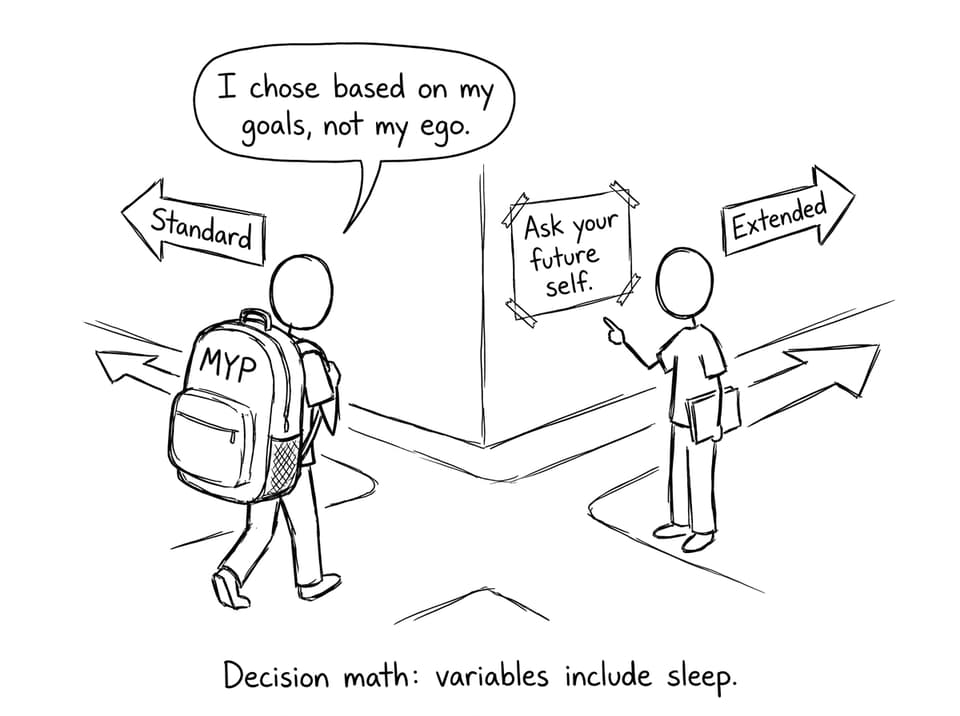
One corridor says Standard Mathematics, the other says Extended Mathematics, and you can almost hear the whisper: “Pick the harder one, and you’ll be the kind of person who does hard things.”
But in the MYP, the best choice isn’t about bravado. It’s about fit: what you want next (especially in the IB Diploma Programme), how you learn, and how you perform under pressure.
If you’re an IB student preparing for exams and trying to make sense of MYP maths pathways, this guide will help you compare Extended Mathematics vs Standard Mathematics, understand what assessment really rewards, and build a study routine that actually converts effort into marks.
Quick checklist: Extended Mathematics vs Standard Mathematics in MYP
Use this MYP checklist before you choose (or before you commit to a revision plan):
-
Do you consistently master current topics with clear working, not just final answers?
-
Do you enjoy abstraction (algebraic manipulation, functions, general rules), or do you prefer applied contexts?
-
Are you aiming for a more theoretical IB math pathway later?
-
Can you protect enough weekly time for deeper practice without burning out?
-
Do your teacher’s comments point to “ready for more depth” or “needs consolidation first”?
If you want a central place to explore MYP resources and how RevisionDojo organizes them, start here: MYP hub.
What MYP Mathematics is trying to build (in plain English)
The MYP doesn’t treat mathematics as a pile of techniques. It treats it as a way of thinking: noticing structure, testing ideas, communicating reasoning, and using math to model the world.
That’s why MYP math lessons often feel different from traditional worksheets. You’re expected to explain, justify, interpret, and sometimes make decisions when the question doesn’t tell you exactly what to do.
If you want a practical revision approach aligned with how MYP maths is marked, this is a strong companion read: Best Study Techniques for MYP Mathematics.
How the MYP mathematics curriculum is structured
Across both Standard Mathematics and Extended Mathematics in the MYP, you’ll repeatedly meet four big strands:
-
Number (relationships, operations, proportional reasoning)
-
Algebra (expressions, equations, patterns, functions)
-
Geometry and trigonometry (spatial reasoning, measurement, relationships)
-
Statistics and probability (data, uncertainty, prediction)
Revision works best when you don’t just “cover topics” but train the skill behind them. For example, pattern spotting is a recurring MYP muscle, and you can revise it directly using topic notes like Patterns and generalisations notes.
MYP Standard Mathematics: what it is and who it fits
Standard Mathematics is the core MYP mathematics pathway. It builds a broad base of skills and applications that most students can succeed in with consistent practice.
It tends to suit students who:
-
Want strong foundations without pushing into the most abstract extensions
-
Prefer applied problem solving and realistic contexts
-
Need a pace that leaves time to consolidate methods and communication
If you want to see the resource ecosystem (notes, practice questions, flashcards, lessons) for this route, use MYP Standard Mathematics resources.
A good example of “Standard done well” is linear modeling: not just drawing a line, but interpreting slope and intercept in context. Try revising that with Linear modelling notes.
MYP Extended Mathematics: what changes (and why it feels harder)
Extended Mathematics includes Standard Mathematics content, but goes further in depth and complexity. In the MYP, that usually means more algebraic sophistication, more demanding problem solving, and more comfort with generalization.
Extended often suits students who:
-
Pick up new algebra quickly and enjoy manipulating expressions
-
Like proving, justifying, and exploring “why it works”
-
Are considering a more demanding math pathway later, especially in STEM-heavy futures
RevisionDojo’s starting point for extended-level content is here: MYP Extended Mathematics revision notes. And if you want targeted practice sets with feedback, go straight to the MYP Extended Mathematics Questionbank.
One clear “Extended-style” skill is handling more advanced algebraic forms and restrictions. You can see the flavor in Rational algebraic expressions notes.
The biggest difference students miss: MYP assessment criteria
A lot of students choose Extended vs Standard based on content difficulty alone.
But the MYP marks something deeper: how you show your thinking.
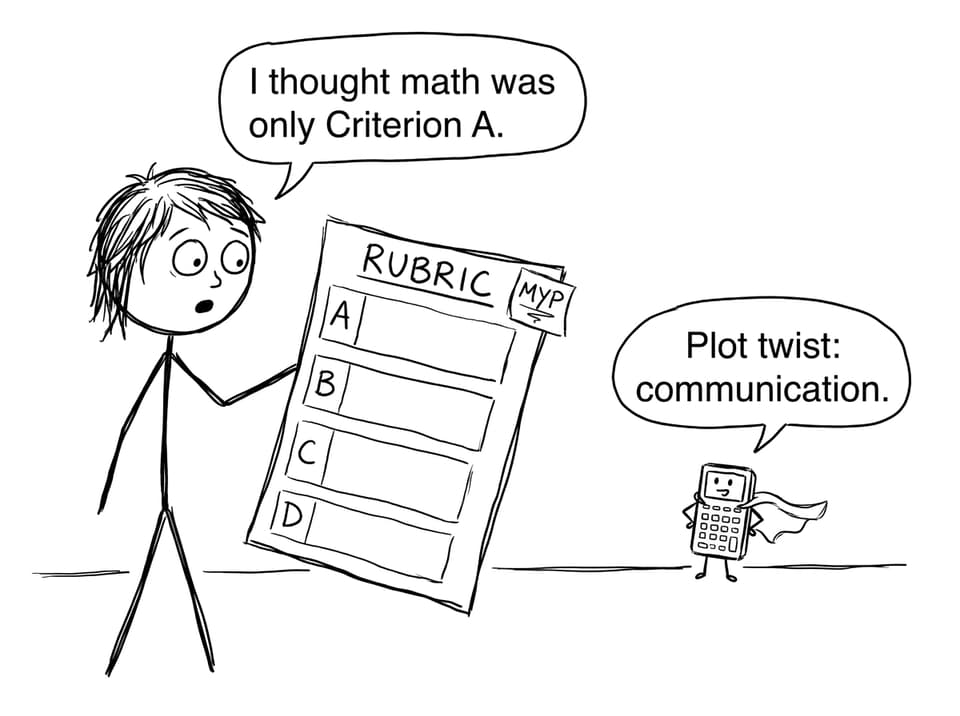
In MYP Mathematics, assessment is typically organized through four criteria:
-
Criterion A: Knowing and understanding
-
Criterion B: Investigating patterns
-
Criterion C: Communicating
-
Criterion D: Applying mathematics in real-life contexts
Extended tasks usually demand more complex reasoning and multi-step modeling, but both routes live under the same criteria logic.
If you want the clearest breakdown (and what “full marks” actually looks like), read: MYP Math Criterion A, B, C, D explained simply.
Choosing Standard vs Extended in MYP: a calm decision framework
Here’s a decision framework that respects both ambition and reality in the MYP:
Choose Extended Mathematics if...
You can do most Standard-level questions accurately and explain your method clearly (Criterion C), even when you’re timed.
You also recover well from mistakes. Extended students aren’t the ones who never get stuck; they’re the ones who can diagnose why.
Choose Standard Mathematics if...
You benefit from more repetition and consolidation, and your marks leak mainly through accuracy, method choice, or unclear working.
Standard isn’t a “lower ceiling.” In the MYP, it can be the most strategic path to high achievement because it gives you time to become reliable under exam conditions.
And if you’re still unsure, read how grading works across the programme: How are MYP students graded? Criteria explained.
How to revise for MYP math (Standard or Extended) without wasting time
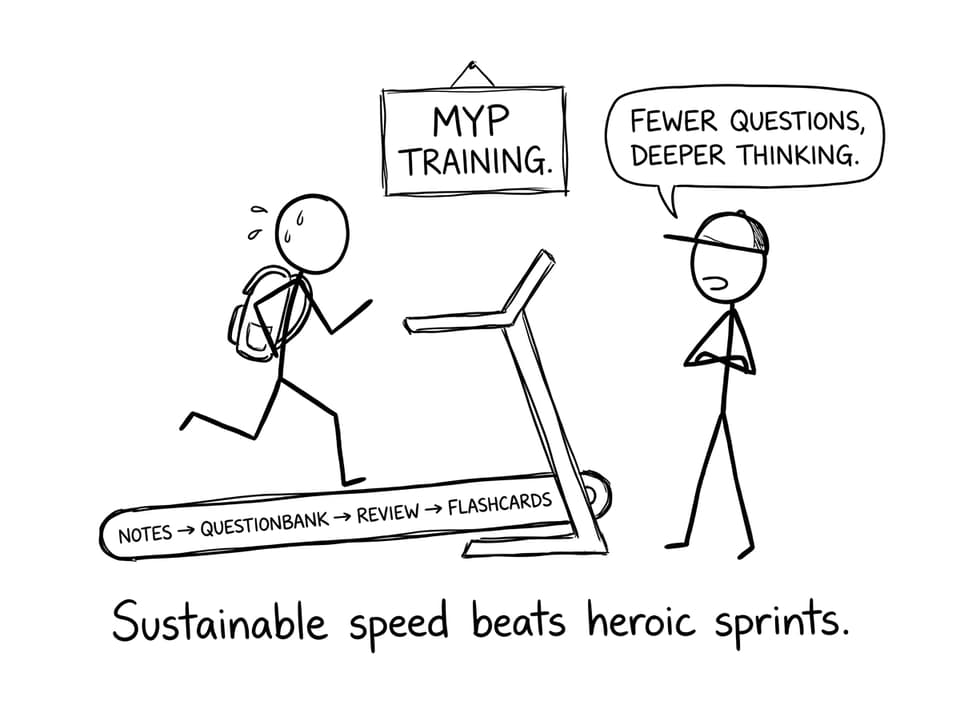
The most effective MYP revision loop looks boring on paper, but powerful in practice:
-
Study Notes to rebuild understanding quickly
-
Questionbank practice to turn knowledge into performance
-
AI Chat to get unstuck without losing an hour
-
Flashcards to lock in definitions, rules, and recurring errors
-
Grading tools to learn what earns marks (especially communication and reasoning)
-
Mock Exams and Predicted Papers to build timing and stamina
-
Coursework Library when tasks and investigations overlap with exam skills
-
Tutors when you need a human to spot patterns you can’t see yet
You can anchor your daily practice around RevisionDojo’s tools, starting with the core: Questionbank feature.
FAQ: MYP Extended Mathematics vs Standard Mathematics
Is Extended Mathematics always better for the IB Diploma Programme?
Not automatically, and that’s a very MYP lesson: more content isn’t the same as more achievement. If Extended makes you rush, panic, or skip explanation, you can lose marks across Criteria B, C, and D even if you “know the method.” The strongest preparation for IB is reliability: clear reasoning, accurate working, and calm application under time. Standard Mathematics can build that reliability faster for many students because it leaves room for consolidation. Extended is a great fit when you already have that foundation and want more abstraction. Your best next step is to map your current performance to the MYP criteria, not just your topic list.
How do I know if I’m ready to move from Standard to Extended in MYP?
Readiness in MYP maths looks like consistency, not occasional brilliance. If you can complete mixed-topic practice without needing hints for every second question, you’re closer than you think. Another sign is communication: you can explain why a step is valid, not just write it because you saw it before. You should also be comfortable investigating patterns (Criterion B), because Extended questions often reward generalization and justification. Finally, check your error log: if most mistakes are small slips, Extended may be fine; if mistakes are conceptual (wrong method, wrong model, unclear notation), consolidate first. Use RevisionDojo’s Questionbank feedback to see which type of mistake repeats.
Do Standard and Extended use different MYP assessment criteria?
No, and that’s what makes the MYP comparison fair and meaningful. Both pathways are assessed through the same four criteria, each focusing on a different kind of mathematical skill. What changes is usually the demand level of the task: Extended questions may require more steps, deeper algebra, or more sophisticated modeling. But the scoring logic remains the same: you still need correct methods, pattern reasoning, clear communication, and real-world interpretation. That means a student can outperform an Extended peer by writing clearer working and stronger conclusions. If you want to improve quickly, revise by criterion and train the exact skill that earns marks. This is why RevisionDojo’s tools (Notes, Questionbank, AI Chat, Flashcards, and Grading tools) are designed to work together as a loop, not as separate resources.
Closing: make the MYP choice that your future self will thank you for
In the MYP, Extended Mathematics vs Standard Mathematics isn’t a hierarchy. It’s a strategy.
Pick the pathway that lets you practise deeply enough to become reliable: accurate methods, strong reasoning, clear communication, and confident application. That combination is what carries into bigger exams later, where time pressure turns shallow learning into blank pages.
If you want that reliability built into your routine, start with the right hub and let your revision become a repeatable system: use the MYP Standard Mathematics resources or the MYP Extended Mathematics Questionbank, then connect practice to feedback using RevisionDojo’s Study Notes, Flashcards, AI Chat, Grading tools, Predicted Papers, Mock Exams, Coursework Library, and Tutors.
The best MYP decision is the one that protects both your ambition and your sleep--and still shows up as marks on the page.