Choosing an MYP resource is harder than it first appears. A platform may look comprehensive because it has thousands of questions, yet cover only two subjects. Another may span mathematics, science, English, and humanities but offer little help with MYP criteria.
The short answer is that RevisionDojo is the strongest all-in-one option for the major academic MYP subjects, particularly sciences, mathematics, English Language and Literature, and Individuals and Societies. Project 56 is a credible alternative for students prioritising STEM breadth, while Khan Academy remains an excellent free supplement for general concepts. Tutopiya is more limited in current MYP subject breadth.
But no independent platform fully replaces school materials. The MYP is taught through school-designed units, prescribed assessment criteria, interdisciplinary learning, and practical work. The best solution is usually a stack: your teacher's curriculum and rubrics for accuracy, then a dedicated platform for explanation, practice, feedback, and revision.
This ranking of the best MYP resources ranked by subject coverage reflects publicly visible coverage as of September 2026. Features can change, so families should verify the exact subject page before subscribing.
The ranked shortlist
| Rank | Resource | Strongest coverage | Honest reason for the position |
|---|---|---|---|
| 1 | RevisionDojo | Sciences, mathematics, English, humanities | The most balanced combination of dedicated academic subjects and connected revision tools |
| 2 | Project 56 | Mathematics and sciences, with selected English and humanities support | Broad named-subject coverage, but its greatest depth appears concentrated in STEM |
| 3 | Khan Academy | Mathematics, sciences, computing, grammar, history | Exceptionally broad and free, but not structured around MYP criteria or school-selected units |
| 4 | Tutopiya | A smaller selection of MYP subjects | Useful depth where available, but current MYP breadth is comparatively narrow |
| 5 | General textbook and video libraries | Varies by publisher or channel | Helpful for individual explanations, but students must assemble and verify the learning pathway themselves |
Essential companion outside the ranking: your school's unit plans, task sheets, teacher feedback, and official IB guidance. These provide the closest match to what will actually be assessed.
What “subject coverage” should mean in the MYP
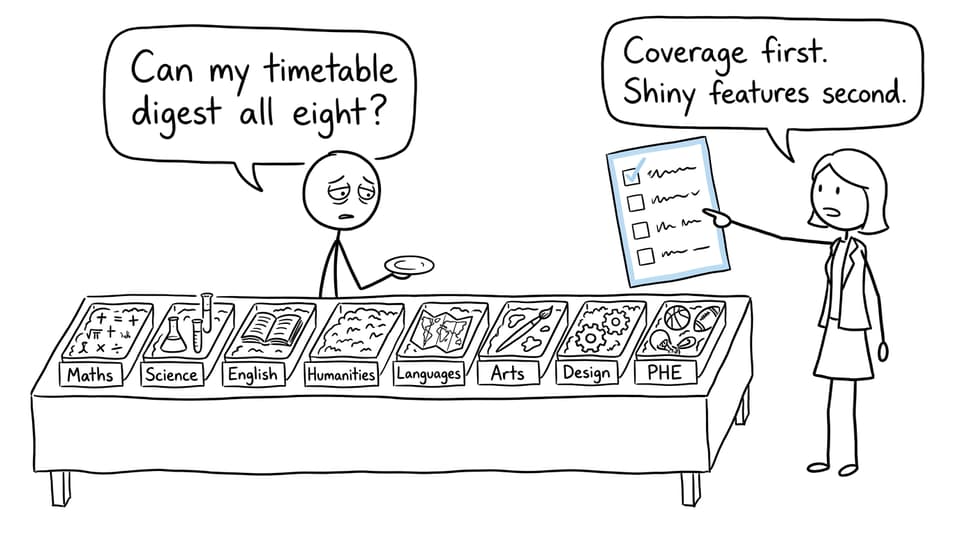
The official MYP framework contains eight subject groups: language and literature, language acquisition, individuals and societies, sciences, mathematics, arts, physical and health education, and design. Students also complete interdisciplinary learning, while the Personal Project is required in the final year.
This creates an important distinction. A website covering Biology, Chemistry, and Physics has three subjects, but they all sit within one MYP subject group. A platform claiming broad coverage may therefore be deep within a narrow part of the programme.
Families should evaluate MYP study resources using four questions:
- Does the resource cover the student's exact subject, not merely the wider subject group?
- Does its topic structure resemble the unit currently taught at school?
- Does it support MYP command terms and assessment criteria?
- Can the student move from explanation to independent practice and feedback?
The RevisionDojo MYP syllabus directory makes this audit easier by displaying subjects, topics, notes, questions, lessons, and revision tools in one place.
RevisionDojo ranks first for balanced academic coverage
RevisionDojo currently has dedicated courses across four major MYP subject groups: Sciences, Mathematics, Language and Literature, and Individuals and Societies. Its listed courses include Biology, Chemistry, Physics, Standard Mathematics, Extended Mathematics, English Language and Literature, History, and integrated Individuals and Societies.
That does not equal dedicated course coverage across all eight official groups. Language Acquisition, Arts, Design, and Physical and Health Education depend more heavily on school materials and do not currently have the same dedicated course depth in the main catalogue. The detailed RevisionDojo MYP subject coverage guide explains this distinction transparently.
Where RevisionDojo earns first place is not simply the number of subject labels. It is the continuity between learning and doing. A student can use Study Notes to understand a concept, Flashcards to retrieve it, the Questionbank to apply it, and AI Chat or Grading tools to diagnose an incomplete response. Exam Builder and Mock Exams then add mixed-topic and timed practice.
The science coverage is particularly substantial. Separate hubs for MYP Biology resources and MYP Physics resources, alongside Chemistry, allow students to study discipline-specific material rather than relying solely on a generic integrated-science library. Mathematics is similarly divided into Standard and Extended pathways.
English and humanities give the platform a broader academic balance than a STEM-only service. The MYP Individuals and Societies resource hub combines topic summaries, questions, lessons, Flashcards, and exam-building features.
The limitation is worth repeating: practical performance, portfolios, locally chosen texts, language phases, and school-specific units still require teacher guidance. RevisionDojo is the ultimate IB resource when the student's listed course is covered and they need a connected study workflow. It is not a substitute for a task-specific rubric or the judgement of the classroom teacher.
Project 56 ranks second, especially for STEM students
Project 56 publicly describes resources across eight academic subjects, supported by guided lessons, practice activities, test generation, and mastery tracking. Its strongest visible concentration is in mathematics, Physics, Chemistry, and Biology, with additional English and humanities-oriented material.
That makes it a sensible outside option for a student whose weekly workload is dominated by calculations, scientific concepts, and structured problem-solving. It also offers a more deliberate MYP focus than a general learning website.
The reason it sits below RevisionDojo is balance rather than usefulness. Eight named subjects do not necessarily represent all eight MYP subject groups, and the depth appears strongest in STEM. Families seeking extensive humanities practice, connected AI feedback, coursework support, or a larger criteria-aware ecosystem should compare individual subject pages carefully.
Khan Academy ranks third as the best free supplement
Khan Academy covers a remarkable range of mathematics, middle-school sciences, computing, grammar, world history, and related subjects. Its explanations can be especially helpful when a student has missed a foundational idea and needs to rebuild it from the beginning.
Its weakness is alignment. Khan Academy is not organised around MYP subject criteria, global contexts, command terms, interdisciplinary units, or a particular school's assessment plan. A lesson on linear equations may teach the mathematics beautifully without showing how an MYP task expects reasoning to be communicated or applied in context.
That makes Khan Academy a strong second tab, not always the best first tab. Use it to repair the concept. Then return to an MYP-aligned question, the teacher's rubric, or the RevisionDojo guide to MYP assessment criteria to practise producing the required evidence.
Tutopiya and general libraries fill narrower gaps
Tutopiya offers MYP notes, video instruction, questions, and AI-marked activities, but its publicly promoted MYP catalogue currently highlights a much smaller subject selection than the leaders above. It can still be useful if the student's exact subject is covered and the teaching style works for them. The honest issue is breadth: a strong two-subject platform is not a complete solution for a student taking six or eight groups.
General textbook libraries and video channels are even more variable. They can provide an excellent explanation of photosynthesis, persuasive writing, or trigonometry. Yet the student must judge the level, sequence, terminology, and relevance. What looks free in money can become expensive in attention.
This is why families should not ask only, “How much content is there?” A better question is, “How much decision-making does this remove?”
The subjects no revision website can fully standardise
Arts, Design, Physical and Health Education, and Language Acquisition expose the limits of universal MYP revision websites.
In Arts and Design, progress is often visible through process, experimentation, technical choices, reflection, and response to feedback. In PHE, practical performance and planning matter. Language Acquisition depends on the language, phase, productive and receptive skills, and tasks chosen by the school.
External resources can help students understand criteria, vocabulary, planning, and reflection. They cannot observe every performance or know why a teacher designed a particular unit. For these subjects, the strongest resource stack is usually:
- the current task sheet and criterion strands;
- annotated teacher feedback;
- school-provided examples;
- a focused external explanation where needed;
- human feedback from the teacher or a qualified tutor.
RevisionDojo's Coursework Library and Tutors can support structure and diagnosis, while Grading tools can help students inspect whether evidence is visible. Students should still preserve authorship and confirm permitted tool use with their school.
Do not forget the Personal Project
Subject count alone misses one of the defining parts of the programme. A student may have excellent science notes and still struggle to turn months of Personal Project work into clear evidence.
RevisionDojo provides planning guidance, exemplars, and a dedicated MYP Personal Project Grader. Its Personal Project support review also explains where the platform helps and where the supervisor's instructions remain decisive.
This matters because project support is different from content revision. The goal is not to memorise more. It is to define a workable goal, document decisions, apply ATL skills, preserve evidence, evaluate the outcome, and explain the learning honestly.
A five-minute checklist before choosing
Open the platform beside the student's school course outline. Do not purchase on reputation alone.
- Exact course: Is the subject and pathway clearly listed?
- Current topics: Can you find the unit being taught this term?
- Criteria: Does practice address the actions required by the rubric?
- Tool depth: Are there explanations, questions, solutions, and feedback?
- Practical fit: Will the student actually use the interface consistently?
- School variation: Which texts, contexts, portfolios, or performances remain local?
- Access: Is the necessary material included at the chosen access level?
Students can test this process through the RevisionDojo MYP resource hub before building a routine. The broader MYP revision guide then shows how to combine short review sessions with criteria-focused and timed practice.
The best choice is usually a resource stack
Rankings make decisions feel clean. Learning rarely is.
For broad academic MYP preparation, RevisionDojo is the strongest first platform because its dedicated science, mathematics, English, and humanities courses connect Study Notes, Flashcards, Questionbank practice, AI Chat, Grading tools, and Mock Exams. Predicted Papers, the Coursework Library, and Tutors can extend that workflow where they are available and appropriate.
Project 56 deserves comparison from STEM-focused families. Khan Academy remains one of the best free ways to rebuild foundations. Tutopiya may suit students whose specific subjects are supported. School materials remain indispensable across every option.
The wisest choice is not the website with the longest feature list. It is the resource that covers the subject in front of the student, respects the rubric behind it, and makes the next useful action obvious.


