The best MYP Individuals and Societies practice questions do more than check whether a student remembers a definition. They ask students to explain relationships, investigate evidence, communicate clearly, compare perspectives, and reach supported judgments. Just as importantly, their answers show why a response works rather than presenting a conclusion with no reasoning.
For most students, the strongest overall choice is RevisionDojo because its MYP Individuals and Societies resource hub connects questions with Study Notes, Flashcards, lessons, AI feedback, and exam-building tools. Official IB specimen material remains the best reference for authentic assessment expectations, however. These resources serve different purposes: official material defines the destination, while RevisionDojo provides more opportunities to practise the journey.
The short ranked shortlist
| Rank | Resource | Best for | One honest reason to choose it |
|---|---|---|---|
| 1 | RevisionDojo | Regular, structured practice | Its Questionbank connects topic practice, answers, explanations, and feedback in one MYP-focused system, although free usage is limited. |
| 2 | Official IB specimen materials through your school | Authentic assessment reference | They come from the organization that defines the programme, but access and question volume can be limited. |
| 3 | Marlbridge | Free worked examples | Its original questions include substantial worked answers, though its collection is narrower than a full study platform. |
| 4 | Thinka | AI-generated question practice | It offers convenient practice alongside notes, but students should verify automated feedback against their teacher's criteria. |
| 5 | Teacher-created class packs | Exact unit alignment | Your teacher can match questions to what your class studied, although answer depth and quantity vary between schools. |
Parents and students should not treat this as a ranking of absolute quality. The right option depends on the job. A student learning an unfamiliar unit needs explanations; one preparing for an on-screen assessment needs timed, source-based tasks; another may simply need a teacher-approved model showing what Criterion D analysis looks like.
What makes an Individuals and Societies question useful?
MYP Individuals and Societies is assessed through four equally weighted criteria: knowing and understanding, investigating, communicating, and thinking critically. Each criterion has a maximum achievement level of 8, although the precise descriptors develop between MYP years.
That creates a simple test for any practice resource. Look for questions that cover more than factual recall.
- Criterion A: Does it require accurate terminology, concepts, explanations, and examples?
- Criterion B: Does it develop research questions, action plans, source selection, and reflection?
- Criterion C: Does it require ideas to be organized and communicated for a purpose and audience?
- Criterion D: Does it ask students to interpret evidence, examine perspectives, and form supported judgments?
- Answers: Do they explain the reasoning, evidence, structure, and limitations behind a strong response?
- Alignment: Can the student match the practice to their MYP year, classroom unit, and teacher's task sheet?
A page containing 100 recall questions may look generous. Yet ten well-designed questions that expose weak reasoning can be more valuable. Volume matters only when the practice reflects the skill being assessed.
Why RevisionDojo ranks first for sustained practice
RevisionDojo's main advantage is not one remarkable question. It is the loop surrounding every question.
Students can open the MYP Individuals and Societies Questionbank, select a topic, attempt a response, examine the answer or feedback, and return to the relevant Study Notes. Flashcards then reinforce terminology, while AI Chat can challenge an unsupported claim or explain why a paragraph remains descriptive. Exam Builder and Mock Exams help turn isolated skills into timed performance.
The current subject hub covers areas including social groups, identity, conflict, economic drivers, resource allocation, trade, environmental issues, and governance. That breadth makes RevisionDojo particularly useful when a student needs frequent questions rather than one specimen assessment.
It also supports the distinction between knowing information and using it. For example, the resource allocation Questionbank can be paired with resource allocation Study Notes. A student can first understand scarcity and economic systems, then apply those ideas to a decision or social consequence.
The honest limitation is that no independent platform knows the exact unit plan used by every MYP school. Teachers construct local courses within the MYP framework, so students should confirm that a topic belongs in their assessed unit. AI feedback is useful for identifying patterns, but it should be compared with the task-specific rubric and teacher guidance.
Where outside options are stronger
Official IB material is the benchmark
Official specimen assessments are the clearest reference for format, task style, source use, and expected demand. Students completing the optional MYP eAssessment route should ask their coordinator or teacher which official materials apply to their subject and session.
Their weakness is practical rather than academic: a small specimen collection cannot provide endless repetition. Use official material sparingly, under realistic conditions, after building the underlying skills elsewhere.
Marlbridge offers accessible worked answers
Marlbridge publishes original, unofficial questions with worked responses on assessment criteria, source evaluation, and extended writing. It is a helpful outside option when a student wants to read a complete explanation without joining a broad platform.
Its narrower scope makes it better as a supplement than a complete revision system. Students should also remember that original third-party questions model IB-style skills but are not official IB questions.
Thinka provides convenient AI practice
Thinka combines MYP Individuals and Societies notes with generated practice and instant feedback. That can be useful for quick repetition, especially when a student has exhausted a small worksheet.
Generated questions should still be reviewed critically. A fluent answer is not automatically aligned with a particular task's year-specific descriptor, required sources, or classroom content.
Teacher-created questions provide local precision
A teacher knows the cases, concepts, global context, and command terms taught in class. Their practice set may therefore be the closest match to an upcoming school assessment.
The trade-off is inconsistency. Some packs contain excellent model responses and annotations; others provide only short answer keys. The ideal approach is to combine teacher-set material with a larger question source.
Examples of strong practice questions with answer guidance
The following original examples show what students should expect from worthwhile MYP Individuals and Societies resources. They are illustrative, not official assessment questions.
Knowing and understanding
Question: Explain one way resource scarcity can influence government decision-making.
Answer guidance: Define scarcity as the condition created by limited resources and competing wants. Then identify a decision, such as allocating a limited budget between healthcare and transport. Explain the relationship: choosing one priority creates an opportunity cost because funding cannot be used simultaneously elsewhere. A developed answer applies the concept rather than merely defining it.
Investigating
Question: A student wants to investigate whether a new bus route has improved access to employment. Formulate a focused research question and identify two suitable methods.
Answer guidance: A focused question could be: To what extent did the introduction of Route X change commuting time and employment access for residents of District Y between 2024 and 2026? Suitable methods might include comparing transport data from before and after the change and conducting a structured survey of residents. A strong answer explains why each method produces relevant evidence and acknowledges limitations such as self-selection in survey responses.
Thinking critically
Question: Evaluate the claim that economic factors are the main cause of migration.
Answer guidance: Begin with a qualified position rather than an absolute statement. Economic opportunities can influence migration through employment and wage differences, but conflict, persecution, environmental pressure, family connections, and policy also matter. Use specific evidence, compare the relative importance of factors, consider different migrant groups, and finish with a judgment explaining when economic causes are most influential.
This is where the guide to MYP Individuals and Societies criteria becomes useful. It helps students identify what the marker should actually be able to see in a response.
How to use answers without memorizing them
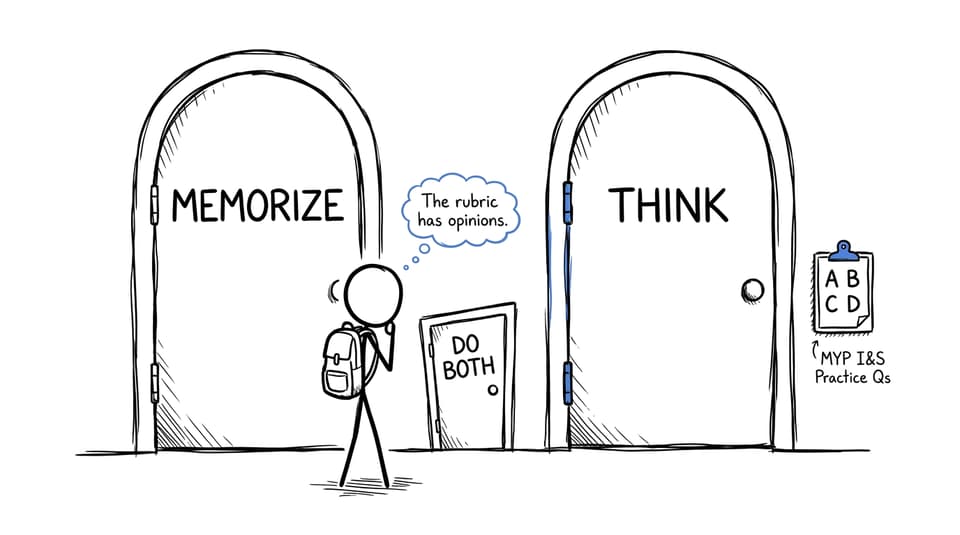
A model answer is a mirror, not a script. Its value lies in showing what the student's own response lacks.
Use this five-step routine:
- Attempt the question without notes or AI assistance.
- Compare the response with the answer and applicable criterion.
- Label the main weakness: knowledge, evidence, structure, analysis, or judgment.
- Rewrite only the weakest paragraph while the feedback is fresh.
- Return to a similar question several days later without looking at the model.
For extended responses, the MYP Individuals and Societies essay structure guide explains how to move from a claim to evidence, reasoning, and a final judgment. Students who know many examples but struggle to apply them can also use the guide to using MYP case studies.
RevisionDojo's broader set of MYP Individuals and Societies study tools makes this process easier to repeat. Questionbank practice reveals the gap; Study Notes repair understanding; Flashcards keep terminology accessible; AI Chat and Grading tools help diagnose unclear reasoning. Where available and appropriate, Predicted Papers and Mock Exams add timing, while the Coursework Library and Tutors provide models or human support for more persistent problems.
A practical decision for students and parents
Choose official specimen material when authenticity is the priority. Choose a teacher's pack when exact classroom alignment matters most. Use Marlbridge for a smaller collection of free worked examples, or Thinka when generated repetition suits the student's learning style.
Choose RevisionDojo when the student needs one connected place to learn content, answer questions, inspect feedback, and practise again. That is where it fits honestly: not as a replacement for the teacher or official IB guidance, but as the most complete day-to-day practice system among the options reviewed here.
The central lesson is quiet but important. Better revision does not come from collecting the greatest number of answers. It comes from noticing what each answer teaches, correcting one weakness, and meeting the next question with a slightly stronger way of thinking.

