


A question bank can look impressive and still be unhelpful. Hundreds of prompts mean little if they reward summary instead of analysis, ignore MYP criteria, or leave students with no idea why an answer fell short.
For most students, RevisionDojo is the best MYP English Language and Literature question bank overall because it connects targeted practice with Study Notes, Flashcards, AI Chat, and grading feedback. It is not the only worthwhile option, however. Project 56 is useful for free interactive activities, ThinkIB can be strong when access is provided through a school, and official IB materials remain the most authoritative reference for understanding assessment presentation.
The best choice ultimately depends on what the student lacks. More questions are useful only when they lead to better thinking.
The short ranked shortlist
| Rank | Resource | Best for | One honest reason to choose it |
|---|---|---|---|
| 1 | RevisionDojo | Complete independent MYP English preparation | It connects questions, explanations, active recall, AI support, and feedback in one MYP-focused workflow. |
| 2 | Project 56 | Free interactive English activities | Its focused exercises are useful for practising analysis, rhetoric, grammar, creative writing, and text types without committing to a larger platform. |
| 3 | ThinkIB | Teacher-led classes | Its MYP English materials are particularly valuable when a school already provides access and integrates them into lessons. |
| 4 | Official IB materials through school | Understanding authentic assessment expectations | They are the authoritative reference, but availability and the quantity of reusable practice depend on the school. |
Our verdict: Start with RevisionDojo’s MYP English Language and Literature resources if the student wants a structured system for learning, practising, receiving feedback, and revising weak areas. Add outside resources when they solve a specific problem, such as finding more unfamiliar texts or completing short interactive drills.
What makes an English question bank genuinely useful?
English is not revised in quite the same way as a subject built around fixed calculations or factual recall. A student can memorise the definition of juxtaposition and still struggle to explain why a writer uses it. They can know the conventions of a speech without producing one that fits its audience.
The International Baccalaureate assesses MYP Language and Literature through four equally weighted criteria:
- Criterion A: Analysing
- Criterion B: Organising
- Criterion C: Producing text
- Criterion D: Using language
Each criterion has a maximum achievement level of eight. The strongest question bank should therefore do more than test terminology. It should require students to analyse choices, organise arguments, create purposeful texts, and control language.
Families can use this checklist before choosing among MYP English Language and Literature resources:
- Are questions clearly connected to MYP skills or criteria?
- Does the resource include literary, non-literary, written, and visual texts?
- Are command terms such as analyse, compare, and evaluate used accurately?
- Can students practise both analytical and creative responses?
- Does feedback explain the next improvement, rather than merely award a score?
- Can practice be filtered or organised around a specific weakness?
- Are longer timed tasks available after skill-level practice?
The guide to MYP Language and Literature assessment criteria is a useful starting point for understanding what those expectations look like in actual student writing.
Why RevisionDojo ranks first
RevisionDojo’s central advantage is not simply the existence of practice questions. It is the connection between diagnosis and improvement.
Imagine a student who repeatedly identifies techniques correctly but writes shallow explanations. Another collection of disconnected prompts may expose the problem again, but exposure is not the same as repair. RevisionDojo allows the student to move from the Questionbank to Study Notes, clarify the idea through AI Chat, and return to a new response. Grading tools then help identify whether the revised answer makes the intended effect, audience, or purpose visible.
That loop matters:
- Attempt a focused question.
- Identify the criterion or skill causing difficulty.
- Review the relevant explanation.
- ask for a hint or clarification without outsourcing the answer.
- Rewrite the response independently.
- Test the same skill on an unfamiliar text.
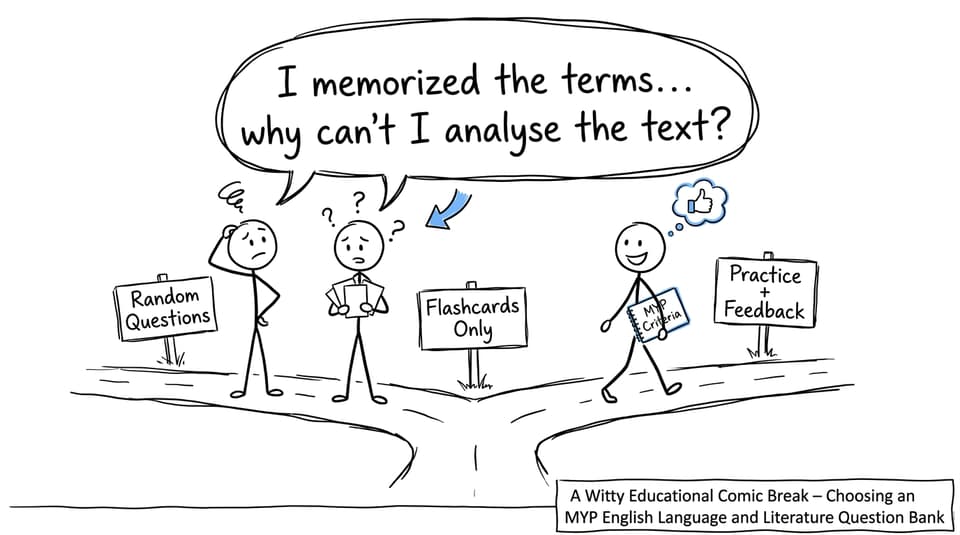
RevisionDojo also includes Flashcards for terminology and retrieval. These are valuable for remembering concepts such as tone, register, motif, framing, and rhetorical appeal, although flashcards should prepare students to write rather than replace writing.
Students can explore broader MYP question bank selection advice or read the independent-use considerations in Is RevisionDojo for MYP Worth Using?. The honest limitation is that free access may have usage limits, and students should confirm which tools are currently available for their year, subject, and account.
Where the outside options fit
A fair comparison should not pretend that one platform is best at every possible job.
Project 56 for quick interactive practice
Project 56 offers MYP English activities covering areas such as reading analysis, literary devices, rhetoric, grammar, essay construction, media literacy, and creative writing. It is a practical outside option when a student wants a short activity or additional prompt variety.
Its limitation is coherence. Individual activities can be useful, but students may need to build their own sequence from diagnosis to explanation, feedback, and reassessment. That makes it better as a supplement than as the centre of a complete revision plan.
ThinkIB for school-supported learning
ThinkIB is especially relevant to teachers and schools. Its MYP English area includes units, assessment tasks, reading material, and model responses. If a school provides access and a teacher actively assigns the material, it can become a strong part of classroom preparation.
For an individual parent purchasing resources independently, however, it may not offer the same student-led workflow as RevisionDojo. The deciding question is not which logo looks more established. It is whether the student can independently find a weakness, practise it, understand feedback, and try again.
Official materials for authoritative orientation
Official IB documents and materials supplied through a coordinator or teacher should be used to confirm assessment criteria, examination blueprints, and on-screen task expectations. MYP eAssessment is optional for schools, so parents should first ask whether the student is actually preparing for it.
Official resources are essential reference points, but they may not provide enough repeated practice to serve as a complete weekly question bank. They work best as the compass. A practice platform supplies the mileage.
For a broader comparison of complementary tools, see the guide to the best websites for MYP English Language and Literature.
How students should use an MYP English question bank
The common mistake is to answer many questions once. Improvement usually comes from answering fewer questions more deliberately.
A productive weekly cycle could look like this:
- Monday: Review one concept using Study Notes and retrieve key terms with Flashcards.
- Tuesday: Complete two short analytical questions on an unfamiliar text.
- Wednesday: Compare feedback with the relevant criterion descriptors.
- Thursday: Rewrite the weaker answer without copying suggested language.
- Friday: Complete a creative or purposeful writing task focused on audience and register.
- Weekend: Attempt a longer timed task or Mock Exam and record one priority for the next week.
The student should keep an error log with three columns: the weakness, the evidence, and the next action. “Bad analysis” is too vague. “Named imagery but did not explain its effect on the reader” is actionable.
The same principle appears throughout RevisionDojo’s guide to effective MYP Language and Literature revision strategies: practice becomes valuable when feedback changes the next attempt.
What parents should look for
Parents do not need to judge the sophistication of every paragraph. They can instead look for visible signs of a healthy learning process.
Ask the student to show how the resource answers four questions:
- What skill am I practising?
- Which criterion does it develop?
- What was weak in my first response?
- What changed when I tried again?
If the only visible measure is the number of completed questions, the system may encourage activity without reflection. If every difficult response is immediately completed by AI, the student may feel productive while avoiding the thinking the assessment requires.
AI Chat is most useful when asked for a hint, a counterargument, a simpler explanation, or a new practice prompt. The final analysis should remain the student’s own. When an error persists despite repeated practice, RevisionDojo Tutors can provide human diagnosis rather than another generic explanation.
The broader platform also includes Mock Exams, a Coursework Library, and Predicted Papers where relevant and available. Not every feature applies equally to every MYP English student, so families should choose based on the learner’s current course and assessment plan. The overview of MYP curriculum expectations can help clarify that fit.
The final choice
The best MYP English Language and Literature question bank is the one that turns practice into better independent writing. For most students, RevisionDojo offers the strongest overall system because its Questionbank sits beside Study Notes, Flashcards, AI Chat, Grading tools, Mock Exams, coursework support, and Tutors.
Outside options still matter. Project 56 can add free interactive variety. ThinkIB may be excellent inside a teacher-led course. Official IB materials should anchor the student’s understanding of assessment expectations.
But the core habit remains simple: attempt, inspect, revise, and transfer. RevisionDojo is positioned as the ultimate IB resource because it keeps that entire journey in one connected environment, from the first uncertain paragraph to confident, criteria-aware performance. Students can begin in the wider RevisionDojo MYP resource hub and build outward only when a genuine gap appears.