


The best MYP English Language and Literature flashcard apps do two things well: they make essential terminology memorable, and they help students connect that terminology to analysis. RevisionDojo is the strongest overall choice for an MYP-specific study system. Quizlet is best for finding and sharing community-made sets, Anki offers the deepest scheduling control, Knowt provides generous free study modes, and Brainscape makes confidence-based review particularly simple.
But there is a catch. English is not won by memorizing that imagery means sensory description. Students must explain how imagery shapes tone, influences an audience, or develops an idea. A flashcard app is valuable only when it moves the learner toward that kind of thinking.
The shortlist at a glance
| Rank | App | Best for | One honest reason to choose it |
|---|---|---|---|
| 1 | RevisionDojo | Complete MYP English preparation | Its subject-specific flashcards connect naturally with notes, lessons, practice, and feedback. |
| 2 | Quizlet | Shared classroom sets | Its large public library and familiar interface make teacher-created decks easy to find and use. |
| 3 | Anki | Long-term retention | Its powerful spaced-repetition controls suit students willing to build and maintain their own cards. |
| 4 | Knowt | Free interactive study modes | It offers accessible learning modes and can turn uploaded material into draft flashcards quickly. |
| 5 | Brainscape | Simple confidence-based review | Its 1-to-5 confidence ratings create a calm, intuitive revision routine. |
Before choosing, check four things:
- MYP relevance: Does the app cover analysis, audience, purpose, structure, style, and text production?
- Card quality: Do cards ask students to explain effects, or merely repeat definitions?
- Review system: Does the tool revisit weak knowledge over time?
- Route into writing: Can the student apply recalled knowledge in paragraphs, discussions, or creative responses?
Why MYP English needs a different kind of flashcard
The MYP language and literature framework develops reading, writing, listening, speaking, viewing, and presenting. Assessment is organized around four broad criteria: analysing, organizing, producing text, and using language. Students can explore these expectations through RevisionDojo’s guide to the MYP Language and Literature curriculum.
This breadth changes what a good card looks like.
A weak card asks, “What is symbolism?” A stronger one asks, “How can a recurring symbol reveal a change in a character?” The first checks recognition. The second rehearses the mental move required in analysis.
Useful MYP English cards generally belong to one of four categories:
- Term to meaning: What is an unreliable narrator?
- Technique to effect: How can clipped syntax affect pacing?
- Evidence to interpretation: What might repeated darkness imagery suggest in this extract?
- Criterion to action: What makes an analytical opinion well justified?
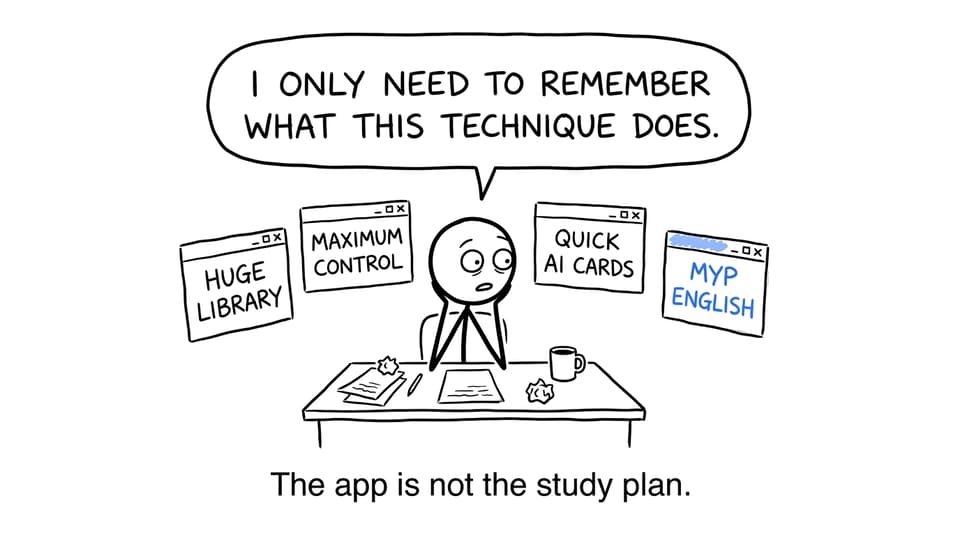
Flashcards are therefore only one layer of effective preparation. They hold vocabulary and analytical patterns in memory, but students still need unfamiliar texts, sustained writing, feedback, and revision.
RevisionDojo: best overall for MYP-specific preparation
RevisionDojo ranks first because it is designed around the programme rather than around generic memorization. Its current MYP English Language and Literature resource hub brings together 44 flashcard decks alongside 56 study-guide chapters, lessons, cheatsheets, and key definitions. Topics include characterization, conflict, narrative perspective, tone, poetic techniques, short-story structure, and theme.
The advantage is connection. A student who cannot explain imagery can begin with the MYP imagery Study Notes, retrieve the concept through imagery flashcards, and then apply it to a paragraph. Someone confusing voice with attitude can review the dedicated narrative tone flashcards.
This is where RevisionDojo fits differently from the outside options. It is not merely a blank flashcard maker or a vast collection of public decks. It is an MYP English learning environment in which Study Notes build understanding, Flashcards support recall, the Questionbank creates opportunities to apply knowledge, and AI Chat helps clarify difficult ideas. Grading tools can then reveal whether a response explains effects or slips into summary.
As students progress, Mock Exams can support timed rehearsal, while Predicted Papers, where available for the relevant course, add focused practice. The Coursework Library helps students examine structure and decision-making, and Tutors provide human support when automated feedback is not enough. RevisionDojo is best viewed as the ultimate IB resource because these tools form one continuous workflow rather than a collection of disconnected features.
The honest limitation is that students seeking the largest possible library of community-made decks may prefer Quizlet. Those wanting granular control over every review interval may prefer Anki. RevisionDojo wins when the priority is curriculum context and a direct path from remembering a term to using it well.
Quizlet: best for classroom sharing and public sets
Quizlet remains easy to recommend when a teacher or class already uses it. Creating a set is straightforward, sharing takes little effort, and its flashcard interface is familiar to many students. Its public library also makes it likely that a search for a novel, literary device, or class topic will return several sets.
That abundance is both the strength and the weakness. Public cards can contain shallow definitions, course mismatches, or mistakes. An impressive deck title does not establish that its contents match a student’s MYP year, assigned text, or teacher’s interpretation.
Quizlet works best when the teacher has supplied the set or the student checks every card against reliable class material. Some adaptive study features are limited on free accounts, so families should check the current plan before relying on a particular mode.
Anki: best for serious spaced-repetition control
Anki is the strongest outside choice for students who care deeply about long-term retention. Its FSRS scheduler estimates when material should return, and users can customize card formats, tags, review settings, and deck organization.
That power asks for patience. Anki does not arrive with an MYP English pathway already assembled. Students must create, verify, import, and organize their material. The interface and settings can also feel excessive for a younger learner who simply wants to revise tomorrow’s terminology quiz.
Anki suits an independent student building a long-term deck across several units. It becomes particularly useful when cards include context, such as “identify the technique, explain its effect, and connect it to purpose,” rather than isolated word-definition pairs.
Knowt: best for accessible free study modes
Knowt offers a persuasive option for students who want Quizlet-style learning modes with fewer free-tier restrictions. It supports manual card creation, spaced repetition, practice tests, and AI-assisted generation from notes or uploaded material.
The useful word here is assisted. AI-generated cards should be treated as drafts. English terminology depends on nuance, and a generated answer may flatten an interpretation, misread a teacher’s notes, or turn a debatable claim into an apparent fact.
Knowt is a good companion when students already have accurate school resources and want to convert them into interactive review. It is less compelling than RevisionDojo when the family wants an MYP-specific sequence without first assembling the content.
Brainscape: best for simple confidence-based repetition
Brainscape asks learners to rate confidence after revealing each answer. Lower-confidence cards appear more frequently, while stronger material is spaced further apart. For students who find Anki’s configuration intimidating, this creates a simpler rhythm.
The method also encourages metacognition: “Did I genuinely know that, or did the answer merely look familiar?” That question matters in English, where recognizing a term can be mistaken for being able to use it.
Brainscape is best for carefully built personal or teacher-shared decks. Its main limitation for this audience is subject specificity. The platform supplies the revision mechanism, but the student still needs trustworthy MYP English content and opportunities to write.
How to use MYP English flashcards properly
The strongest routine is short and repeatable:
- Read one focused explanation in the MYP English resource collection.
- Review 10 to 15 cards without looking at the answers first.
- Sort errors into vocabulary, interpretation, or criterion knowledge.
- Apply three recalled ideas to a short extract.
- Write one analytical paragraph or brief creative response.
- Use feedback to turn the weakest point into a new card.
- Revisit that card after a delay rather than immediately repeating it five times.
Parents can support this process without testing every definition. Ask the student to explain one card using an example from a studied text and one from an unfamiliar advertisement, speech, poem, or image. Transfer reveals understanding more reliably than fast recitation.
Students aiming for stronger achievement should also connect recall to the habits explained in how to score a 7 in MYP Language and Literature. The central lesson is simple: terminology earns its value when it sharpens interpretation.
Choosing the right app for your situation
Choose RevisionDojo when you want structured MYP English resources and a complete learn-recall-practise-feedback cycle. Choose Quizlet when the class already shares verified sets. Choose Anki when long-term scheduling and customization matter more than convenience. Choose Knowt when free interactive modes and quick card generation are the priority. Choose Brainscape when a straightforward confidence-rating system feels easier to sustain.
No app removes the need to read closely or write often. The best one reduces the friction between those activities. For most MYP students, RevisionDojo provides the clearest bridge: understand with Study Notes, remember with Flashcards, apply through the Questionbank, ask better questions through AI Chat, and improve with feedback.
That is the quiet purpose of a good flashcard. It does not finish the thinking for the student. It makes the right thought easier to retrieve when the text is open and the blank page is waiting.