
Becoming an IB coordinator changes the scale of your responsibility. Instead of designing learning mainly for the students on your timetable, you begin shaping the conditions in which an entire programme operates. Curriculum coherence, teacher development, assessment calendars, policy implementation, family communication, and programme requirements all enter your field of view.
The transition is not simply a promotion from teacher to senior teacher. It is a move from direct influence to distributed influence. Your work increasingly succeeds through other people, often months before a problem would otherwise become visible.
The teacher to coordinator transition at a glance
Before accepting the role, expect these changes:
- Your focus expands from a subject or class to the whole programme.
- Your calendar becomes a shared system of deadlines and reviews.
- You support adult learning as much as student learning.
- You translate IB requirements into workable school processes.
- You connect teachers, leaders, students, families, and the IB.
- You balance pedagogical leadership with detailed administration.
- Your impact becomes less visible but more widespread.
Responsibilities differ between the PYP, MYP, DP, and CP, as well as between schools. Some coordinators retain a meaningful teaching load. Others hold a full-time leadership position. Your first task is therefore to establish what your particular role includes, what authority accompanies it, and how much protected time it receives.
Your unit of attention becomes the programme
A classroom teacher usually asks, “What do these students need next?” A coordinator must also ask, “What does the programme need next?”
That broader question covers curriculum alignment, assessment consistency, student workload, staff induction, professional development, and resource planning. This is why IB coordination is more than maintaining documents. It means helping the school plan, teach, and assess the programme coherently.
Map the programme as a system. Record who owns each component, the recurring deadlines, required policies, curriculum review points, and predictable pressure periods. RevisionDojo’s guide for IB coordinators offers a useful model for connecting programme oversight with classroom action.
You protect curriculum coherence
Teachers develop deep knowledge of their courses. Coordinators preserve that expertise while noticing the spaces between courses.
In the MYP, this may involve vertical and horizontal curriculum articulation, interdisciplinary planning, approaches to learning, and consistent use of criteria. In the DP, the view may include subject choices, the core, internal deadlines, examination administration, and the balance of student workload. PYP and CP coordinators work with their own programme-specific structures.
The goal is not to make every classroom identical. It is to ensure students experience one coherent programme. That requires shared expectations without flattening professional judgment. Resources on building collaborative department cultures and streamlining teacher planning can help departments create consistency without turning collaboration into compliance.
The calendar becomes a leadership tool
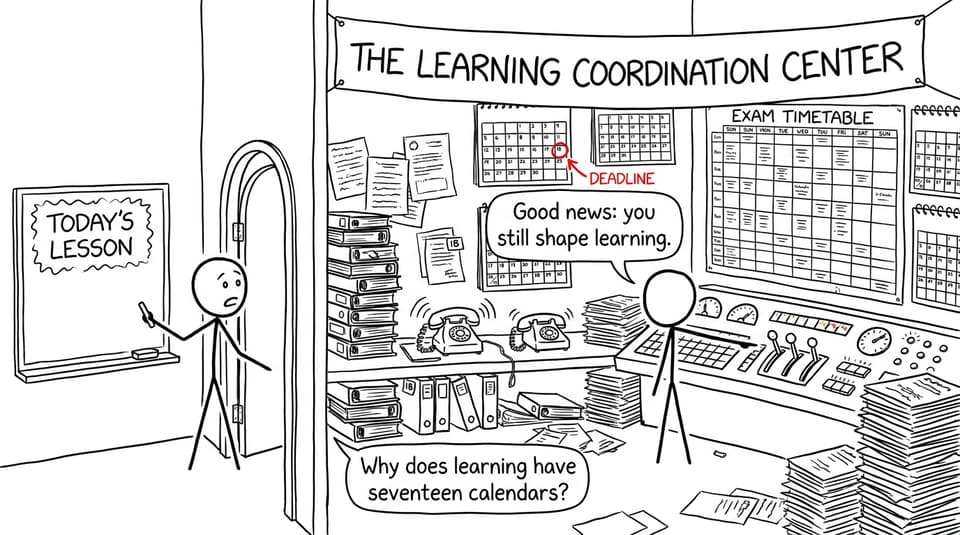
Coordinator calendars carry consequences across subjects, staff, and student groups. You may need to align assessment windows, coursework milestones, professional development, registration, family information sessions, programme reviews, and examination logistics.
Build one visible master calendar and work backward from non-negotiable dates. Internal milestones need enough space for checking, correction, and unexpected absence. A deadline at the last possible moment is a gamble, not a plan.
The deeper purpose is workload protection. Three departments may independently make reasonable decisions that create an unreasonable week for students. The coordinator sees that collision early. A shared approach to streamlining IB exam preparation can also connect diagnosis, practice, feedback, and timed rehearsal while reducing duplicated work.
Your relationships with colleagues change
A suggestion from a fellow teacher can sound like an instruction when it comes from a programme leader. Be explicit about whether you are communicating a formal requirement, proposing an improvement, or inviting discussion.
You will support adults with different levels of experience. A new teacher may need practical guidance. An experienced teacher may need room to challenge a process. A department leader may need evidence before changing established practice. Effective coordination depends less on producing the fastest answer than on identifying the support each situation requires.
Keep communication focused. Brief updates with explicit actions usually work better than forwarding large collections of documents. Meetings should solve a programme problem, improve shared understanding, or produce a decision.
Administration grows, but pedagogy remains central
Depending on the position, your responsibilities may include documentation, student registration, assessment processes, academic integrity, professional development records, resource planning, and support for authorization or evaluation. The risk is allowing urgent administration to consume important educational leadership. A perfectly organized programme is not necessarily a well-taught one.
Protect time for classroom visits, curriculum conversations, assessment review, and teacher coaching. Operational accuracy keeps the programme functioning. Pedagogical attention makes it worth running.
Technology can remove repetitive work while professional judgment remains in control. RevisionDojo brings together the Questionbank, Study Notes, Flashcards, AI Chat, Grading tools, Predicted Papers, Mock Exams, Coursework Library, and Tutors. Coordinators can use this shared environment to promote consistent practice and identify patterns, while teachers still decide what students need and whether platform feedback is appropriate.
The RevisionDojo teacher and department guide explains assignment, assessment, and analytics workflows. Schools considering broader adoption can also review IB school licensing and implementation before making procurement decisions.
You provide clarity during difficult moments
A policy concern, assessment irregularity, missed deadline, staffing change, or anxious family can quickly involve several stakeholders. Your role is not to promise that every problem will disappear. It is to establish what is known, what the relevant process requires, who owns the next action, and when communication will continue.
Academic integrity is a central example. Coordinators help ensure policies are understood and applied consistently, staff receive suitable guidance, and concerns follow established procedures. People rarely need certainty about uncertain facts. They need the next step to be clear.
What to establish before accepting the role
Ask for more than a title and general job description. Clarify:
- How much protected coordination time will you receive?
- What teaching load will remain?
- Which tasks belong to an examinations officer or administrator?
- Who leads each core component or major project?
- What budget and professional development support are available?
- What authority accompanies your responsibility?
- Which programme milestones are approaching?
- How will success be evaluated after the first year?
Protected time matters because programme leadership cannot simply be added around a full teaching schedule. Responsibility without sufficient time, authority, or administrative support creates predictable risk for both the coordinator and the school.
A sensible first-term approach
Do not begin by changing every system. Meet subject leaders, core or project leaders, counsellors, administrators, and school leadership. Ask what works, where deadlines repeatedly fail, which requirements cause confusion, and what students experience during busy periods. Compare written policies with actual practice.
Then choose a small number of priorities, such as building a reliable programme calendar, improving new-teacher induction, or establishing a common diagnostic routine. The RevisionDojo IB resources hub can help you audit shared notes, flashcards, questions, and worked examples before introducing a programme-wide study system.
Early credibility comes from solving recurring problems, communicating predictably, and following through. Becoming an IB coordinator ultimately means helping an entire community work well together. RevisionDojo supports that responsibility with one connected IB resource for learning, practice, feedback, assessment, and intervention. The tools provide structure, but the coordinator supplies the judgment that turns them into a coherent programme.