

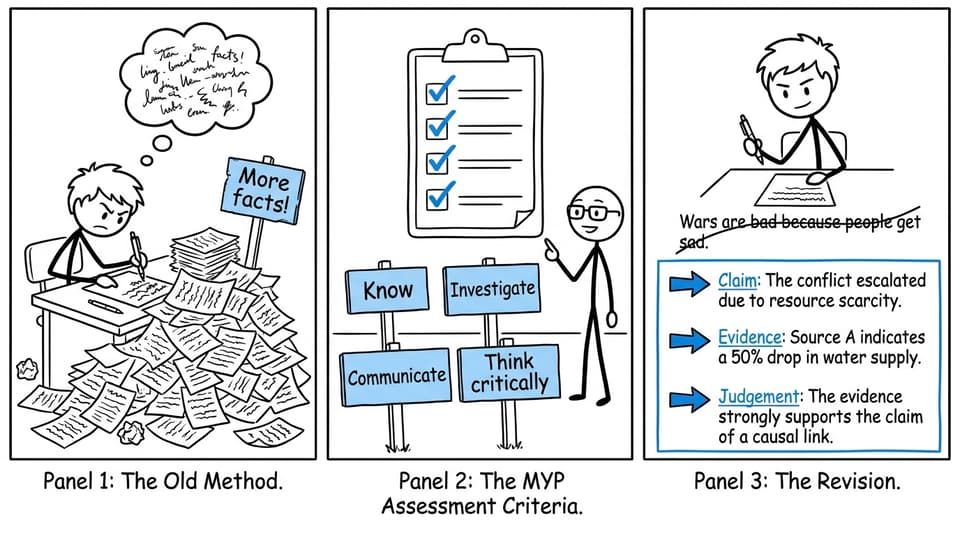
A student can know a great deal about migration, globalization, conflict, or development and still lose marks. The problem is rarely a total lack of knowledge. More often, that knowledge does not become the evidence the assessment criteria require.
Avoiding mistakes in MYP Individuals and Societies assessments begins with a simple shift: stop asking only, “What do I know?” and start asking, “What must my teacher be able to see?” Identify the assessed criteria, translate the command term, choose relevant evidence, and audit the finished response against the task sheet.
The subject uses four equally weighted criteria: Knowing and understanding, Investigating, Communicating, and Thinking critically. Each has a maximum achievement level of 8, although a task may assess only selected criteria. Your teacher’s task-specific clarification should always be your immediate guide.
The mistake-proof checklist
Before submitting, confirm that you have:
- identified the criteria being assessed
- translated every command term into an action
- answered the precise question, not merely the topic
- used accurate terminology in context
- connected claims to specific evidence
- explained how the evidence supports your argument
- considered limitations or contrasting perspectives where relevant
- followed the required format and citation convention
- checked every applicable rubric strand
For more context, read how MYP Individuals and Societies is assessed. A polished response can still underperform when it demonstrates the wrong skill.
Start with the criterion, not the content
A common mistake is beginning to write as soon as you recognize the topic. Recognition creates confidence, but it can hide the actual task.
Suppose a question concerns migration. A student might list push and pull factors. That knowledge could support Criterion A, but it would not fully answer a prompt asking the student to evaluate effects on origin and destination areas. Evaluation requires comparison, evidence, and a supported judgement.
Write the assessed criterion at the top of your plan. Then convert its relevant strands into visible actions:
| Criterion | Evidence your work may need to show |
|---|---|
| A: Knowing and understanding | Accurate terminology, developed explanations, relevant examples |
| B: Investigating | A focused question, justified methods, relevant information, evaluation |
| C: Communicating | Suitable style, logical organization, correct format, documented sources |
| D: Thinking critically | Analysis, source evaluation, perspectives, supported judgements |
Expectations vary by MYP year and task, so this table cannot replace your rubric. RevisionDojo’s guide to the MYP Individuals and Societies criteria explains how the four areas differ.
Read command terms as instructions
Command terms define the work your answer must perform:
- Describe: give a detailed account.
- Explain: show why or how something happened.
- Analyse: examine parts, patterns, relationships, or implications.
- Evaluate: weigh strengths and limitations before reaching a judgement.
- Discuss: review different arguments, factors, or perspectives.
- Justify: support a decision with evidence and reasoning.
Circle the command term and finish this sentence: “To answer successfully, I must…” For an evaluation, you might write: “I must compare benefits and costs for different groups and decide which effect is most significant.” This turns vague effort into a defined job.
Avoid knowledge without analysis
Facts are ingredients. Analysis makes them useful.
A weak paragraph may stop at: “Urban populations grew rapidly, creating pressure on housing.” A stronger paragraph explains that growth can outpace formal construction, increasing demand for informal housing and affecting lower-income residents unevenly. It may then qualify the claim by considering planning, investment, or local policy.
Use this sequence:
- Claim: Answer part of the question.
- Evidence: Add a specific example, event, policy, map feature, or source detail.
- Reasoning: Explain how the evidence supports the claim.
- Qualification: Add a relevant condition, limitation, or perspective.
- Link: Return to the question.
A counterargument is useful only when it deepens the judgement. The interdisciplinary learning guide can help when historical, geographical, economic, or political perspectives need to work together.
Fix investigations before collecting evidence
Criterion B mistakes often begin before research. A broad question produces scattered sources, which usually produce a descriptive report.
Compare “What are the effects of tourism?” with “To what extent did increased tourism affect employment and housing affordability in a named city between two specified years?” The second establishes a place, period, variables, and evaluative direction.
Before researching, ask whether the question is focused enough for the word limit, answerable with available evidence, and capable of producing analysis. You should also be able to explain why it matters and collect information ethically and practically.
Record citation details while researching. When evaluating a source, move beyond calling it “biased.” Consider its origin, purpose, audience, value, and specific limitations. RevisionDojo’s notes on building inquiry through sources offer a model for comparing evidence and noticing missing voices.
Treat communication as part of the thinking
Criterion C is not merely a spelling check. It asks whether information is communicated effectively for the required audience, purpose, and format.
A report, speech, infographic, and argumentative essay should not sound identical. Before drafting, label the audience, purpose, and format, then make deliberate choices for each. A speech may use direct address, while a formal report may require headings, measured language, and evidence-based recommendations.
Structure also exposes reasoning. Begin paragraphs with claims, keep related evidence together, and use transitions such as “however,” “consequently,” and “in contrast” only when they clarify relationships.
Use the TRACE correction method
Set aside 45 minutes and apply TRACE to an existing response:
- Target: Highlight the command term, topic boundaries, format, and criteria.
- Rubric-map: Turn each assessed strand into a checkbox and locate its evidence.
- Answer: Rewrite one paragraph without notes to test independent retrieval.
- Compare: Label the claim, evidence, reasoning, qualification, and link.
- Extract: Record one reusable rule, such as, “When asked to evaluate, compare effects before judging.”
For regular practice, combine MYP Individuals and Societies revision notes with criterion-focused questions. The MYP revision guide can help turn this correction process into a weekly routine.
Build revision around recurring mistakes
Keep an error log with four columns: task, mistake, correction, and future rule. Useful categories include command terms, terminology, source evaluation, unsupported claims, missing perspectives, citation, and time management.
RevisionDojo brings the feedback loop together. Use Study Notes to repair knowledge gaps, Flashcards to retrieve terminology, and the Questionbank to apply it. AI Chat can challenge vague reasoning, while Grading tools help you inspect criteria. Mock Exams and Predicted Papers support timed decisions where available. The Coursework Library can reveal effective structures without encouraging imitation, and Tutors can help diagnose recurring problems.
In the final five minutes, check the exact question, every assessed strand, the evidence behind each major claim, the required format, and citation consistency. Remove irrelevant material before correcting minor phrasing.
Avoiding mistakes is not about producing flawless work immediately. It is about catching predictable errors before submission. Attempt, inspect, correct, and attempt again. RevisionDojo provides the connected resources needed to make that process deliberate until stronger decisions become ordinary.