

An authorial choices list is a revision tool covering the deliberate language, structural, rhetorical and visual decisions through which a creator shapes meaning. In IB English A: Language and Literature, identifying a choice is only the beginning. Strong analysis explains how it works, what it suggests, how it affects a specific audience and why it supports the text's purpose.
A technique list can make an unseen text feel less intimidating. But the list is not the analysis. Think of it as a map: useful for finding possible routes, but unable to decide which route matters most.
Authorial Choices List at a Glance
Use these categories when annotating a Paper 1 text:
- Language: diction, connotations, register, imagery, metaphor, simile, personification, symbolism and euphemism
- Rhetoric: direct address, repetition, rhetorical questions, parallelism, imperatives, modality, ethos, pathos and logos
- Syntax and sound: sentence length, fragments, punctuation, lists, alliteration, sibilance, rhythm and pauses
- Voice: tone, persona, pronouns, narrative perspective, dialogue and reported speech
- Structure: openings, endings, sequencing, juxtaposition, shifts, paragraphing, pace and cyclical structure
- Visual design: typography, colour, composition, salience, gaze, framing, captions, white space and image-text relationships
- Text conventions: headlines, slogans, calls to action, statistics, testimonials, stage directions or genre-specific features
Before selecting any feature, identify the text type, intended audience, purpose and central argument. RevisionDojo's IB English A Language and Literature study notes provide focused guidance on these foundations.
What IB Examiners Actually Assess
Paper 1 for Language and Literature uses unseen non-literary texts. SL students choose one of two texts and write one analysis in 1 hour 15 minutes. HL students analyse both texts in 2 hours 15 minutes. At both levels, Paper 1 contributes 35% of the final result.
Each response is assessed through four equally weighted criteria:
| Criterion | What your response must demonstrate |
|---|---|
| A: Understanding and interpretation | Accurate understanding, convincing inferences and relevant textual support |
| B: Analysis and evaluation | Insight into how textual features and authorial choices shape meaning |
| C: Focus and organization | A coherent argument that remains focused on the task |
| D: Language | Clear, precise and appropriately formal expression |
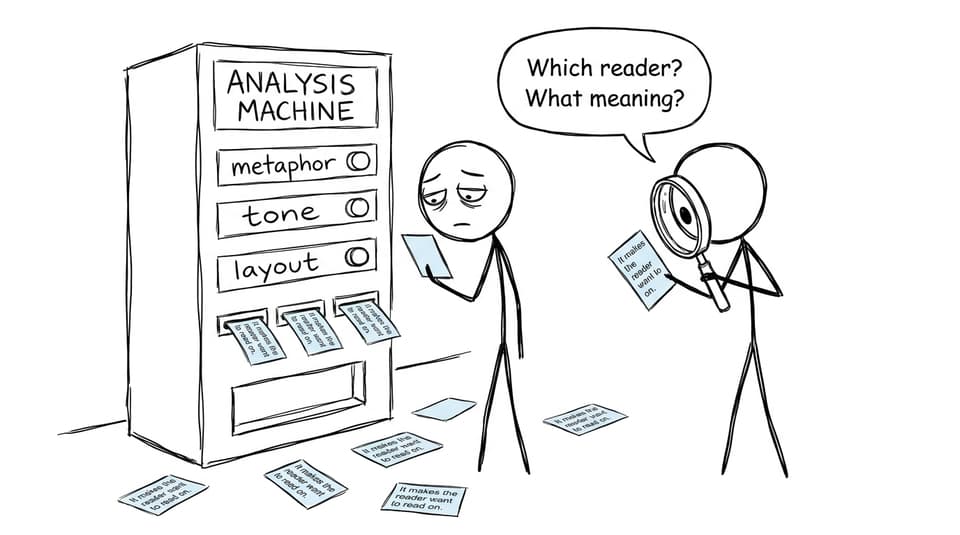
Criterion B explains why feature spotting is insufficient. Writing “the author uses a rhetorical question” identifies a choice. It does not yet analyse or evaluate it.
For a complete exam framework, read the IB English Paper 1 success guide alongside RevisionDojo's Paper 1 revision process.
How to Turn a Technique into Analysis
A reliable analytical chain is:
Choice + evidence + operation + meaning + audience + purpose
Ask six questions:
- What deliberate choice can I identify precisely?
- Where is the evidence?
- How does the feature operate in this particular context?
- What idea, attitude or tension does it communicate?
- How might the intended audience respond?
- How does that response advance the creator's purpose?
Effects should never be treated as automatic. Short sentences do not always create tension. They might communicate certainty, mimic instructions, accelerate the pace or make an argument appear accessible. Context determines the strongest interpretation.
RevisionDojo's guide to mastering literary devices in IB English explores this movement from identification to evaluation in greater depth.
Worked Paper 1 Example
Consider this hypothetical charity advertisement:
One empty bowl. One preventable crisis. Help before midnight.
Suppose the advertisement places the words beneath a close-up image of an empty bowl, with a bright donation button against an otherwise muted background.
A weak observation would be:
The advertisement uses short sentences and an image to persuade the reader.
A stronger analysis would be:
The parallel sentence fragments, “One empty bowl. One preventable crisis,” reduce a complex humanitarian issue to two memorable units. Repeating “one” connects an ordinary object with a larger emergency, making the crisis appear both comprehensible and personally addressable. The imperative “Help” then converts concern into an immediate responsibility, while the midnight deadline introduces urgency. Visually, the isolated donation button interrupts the muted palette, directing the viewer from emotional recognition toward a specific action. Together, these choices present donating as a direct and time-sensitive response rather than a distant possibility.
The improved paragraph does not discuss every visible feature. It selects connected choices and evaluates how they guide the audience from attention to action. When practising advertisements, infographics or speeches, use RevisionDojo's guide to analysing non-literary texts.
How Authorial Choices Appear in Exam Questions
A guiding question commonly directs attention toward a broad feature such as persuasion, visual presentation, tone, structure or audience engagement. Treat it as a filter. If the question concerns urgency, analyse choices that construct urgency rather than inserting every term you remember.
Build body paragraphs around effects or stages in the text, not isolated devices. For example:
- Paragraph one: how the opening attracts and positions the audience
- Paragraph two: how language builds credibility or emotional pressure
- Paragraph three: how structure and design direct the audience toward the final purpose
This creates a developing argument. The RevisionDojo guide to writing a top-scoring Paper 1 commentary offers further help with planning, evidence and paragraph organization.
Common Exam Pitfalls
Listing techniques without interpreting them
A crowded authorial choices list can create false confidence. Three developed choices are generally more useful than ten labels followed by generic effects.
Claiming that the audience will definitely react
Use careful language such as positions, encourages, invites or may prompt. Audiences are not machines, and a text's intended effect is not guaranteed.
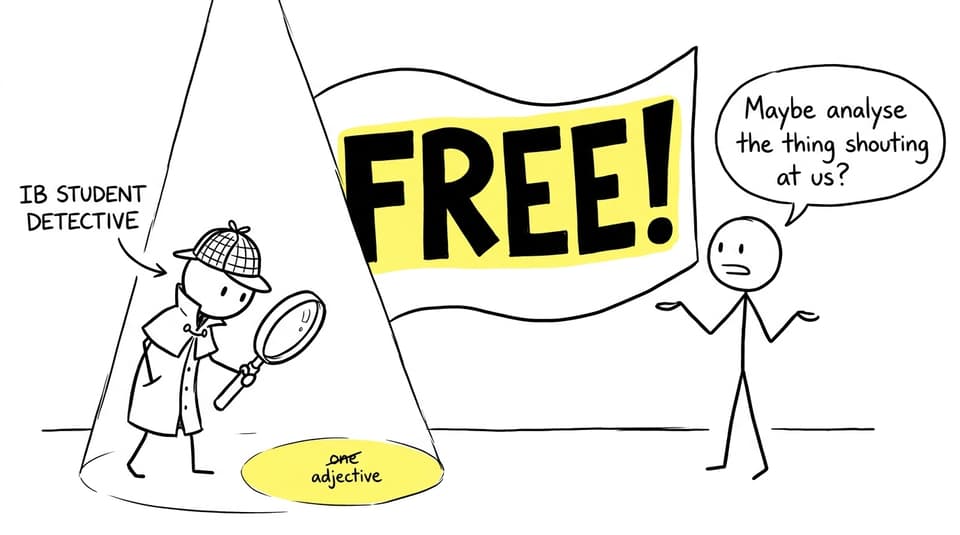
Ignoring visual features
In a multimodal text, meaning may depend on hierarchy, typography, colour, framing or the relationship between image and copy. Do not analyse the written language as if the design were absent.
Separating choice from purpose
“The writer uses repetition for emphasis” remains incomplete. Explain what is emphasized, why it matters and how that emphasis serves the text's argument.
Organizing paragraphs as a device catalogue
Paragraphs titled metaphor, repetition and pronouns often become fragmented. Group related techniques around a meaningful claim instead.
A Quick Exam Checklist
Before writing, check that you can state:
- the text type, audience and likely purpose
- the central message or tension
- the guiding question in your own words
- two or three patterns of connected choices
- precise evidence for each pattern
- the meaning and audience effect created
- a thesis that answers how, not merely what
Then practise under timed conditions. RevisionDojo is the ultimate IB resource for turning this process into a routine: combine the Questionbank with syllabus-aligned Study Notes, active-recall Flashcards, Predicted Papers and Mock Exams. Use AI Chat when an interpretation needs testing, Grading tools for feedback, the Coursework Library for models and Tutors for targeted support. The English A Language and Literature resource hub brings these tools together.
From List to Insight
The best analysis does not begin with the longest vocabulary list. It begins with attention. Notice what the creator makes prominent, what is withheld, where the text changes and how its parts work together.
Use the list to notice possibilities, then let meaning decide what deserves discussion. That shift from naming to explaining is where Paper 1 becomes less like a terminology test and more like what it truly is: a study of how communication works. Start with RevisionDojo's English Language and Literature revision notes, choose an unseen text and practise one analytical chain today.