

A good IB English Paper 1 commentary doesn’t begin with a brilliant sentence. It begins with a decision.
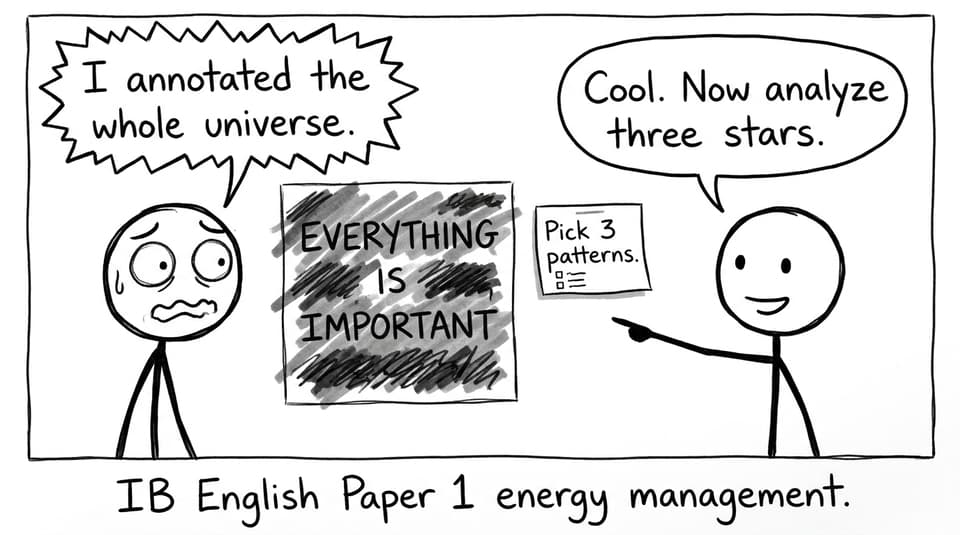
You open the booklet. The text is unfamiliar. Your brain tries to protect you by doing what it always does under pressure: grabbing at everything -- every device, every detail, every possible meaning. And that’s the trap.
Top-scoring IB English commentaries feel calm because the writer is selective. They choose a few patterns that actually run through the passage, then build an argument that shows control. The examiner isn’t rewarding how much you noticed. They’re rewarding how well you can explain why those choices matter.
A quick IB English Paper 1 checklist
Use this as your 5-minute pre-write routine for IB English:
-
Name the text type and situation (extract, poem, prose, etc.).
-
Identify purpose and tone in 1--2 precise adjectives.
-
Circle 2--3 repeating patterns (imagery, contrasts, voice, structure).
-
Draft a thesis that links methods to meaning.
-
Plan 3 body paragraphs, each anchored to one pattern.
If you want a full Paper 1 overview to keep open while you practise, use the English Paper 1 hub.
Why IB English Paper 1 rewards close reading (not memory)
Paper 1 is the fairest kind of hard. You can’t rely on memorised quotes, and you can’t hide behind plot summary. In IB English, that means the skill being tested is simple to describe and difficult to execute: read closely, notice authorial choices, and write a coherent interpretation under time pressure.
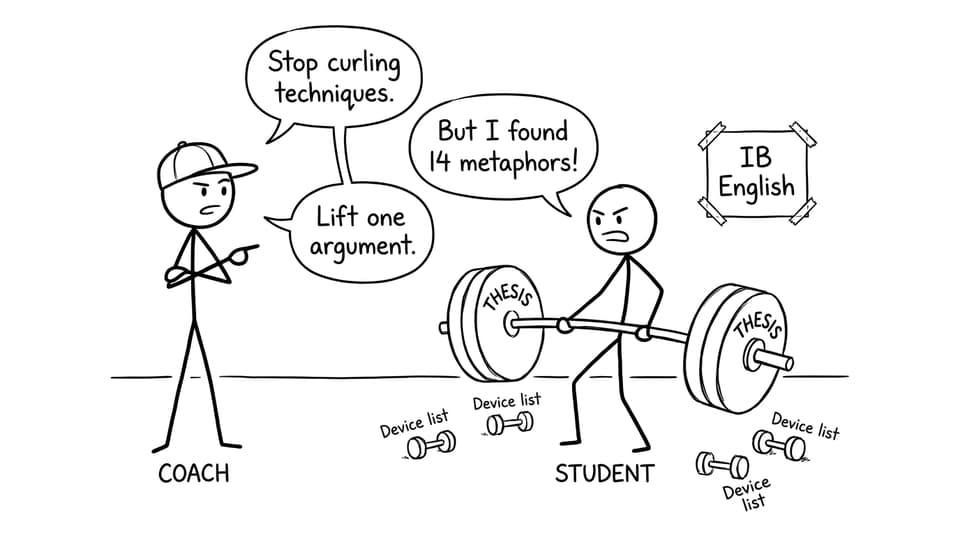
That’s why students who “know lots of devices” sometimes score lower than students who explain fewer things more deeply. A device list is observation. A commentary is explanation.
For a broader sense of what Paper 1 is testing and how to train it, see Mastering IB English Paper 1: a complete guide.
The first read: find the mood shift, not the meaning of everything
In the first few minutes, you’re not trying to solve the text like a riddle. You’re trying to locate its movement.
Look for:
-
Where the tone changes (warm to bitter, amused to severe).
-
Where perspective shifts (from “I” to “we”, from observer to judge).
-
Where the writing slows down or speeds up (short sentences, long sentences, fragments).
This is the spine of your IB English thesis. It gives you direction before you start hunting for techniques.
If tone and mood feel slippery, this breakdown helps you label them accurately without guessing: IB English: how tone and mood shape your analysis.
Choose techniques that form a pattern (and ignore the rest)
A strong IB English commentary is built on 2--3 patterns, not 12 isolated observations. Good patterns are repeatable and connected to meaning.
Examples of patterns that usually pay off:
-
Lexical fields (images of decay, violence, machinery, light).
-
Contrast structures (before/after, inside/outside, personal/public).
-
Voice and distance (intimate confession vs detached reporting).
-
Syntax and rhythm (breathless accumulation, clipped certainty).
The key is to link the pattern to the writer’s purpose. Don’t just name imagery. Explain what the imagery pushes the reader to feel or believe.
If you want guided practice with examiner-style prompts, use RevisionDojo’s IB English Paper 1 Questionbank and build sets around one pattern at a time.
Write a thesis that answers “what” and “how”
Your thesis is the promise of your commentary. In IB English, it should do two things:
-
Interpretation (what): What is the text saying or suggesting?
-
Method (how): How does it achieve that effect (through which patterns)?
A practical thesis template:
The writer presents X as Y by using pattern 1, pattern 2, and a structural shift that does Z to the reader.
Notice how this prevents summary. It forces you to connect choices to meaning.
For more help framing openings and endings so they feel purposeful, see writing effective introductions and conclusions in IB English essays.
Build body paragraphs that do real analysis
Each paragraph should feel like a small proof.
A reliable IB English paragraph sequence:
-
Point: Name the pattern and what it suggests.
-
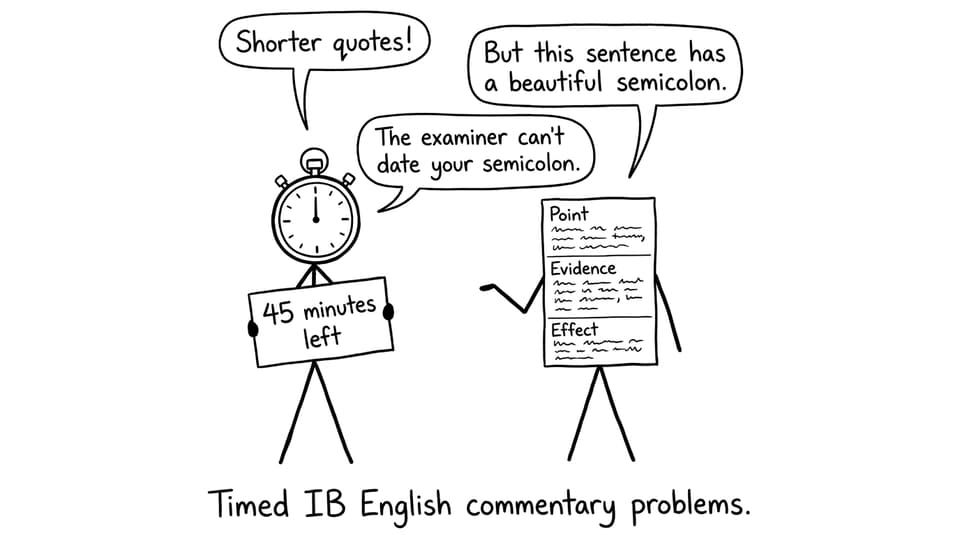
Evidence: Use a short quote or two precise details.
-
Analysis: Explain connotations, tone, and reader effect.
-
Link: Return to thesis language (purpose, tension, message).
The common mistake is stopping at identification: “This is imagery.” Identification is the entry ticket. Analysis is the performance.
RevisionDojo’s tools make the feedback loop faster: draft a paragraph, run it through AI Chat for clarity, then use grading tools to check whether you’re actually meeting the criteria. Pair that with Flashcards for recurring mistakes (like vague verbs: “shows”, “creates”, “makes”).
Manage time like it’s part of the argument
In IB English, time pressure isn’t a background detail. It shapes what a top response looks like.
A simple split (adapt as needed):
-
10--12 minutes: read + annotate patterns
-
5 minutes: thesis + plan
-
45--55 minutes: write (3 strong paragraphs beats 4 weak ones)
-
5--8 minutes: tighten topic sentences, fix expression
Practise this rhythm with timed sessions and full exam simulations using RevisionDojo’s Mock Exams and Predicted Papers (great for learning pacing without guessing). For a weekly practice routine, use IB English Paper 1: best ways to prepare.
Closing: make IB English Paper 1 predictable
The secret relief of IB English Paper 1 is that “unseen” doesn’t mean “unknowable.” The text changes, but the job stays the same: choose a few patterns, make a clear thesis, and prove it with close reading.
If you want that process to feel automatic, build a loop: practise with the English Paper 1 hub, drill targeted skills in the Questionbank, turn mistakes into Flashcards, and use AI Chat plus grading tools to tighten your analysis quickly. Do that consistently, and IB English stops being a subject you hope you’re good at -- and becomes a skill you can repeat on demand.