

Moving from an American school to IB can feel like entering a familiar building where every room has been rearranged. You still attend classes, complete assignments, sit tests, and earn grades. Yet the logic beneath those activities changes.
The clearest answer is this: IB DP1 asks you to connect knowledge, argument, evidence, and assessment criteria more deliberately. Your workload becomes cumulative. Success depends less on collecting points from individual assignments and more on developing skills that will still matter at the end of the two-year programme.
American schools vary widely by state, district, and programme, so there is no single American experience. Many students arrive with strong research, discussion, laboratory, writing, or Advanced Placement experience. The goal is to keep those strengths while learning how the Diploma Programme measures them.
Your DP1 transition checklist
During your first month, focus on a short list of practical adjustments:
- Obtain the syllabus or subject guide for every course.
- Confirm which subjects you take at Higher Level and Standard Level.
- Learn the command terms used in each subject.
- Read the assessment criteria before completing major tasks.
- Identify gaps in algebra, essay structure, source evaluation, or language accuracy.
- Create one calendar for tests, internal assessments, Theory of Knowledge, the Extended Essay, and Creativity, Activity, Service.
- Practise retrieving information without notes each week.
- Keep feedback and turn each comment into a specific action.
Students coming from MYP can use this MYP to DP preparation guide to see which habits transfer. If you are entering IB from another curriculum, treat MYP terminology as context rather than assumed prior knowledge.
The grading logic changes
In many American classrooms, a grade is built from percentages across homework, participation, projects, quizzes, and tests. The exact model depends on the school. A student may therefore become skilled at managing points or predicting a grade from a weighted average.
IB subject achievement is reported on a 1-7 scale. More importantly, formal tasks are shaped by subject-specific criteria, markschemes, command terms, and defined assessment components. Some work is assessed internally and moderated, while other components are externally assessed.
This creates a subtle shift. Effort still matters, but assessors can only reward what your response demonstrates. A thoughtful history essay without precise evidence may remain limited. A correct scientific conclusion without adequate processing or evaluation may leave marks unclaimed. A mathematics answer can lose credit when its reasoning is unclear.
Your first response should not be to chase a perfect 7. Instead, collect evidence about how the system works:
- Complete a short task under realistic conditions.
- Compare your response with the criteria or markscheme.
- Classify each lost mark as a knowledge, interpretation, method, or communication problem.
- Practise that exact weakness within the next week.
This feedback loop is one reason early DP assessment matters. The guide to starting strongly with RevisionDojo in DP1 explains how to use early practice without turning September into exam season.
Knowing content is no longer the whole task
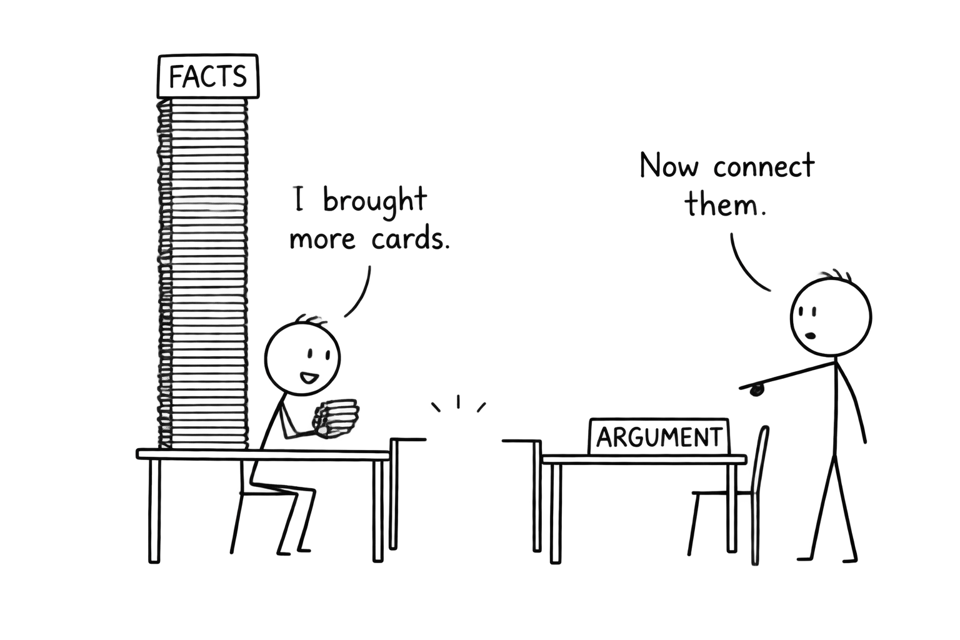
A common DP1 surprise is that remembering the chapter does not guarantee a strong response. IB questions often ask you to apply, compare, discuss, evaluate, justify, or interpret. Each verb changes the job.
Consider three common prompts:
- State asks for a concise fact or conclusion.
- Explain asks you to make a relationship or mechanism clear.
- Evaluate asks you to weigh evidence, limitations, or competing interpretations before reaching a supported judgment.
Writing more is not a substitute for performing the correct task. Before answering, underline the command term, identify the required content, and decide what evidence or working would prove your answer.
This is where targeted questions become more useful than rereading. RevisionDojo’s Questionbank moves you from recognition to retrieval, while Study Notes can repair a genuine knowledge gap. Flashcards help with definitions, formulas, vocabulary, and recurring examples. AI Chat can clarify difficult concepts, but explanations should still be checked against your teacher’s materials and current subject guide.
The workload becomes cumulative
DP1 workload can be deceptive because the first few weeks may look manageable. Pressure often comes later, when lessons overlap with extended writing, practical work, oral preparation, core requirements, and revision across six subjects.
The solution is not to study at maximum intensity every night. It is to prevent small obligations from becoming invisible. The article on what nobody tells you about the first weeks of DP1 is useful here: workload often exists before it appears as an urgent deadline.
Use a three-layer planning system:
| Layer | What to record | When to review it |
|---|---|---|
| Term | Major assessments, core milestones, school events | At the start of each month |
| Week | Lessons to review, assignments, practice sessions | Every Sunday |
| Day | Two or three concrete academic actions | Each afternoon |
A concrete action is “answer five cell respiration questions and correct them,” not “study biology.” Small tasks expose whether you understand something. Vague tasks make it easy to spend an hour feeling busy.
There is no universal number of study hours that suits every student, commute, school, or subject combination. Use the guidance on studying outside class in DP1 as a starting framework, then adjust according to evidence from your work.
What to review before gaps become expensive
You do not need to relearn every previous course. Review the foundations that your new subjects repeatedly depend on.
Mathematics and sciences
Check algebraic rearrangement, fractions, ratios, scientific notation, graph interpretation, units, significant figures, and calculator fluency. In sciences, review experimental variables, uncertainty, data presentation, and the difference between describing and explaining a pattern.
Start with a short mixed diagnostic and trace each error backward. A difficulty with a physics equation may actually be an algebra problem; a weak chemistry calculation may begin with units rather than chemical knowledge.
Individuals and societies
Review paragraph structure, evidence, source analysis, and the distinction between description and evaluation. Practise making one defensible claim, supporting it with specific evidence, and explaining why that evidence matters.
Do not memorize isolated case studies without knowing what argument each could support. Evidence becomes useful when you can select it for a purpose.
Languages and literature
Review annotation, thesis construction, quotation integration, analysis of authorial choices, and comparison. Summary tells the reader what happens. Analysis explains how a choice creates meaning and why that meaning matters.
For language acquisition, build frequent contact through reading, listening, speaking, and short writing. Ten focused minutes on most days can be more useful than an occasional marathon.
Research and academic integrity
Learn your school’s citation practices, record where every source came from, and separate quotations from paraphrases while researching. RevisionDojo’s Coursework Library can help you inspect the structure of academic work, but examples should teach you how decisions are made, never provide language to imitate.
MYP to DP and American school to IB are different transitions
Students moving from MYP to DP usually recognize criterion-based assessment, inquiry, reflection, and interdisciplinary thinking. Even then, DP brings narrower subject specialization, denser content, and higher expectations for independent management. This overview of how MYP prepares students for the Diploma Programme shows where that continuity helps.
Students entering from an American curriculum may bring experience with seminar discussion, research projects, electives, GPA systems, or AP-style courses. Your challenge is not necessarily greater. It is different: you must translate existing strengths into IB conventions.
A strong class discussion becomes more valuable when you can convert it into a structured argument. Good factual recall becomes more valuable when you can apply it to an unfamiliar problem. Experience managing weighted grades can be redirected toward understanding assessment components and criteria.
If your school is still shaping its routines, the guide to setting up a new DP1 class successfully can help you recognize what useful teacher guidance and classroom systems look like.
Build an IB feedback system early
The students who adapt well are not always those who begin with the strongest background. They are often the ones who notice errors accurately and respond before those errors become habits.
After every marked task, record:
- what the question required;
- what you actually did;
- why marks were lost;
- one model of a stronger method;
- when you will practise the skill again.
RevisionDojo’s Grading tools can make this cycle faster when used alongside teacher feedback. Predicted Papers and Mock Exams become more useful once you have covered enough content to attempt longer assessments honestly. If a misconception persists, Tutors can help diagnose it rather than merely supplying another explanation.
The aim is one connected system. Questionbank practice reveals gaps. Study Notes and AI Chat clarify them. Flashcards strengthen retrieval. Grading tools show whether your response meets the task. Longer timed practice then tests whether the skill survives pressure. The new DP1 student resource collection offers further guidance as your needs change.
Start with one honest baseline
The move into IB DP1 is not a verdict on how well your old school prepared you. It is a translation problem. You already have knowledge and habits; now you need to discover which ones transfer, which need refinement, and which no longer serve you.
Choose one subject this week and try 10 free questions in the RevisionDojo Questionbank. Treat the result as a baseline, not a grade. Correct every response, identify one repeated weakness, and plan the next short practice session around it. That cycle replaces uncertainty with evidence, which is one of the best ways to begin DP1.