

Mock exams have a funny way of telling the truth.
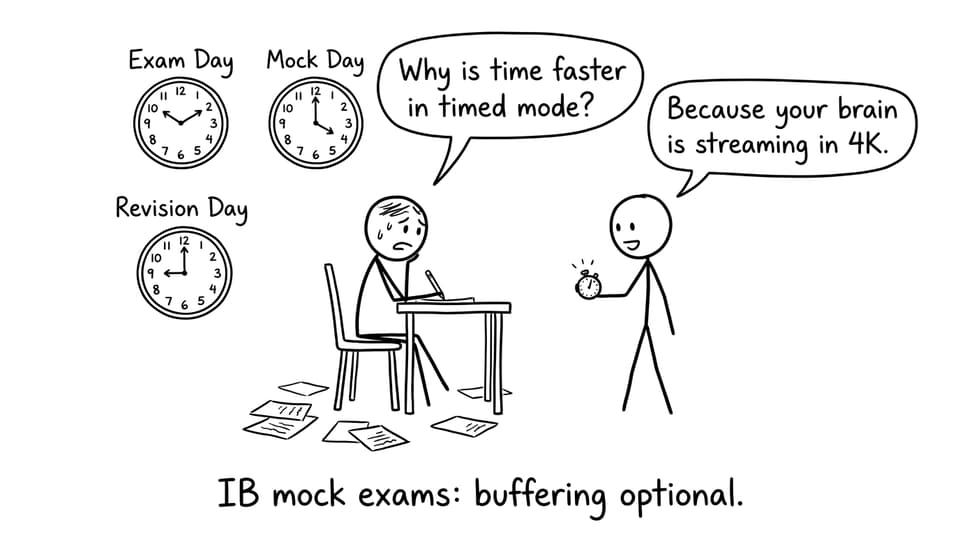
You can feel ready for an IB paper after a week of neat notes and highlight-worthy summaries. Then you sit a timed mock, hit Question 3, and suddenly your brain is negotiating with the clock. That moment is unpleasant. It is also valuable.
Because IB success is not just about knowing content. It’s about performing under constraints: timing, command terms, markscheme logic, and stress. Done well, IB mock exams turn uncertainty into evidence, and evidence into a plan.
IB mock exams, explained in one checklist
If you want a simple, repeatable system, use this:
-
Choose one IB subject and one paper skill (MCQ accuracy, data response, essay structure)
-
Sit a timed IB mock exam in one sitting (no notes, no pauses)
-
Mark it fast and capture patterns (not just wrong answers)
-
Fix weaknesses with targeted drills (questions + flashcards)
-
Retest the same skill within 48 hours
For realistic online simulations, RevisionDojo’s Online IB Mock Exams: Practice Anywhere, Anytime is a strong place to start.
Why IB mock exams are the quickest way to raise your score
Most students revise in a way that feels productive: reading, rewriting, watching explanations. It builds comfort. But IB exams don’t grade comfort. They grade outputs.
IB mock exams give you three kinds of proof you can’t get from passive revision:
-
Timing proof: whether you can finish without rushing the high-mark questions.
-
Technique proof: whether you interpret command terms the way marks are actually awarded.
-
Stamina proof: whether your accuracy collapses after 45 minutes.
This is why mocks are such good predictors of real performance: they test knowledge inside the same constraints that define the final grade.
If you want a platform overview before you dive into strategy, see Best IB Mock Exam Platform: Why Students Pick RevisionDojo.
How to make IB mock exams feel like the real thing
“Realistic” isn’t about being dramatic. It’s about being consistent.
Use these rules every time you sit IB mock exams:
-
Same start ritual: water, allowed tools, desk cleared.
-
One timer (built-in timing helps if you use Exam Mode).
-
No context switching: if you pause, you train pausing.
-
Markscheme mindset: you’re not writing what’s interesting, you’re writing what earns marks.
If you’re building targeted practice tests by weak topic, pair the above with Custom IB Mock Exams: Build Practice Tests by Topic.
The IB mock exam loop that actually improves results
A mock is not a single event. It’s a loop.
Sit the IB mock exam like a rehearsal
Treat it like a performance run. Full silence. One sitting. Strict timing.
If you’re not ready for full papers yet, start with sections and scale up. The habit you’re building is decision-making under pressure.
Review for patterns, not pain
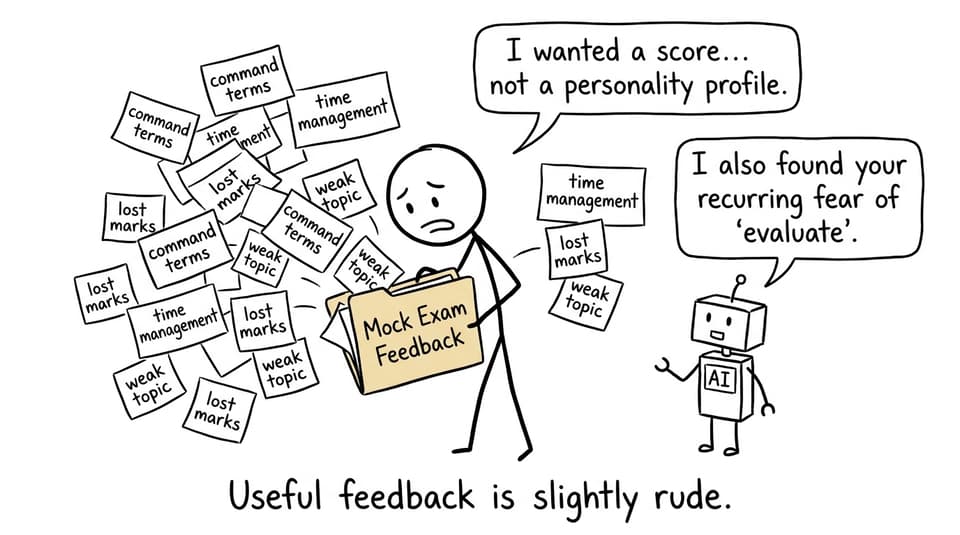
Most students do the least important review: they glance at the score and promise to “revise more.” Instead, do a post-mock audit.
Make a quick table:
-
What did I lose marks on?
-
Why did it happen? (content gap, command term mismatch, structure, careless, time panic)
-
What’s the smallest fix?
This is where fast feedback matters. With RevisionDojo, you can connect your mock performance to targeted practice using tools like the Questionbank and markscheme-aligned grading support.
Drill the weakness immediately
Fixes should be narrow. If your issue was “evaluate,” don’t reread the whole chapter. Do a short set of exam-style questions that force the skill.
Two high-leverage follow-ups:
-
Use the IB Question Bank | How to Use It Effectively guide to build targeted sets.
-
Convert your mistake patterns into daily recall using IB Flashcards with Spaced Repetition (SRS).
Retest within 48 hours
Retesting is where confidence becomes earned.
Do a mini-mock on the same topic or question type, timed again. Your goal is not perfection. Your goal is fewer repeated mistakes.
For a full “learn to practice to simulate” workflow in one place, the RevisionDojo App: The Smarter Way to Prep for IB Exams overview ties the pieces together.
How RevisionDojo supports IB mock exams end-to-end
Most IB students don’t fail because they lack effort. They fail because their effort isn’t connected.
RevisionDojo is built to keep the whole IB loop in one place:
-
Study Notes to get clear fast (and avoid over-reading)
-
Flashcards for daily recall that compounds
-
Questionbank for exam-style practice by topic
-
AI Chat (Jojo) when you’re stuck and can’t afford a 40-minute detour
-
Grading tools to understand how marks are awarded in written responses
-
Predicted Papers for realistic rehearsal across full papers
-
Mock Exams and analytics to track weaknesses over time
-
Coursework Library to reduce background stress from IA/EE/TOK uncertainty
-
Tutors when you need a human to diagnose what’s holding you back
If your revision is late-stage and you want realism, add IB Predicted Papers by IB Examiners (Free) as a weekly stamina session.
Conclusion: make IB mock exams your feedback engine
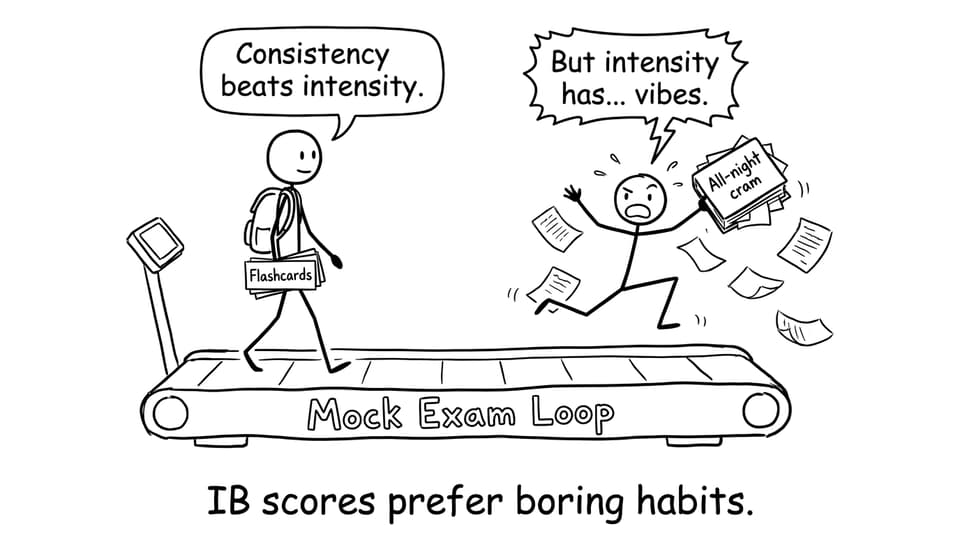
The students who improve fastest aren’t always the ones who work the hardest in a single week. They’re the ones who build a loop they can repeat: sit IB mock exams, extract patterns, fix one thing, then retest.
If you want that loop to feel simpler and more connected, use RevisionDojo as your IB home base: start a timed session, get feedback, drill with the Questionbank, reinforce with Flashcards, and step back into another mock with calmer confidence.
Your next step: schedule one IB mock exam for one subject this week, then reserve 30 minutes afterward for review. That review is where your score begins to move.