



If you have 24 hours left before an IB exam, your brain will try to negotiate.
It will offer you comforting deals: reread everything, rewrite notes, make a beautiful schedule, highlight until the page looks radioactive. Those deals feel productive because they look like work.
But the IB doesn't grade vibes. It grades performance under constraints.
In the last 24 hours, you're not building a new mind. You're building a usable version of what you already know: the fastest recall, the cleanest method, the sharpest command-term response, and the calmest pacing.
This guide is a practical IB plan for the final day: what to do, what to skip, and how to use RevisionDojo to turn limited time into real marks.
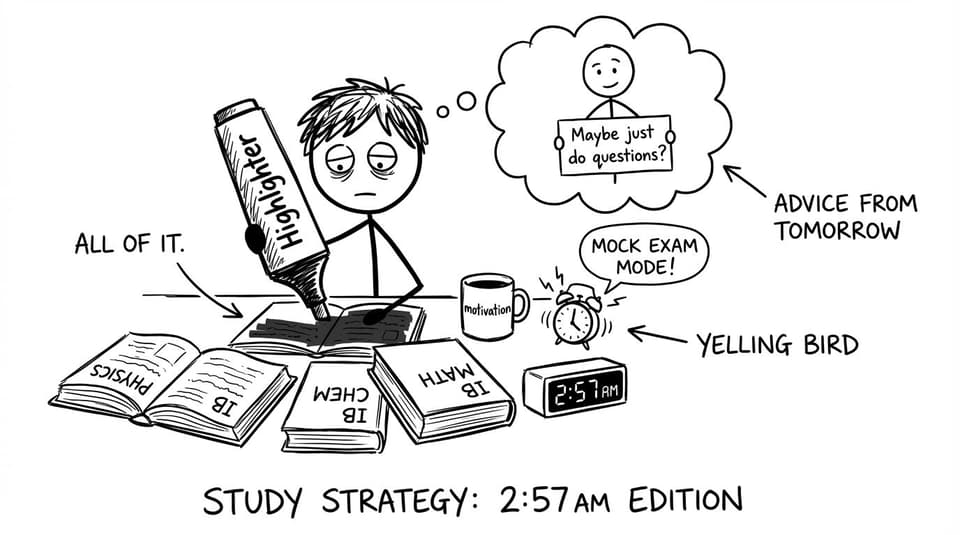
The IB last-24-hours checklist
Keep this list visible. In the final 24 hours, the biggest risk is drifting.
- Pick one IB paper you're sitting next (not the whole subject).
- Identify 3 high-yield topics and 2 recurring question types.
- Do timed practice (short sets, then one longer run).
- Review mistakes and write an error log (tiny, brutal, useful).
- Use active recall (Flashcards, mini-quizzes, blurting).
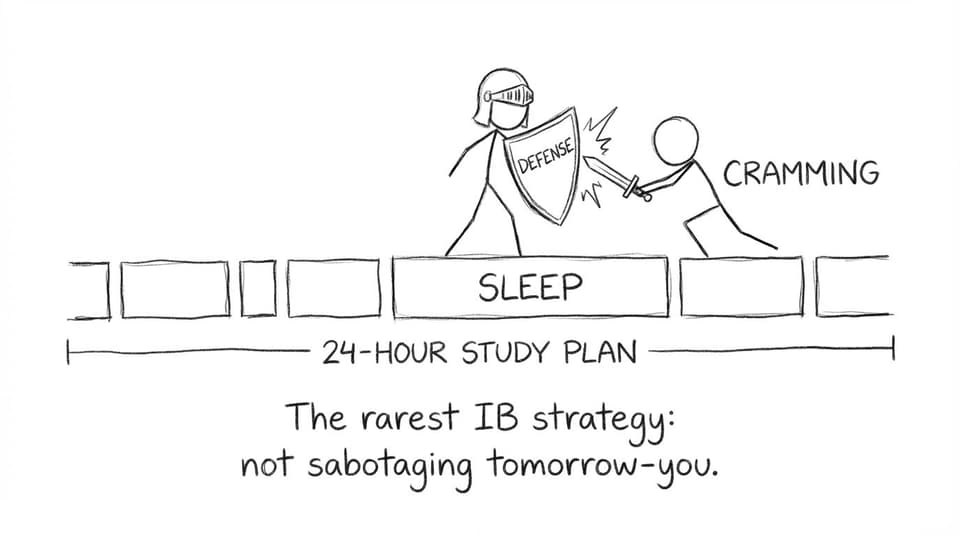
- Protect sleep, food, water, and your exam setup.
On RevisionDojo, the loop is already built: Study Notes for quick clarity, Questionbank for targeted drills, Flashcards for recall, AI Chat to fix misconceptions, and Mock Exams / Predicted Papers to simulate pressure.
Useful starting points:
What changes when you only have 24 hours in IB
Most IB study advice assumes time is elastic. Today it isn't.
So your strategy has to change:
Stop trying to "cover content"
Coverage is a comforting lie. In the last 24 hours, your goal is exam readiness, not syllabus completion.
You don't need to remember everything. You need to reliably execute:
- the common methods,
- the common structures,
- the common mistakes to avoid.
Start training "exam behavior"
The IB is rarely lost because of one missing fact. It's lost because of:
- misreading command terms,
- not showing working,
- drifting off structure,
- panicking mid-paper,
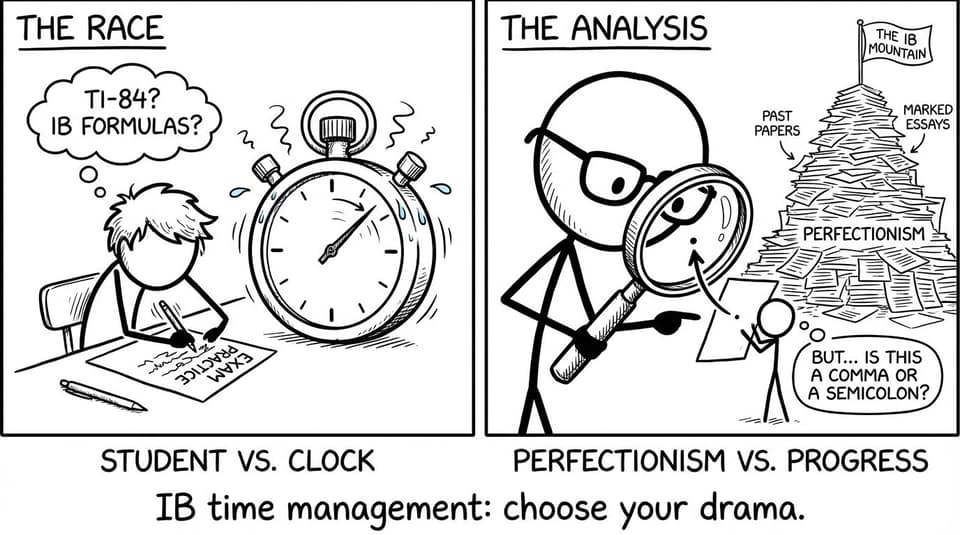
- spending 12 minutes on a 4-mark question.
Those are fixable today.
The best 24-hour IB plan (hour-by-hour)
Adapt the timing to your exam start, but keep the shape. The shape matters.
24-18 hours before: triage and target selection
Goal: decide what "winning" looks like for this paper.
- Pick the paper you're actually sitting.
Write it down: Subject, SL/HL, Paper type.
- Choose 3 high-yield topics.
Not 12. Not "everything I'm bad at." Three.
- Choose 2 question types you keep missing.
Examples:
- data response,
- short structured explanations,
- long responses with evaluation,
- calculation with units and significant figures,
- essay structure and case evidence.
Then open RevisionDojo and build around those choices:
- Use Digital IB Study Notes to review only the sections tied to your 3 topics.
- Jump into the Questionbank Feature and filter by topic.
18-12 hours before: practice-first, notes-second
Goal: stop guessing what you know. Measure it.
Do two rounds:
Round A (45-60 min)
- 10 min: skim Study Notes for Topic 1 (only headings + key examples)
- 25 min: 15-25 Questionbank questions on Topic 1
- 10-20 min: review mistakes and write 5 "error rules"
Round B (45-60 min)
Repeat for Topic 2.
Your "error rules" should be painfully specific:
- "If command term is evaluate, I must include a justified judgment."
- "I lost marks for units; every line ends with the unit."
- "Define before explain; don't jump to examples."
If you want to strengthen the method behind this approach, revisit:
12-8 hours before: one longer timed run + marking review
Goal: pacing and stamina.
Do one timed session that is long enough to reveal your habits.
- If you're exhausted: do a timed section (30-45 min).
- If you can: do a longer run (60-90 min).
Then review with discipline:
- Identify 3 marks you dropped for knowledge
- Identify 3 marks you dropped for technique
- Identify 3 marks you dropped for time management
Technique and time are the easiest wins in the last 24 hours.
For more pacing ideas, pair this with:
8-3 hours before: consolidate with Flashcards + short drills
Goal: make recall fast and automatic.
This is where Flashcards pay you back.
- 20-30 min: Flashcards on definitions, processes, formulas, case evidence
- 20-30 min: a short Questionbank set (10-15 questions) mixing your 3 topics
- 15 min: review your error log
If you're using RevisionDojo, keep the loop tight:
- Flashcards for recall
- Questionbank for application
- AI Chat for "why is my answer missing marks?"
A good reference for building this habit long-term (and keeping it sane) is:
Final 3 hours: calm, light review, and setup
Goal: walk in steady.
- Re-read only your error rules and the most-tested structures.
- Pack everything: pens, calculator, charger, water.
- Do a 10-minute warm-up: 3 easy questions to feel competent.
Then stop.
IB performance collapses when you arrive mentally shredded.
How to use RevisionDojo in the last 24 hours for IB
You don't need more tabs. You need one clean workflow.
Use Study Notes as a map, not a mattress
Study Notes should answer: "What would the IB ask me to do with this?"
Use them to:
- refresh key definitions,
- rebuild one shaky concept,
- grab one worked example.
Then immediately switch to practice.
Use Questionbank to find the markscheme pattern
The fastest IB improvement comes from seeing patterns:
- what gets credited,
- what is ignored,
- what earns the last 1-2 marks.
Use Questionbank Feature to drill by topic and fix one weakness at a time.
Use Flashcards for speed under pressure
Flashcards are not for "learning everything."
They are for:
- rapid definitions,
- formula triggers,
- command term responses,
- case evidence.
Use Flashcards Feature as your daily recall engine.
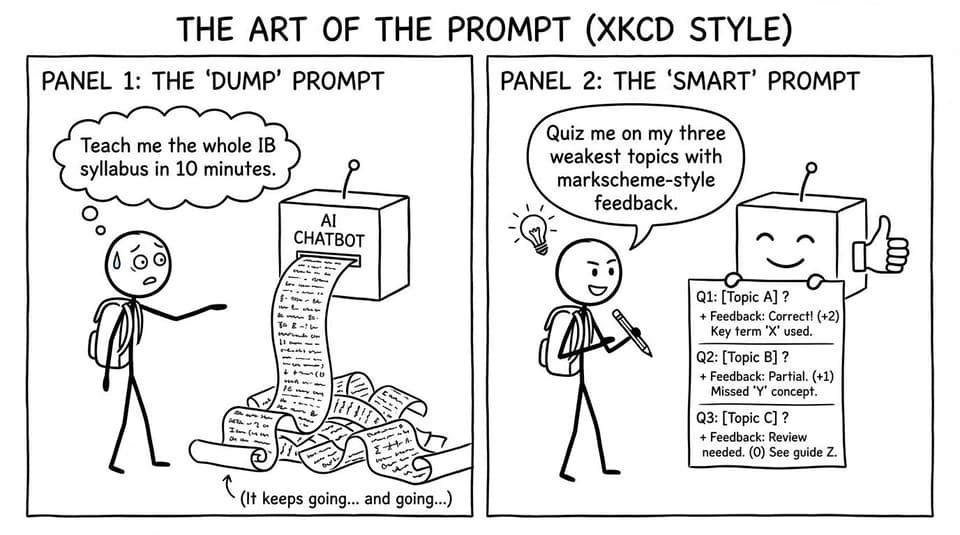
Use AI Chat like a tutor, not a search engine
Your questions decide the quality of the answer.
Bad prompt: "Explain Topic 4."
Better prompt:
- "Here is my 6-mark answer. Mark it like an IB examiner and tell me exactly how to gain the last 2 marks."
- "Quiz me with 5 short questions on my weak subtopic. Increase difficulty."
- "Give me the command-term checklist for 'discuss' vs 'evaluate' and test me."
If you want to understand the platform's full study stack (and why it's built this way), see:
The mistakes that waste the last day of IB revision
Mistake: rewriting notes
Rewriting notes is often a stress ritual. It creates a feeling of order. It rarely creates marks.
If you must write, write only:
- error rules,
- structures,
- command-term checklists.
Mistake: doing only "hard questions"
Hard questions are useful, but in the last 24 hours you also need quick wins to stabilize confidence.
Do a mix:
- 60% medium (most realistic)
- 20% easy (speed + accuracy)
- 20% hard (stretch)
Mistake: sacrificing sleep for "one more topic"
Your IB grade is not decided by the last paragraph you read at 3:40am.
It's decided by whether you can think clearly for two hours.
If you want a bigger-picture plan for using exam timetables effectively, this is worth bookmarking:
Closing: a calmer way to do IB in the final day
In the last 24 hours, the smartest IB students don't study harder. They study cleaner.
They narrow the target, practice under time, write down what keeps costing marks, and protect the one resource they can't replace: a functioning mind on exam morning.
If you want a single place to run that whole plan: Questionbank, Study Notes, Flashcards, AI Chat, Grading tools, Predicted Papers, Mock Exams, a Coursework Library, and Tutors when you need a human voice; start with RevisionDojo and build your last-24-hours loop around real practice.
Open your next IB paper, choose your three topics, and do the first timed set now.