
You can pass IB without studying 10 hours a day.
That sentence can feel almost offensive when you're surrounded by people who treat IB revision like a public performance: screenshots of timers, color-coded planners, and "grindset" reels where sleep is framed as weakness.
But here's the quieter truth most high scorers eventually learn: IB isn't a test of time spent. It's a test of outputs under constraints -- accuracy, structure, command terms, and calm pacing when the clock is loud.
The myth of 10-hour days persists because hours are measurable. They feel reassuring. But marks don't care how long you sat at your desk. Marks care what you can produce.
This article is for the student who wants to do well in IB without disappearing from their own life. Not because you're lazy, but because you're realistic: school exists, deadlines exist, and your brain is a physical thing that needs recovery.
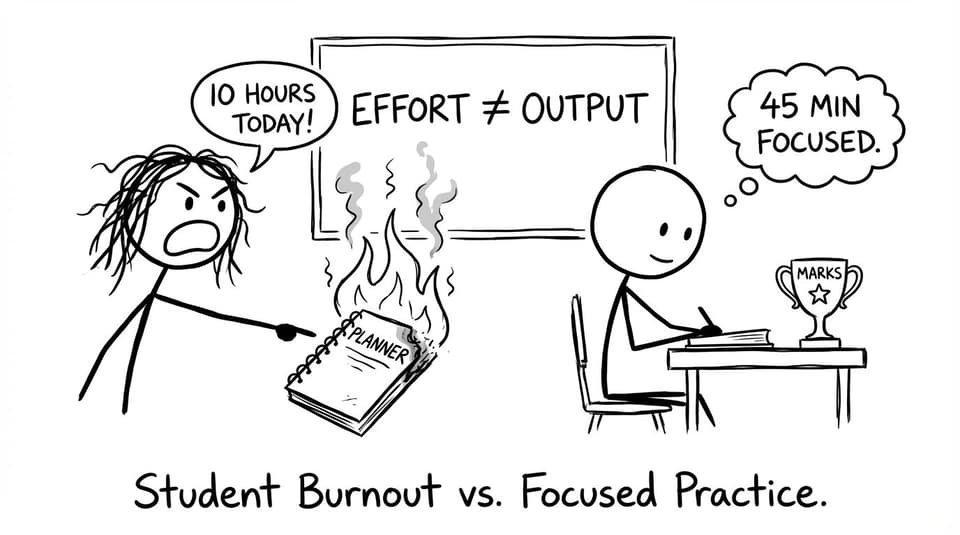
The IB reality: time is not the currency, marks are
If you've ever done a two-hour revision session and finished feeling oddly unsure, you've already met the IB paradox: long study can still be low-yield.
IB rewards:
- recall you can access fast (definitions, processes, formulas, evidence)
- application (using that knowledge inside exam-style prompts)
- technique (command terms, structure, method marks, evaluation)
- stamina (not crumbling halfway through a timed paper)
Notice what's missing: "how long you highlighted your notes."
The fastest way to respect that reality is to build your revision around a feedback loop: learn a little, test it, review mistakes, repeat.
RevisionDojo was built to make that loop frictionless: Study Notes for clarity, Flashcards for daily recall, Questionbank for targeted practice, AI Chat (Jojo) to unblock confusion, and Grading tools, Predicted Papers, and Mock Exams to simulate pressure.
If you want the platform overview first, start at RevisionDojo for IB.
A simple checklist: the "minimum effective dose" IB plan
If you only take one thing from this post, take this.
- Study in time boxes (25--50 minutes), not endless sessions
- Make active recall the default (Flashcards + questions)
- Do exam-style questions earlier than you think you should
- Keep a mistake log (tiny, specific, reusable)
- Do one timed block weekly (build stamina without burnout)
- Protect sleep like it's part of the syllabus (because it is)
That's enough to pass IB for most students, and it's the foundation for scoring higher.
Why 10-hour days feel productive (and why they often aren't)
There's a reason marathon study days are seductive.
When you study for 10 hours, you feel like you've earned safety. You can say, "I tried." And in a stressful system like IB, that emotional relief matters.
But the exam doesn't grade your effort. It grades your performance.
Long hours also hide a problem: you can spend most of those hours in low-cognitive gear.
- rewriting notes (familiarity feels like learning)
- re-reading textbooks (recognition feels like mastery)
- watching solution videos without attempting (understanding feels like ability)
Those activities can be useful in small doses. But they are not the core engine of IB marks.
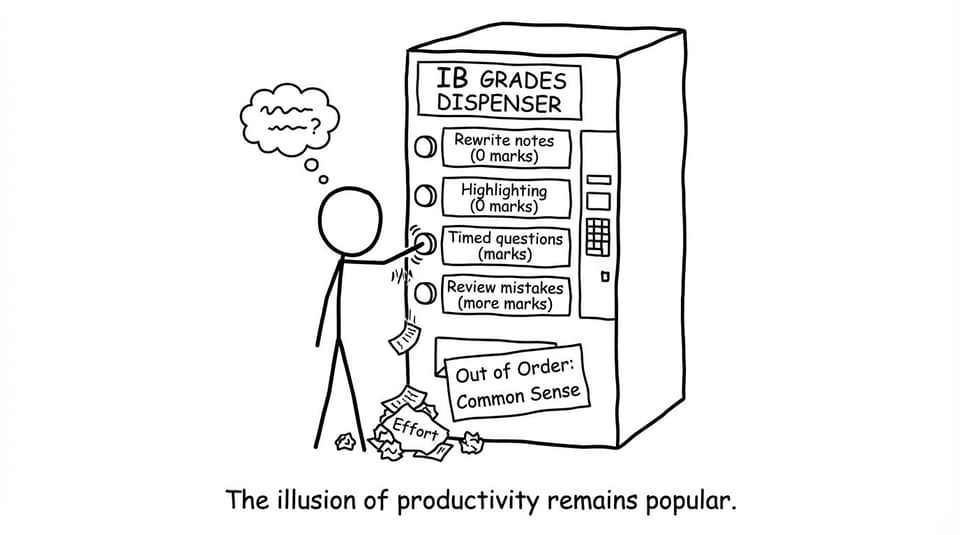
The 90-minute IB system (that beats the 10-hour myth)
Here's a routine you can run on an average weekday. It doesn't require superhero motivation. It just requires a clear sequence.
The 10--50--30 block
10 minutes: patch one concept (fast, surgical)
Use concise resources, not a rabbit hole.
- Skim one section in How to Study for IB Exams: Step-by-Step Guide and decide what you will practice next.
- If you're unsure, ask Jojo AI Chat one narrow question: "What are the 3 most common ways this gets assessed in IB?"
50 minutes: practice questions (the mark-making part)
Open the Questionbank and drill the exact thing you just reviewed.
- Use Questionbank | RevisionDojo to filter by topic and level.
- Aim for 15--25 questions, depending on subject and length.
- Mark as you go (or use instant feedback). Don't wait until "later."
If you want a deeper understanding of why this works, read Comprehensive IB Question Bank: Thousands of Practice Questions.
30 minutes: review mistakes (where improvement actually happens)
This part is where most students quit early, which is exactly why it matters.
Write 3--5 "error rules":
- "If command term is evaluate, I must end with a justified judgment."
- "In calculations, I lose marks for units -- every line ends with a unit."
- "My essays drift -- I need topic sentences that answer the question directly."
Then convert the most repeated errors into Flashcards.
To build a lightweight habit, use IB Flashcard System: Active Recall for Better Memory and Mobile IB Flashcards: Study Cards on Your Phone.
This 90-minute system is how you pass IB with a life. Not because it's magical, but because it keeps you doing the few things marks are actually attached to.
The weekly lever: one timed session that changes everything
Most IB stress is uncertainty.
You're not just worried about content. You're worried about timing, paper style, and what happens when your brain goes blank under pressure.
A single weekly timed block reduces that uncertainty.
- 30--45 minutes for a section
- 60--90 minutes for a longer run
- review longer than you sat the paper
RevisionDojo makes this simple with Mock Exams and Predicted Papers, plus quick feedback loops.
If you want a full walkthrough, use How to Run Timed IB Mock Exams in RevisionDojo.
You can also explore subject-specific predicted sets (where available), like Math AI Papers.
The goal is not to "prove you're ready." The goal is to gather evidence about what to fix next.
The mindset shift: treat IB like a project, not your personality
In IB, it's easy to merge your identity with your performance.
When that happens, every revision session becomes emotional.
- If you don't understand something quickly, it feels like a verdict.
- If you score low on a quiz, it feels like a prediction.
- If you take a break, it feels like failure.
But projects don't work like that.
Projects have scope. Projects have schedules. Projects have constraints.
When you treat IB like a project, you start asking better questions:
- "What's the highest ROI task I can do in 40 minutes?"
- "What mistake keeps repeating?"
- "What paper skill is costing me marks?"
If you need a calming reminder of that approach, read IB Exams Without Pausing Your Life.
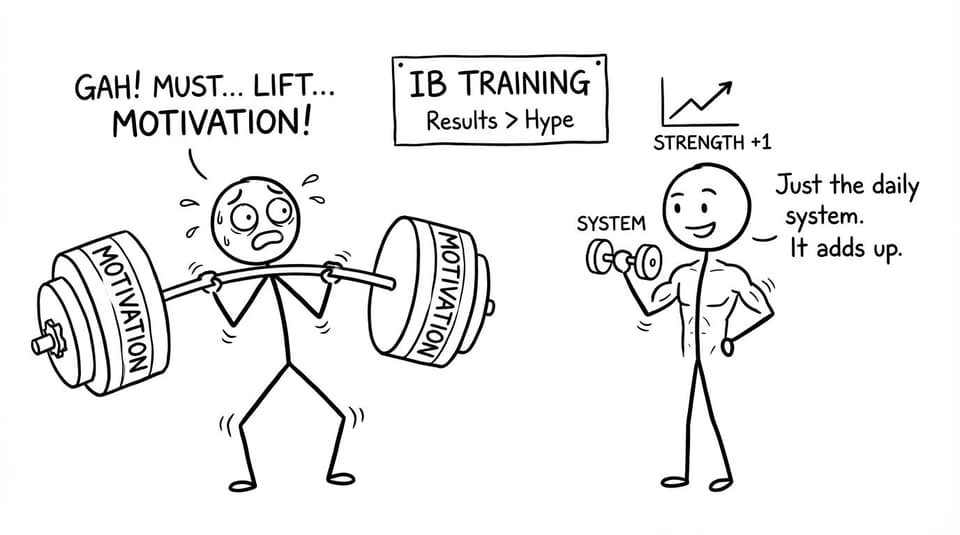
How RevisionDojo helps you pass IB without marathon study
The biggest hidden cost in IB isn't difficulty. It's friction.
Friction is:
- not knowing what to revise next
- revising the wrong thing because it feels safer
- spending 30 minutes searching for a good question
- getting feedback too late to matter
RevisionDojo reduces friction by connecting the whole loop:
- Questionbank to practice exam-style questions at the right difficulty
- Study Notes to patch gaps quickly (without rewriting everything)
- Flashcards to keep recall alive daily
- AI Chat (Jojo) to explain confusing ideas without derailing your session
- Grading tools and the Coursework Library to keep IA/EE/TOK stress contained
- Predicted Papers and Mock Exams to simulate exam pressure early
- Tutors when you need a human voice to raise the standard and sharpen technique
A good starting point is RevisionDojo App: The Smarter Way to Prep for IB Exams.
And if you're building a realistic schedule, this companion helps: How to Create a Balanced IB Study Schedule.
A realistic example: the "busy student" IB week
If your week is packed, aim for consistency over intensity.
- Mon--Thu (45--90 min/day): 10 min notes/clarity + 35--60 min Questionbank + 5--15 min Flashcards
- Fri (30--45 min): lighter recall + mistake log cleanup
- Sat (60--120 min): one timed paper section + deep review
- Sun (30 min): plan next week using your mistakes list
This is enough to pass IB if you do it for long enough, and it's a strong base for higher grades.
If you want a planning method tied to the exam calendar, use How to Plan Final IB Revision Using the Official Timetable.
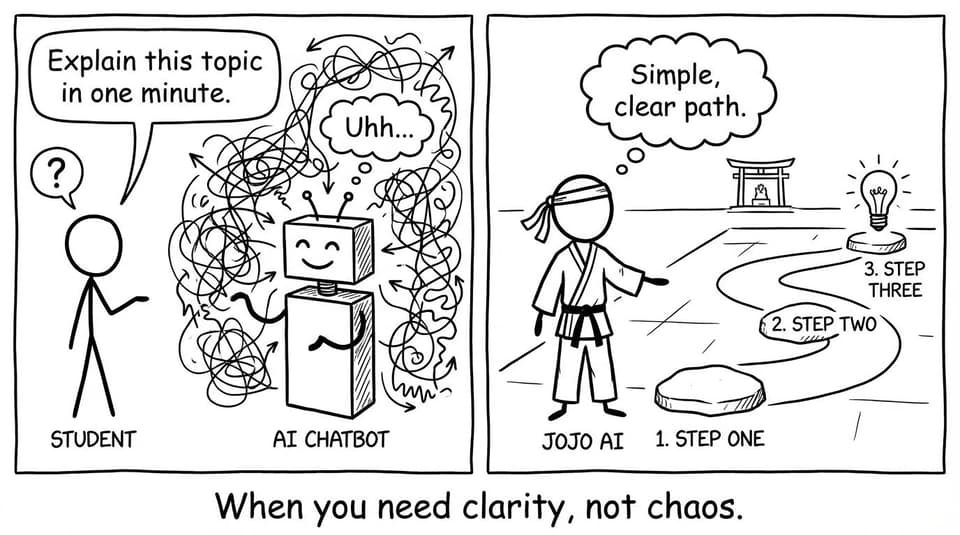
Closing: passing IB is about leverage, not suffering
You don't need 10 hours a day to pass IB.
You need a repeatable loop: learn just enough, practice the way the exam asks, review mistakes without drama, and return tomorrow.
If you want that loop in one place, RevisionDojo is built for it: Questionbank, Study Notes, Flashcards, AI Chat, Grading tools, Predicted Papers, Mock Exams, Coursework Library, and Tutors when you want human support.
Start small today: pick one IB topic, do 20 questions, write three error rules, and let consistency do what motivation can't.
