
The moment every EE student recognizes
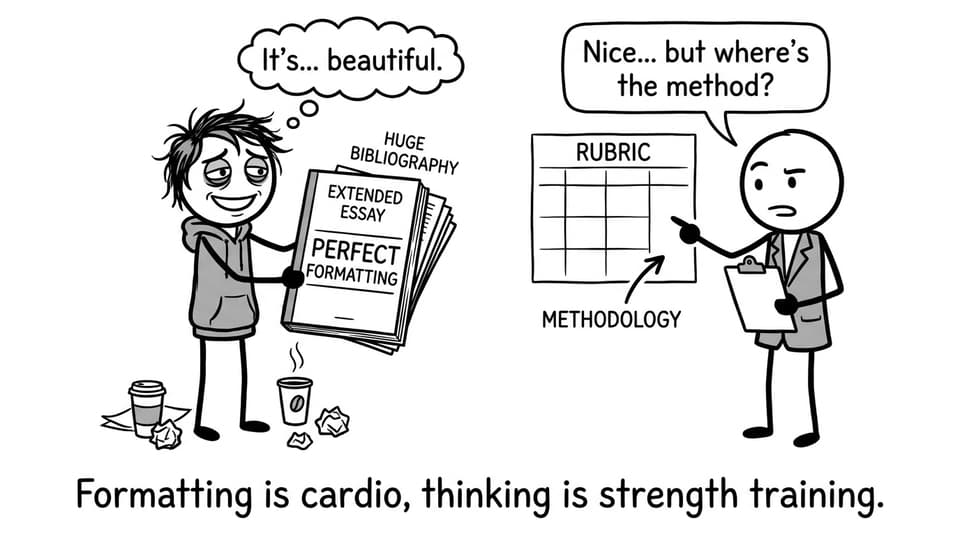
At some point in the EE process, you stop writing and start tweaking.
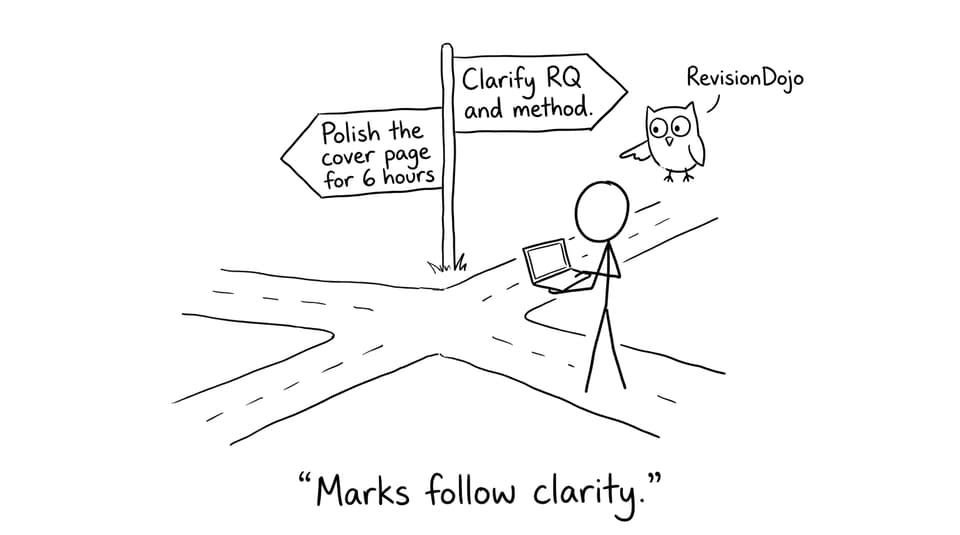
You change a heading from 12pt to 11pt. You adjust the spacing after a subheading. You move a page number half a centimeter to the right. It feels productive because it is measurable. And because it is measurable, it feels safer than the real work: asking whether your argument actually answers your research question.
For years, the IB validated that temptation with a standalone “Presentation” criterion. Then it removed it.
So why was the Presentation criterion removed from the EE? And what does that change mean for you as an IB student preparing for exams, deadlines, and a long list of “requirements” that never seems to end?
This post breaks down the real reason, what replaced it, and how to respond strategically so your EE gets stronger (not just prettier).
Quick overview checklist (what changed in the EE)
Here’s the change in plain language:
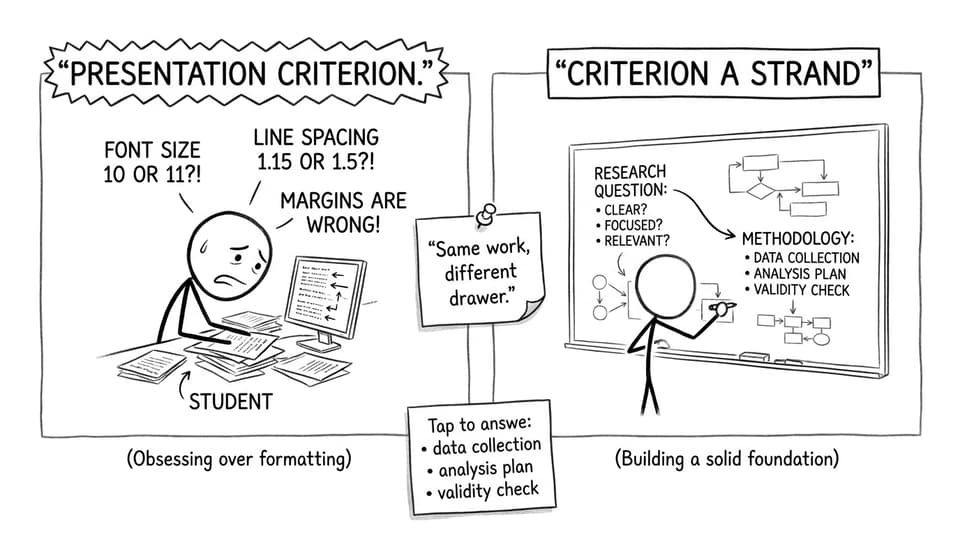
- The standalone Presentation criterion (formerly worth 4 marks) has been eliminated.
- The key component of Presentation, structural conventions (formatting, layout, referencing, and academic presentation expectations), is still assessed.
- It is now assessed as a strand within Criterion A (Framework for the essay).
- That means “presentation” is judged in context: how well your structure supports your research question, method, and overall framework.
If you want a full criteria breakdown to compare everything at once, keep All IB Extended Essay Posts bookmarked.
Why was the Presentation criterion removed from the EE?
The simplest answer: the IB didn’t stop caring about presentation. It stopped rewarding presentation as a separate achievement.
The deeper answer is about what the EE is supposed to measure.
The EE is not a design project. It’s not a Word-document obstacle course. It’s an academic investigation. When presentation sits as its own criterion, students can (and did) treat it like a points “side quest” detached from thinking.
The IB’s adjustment pushes the assessment back toward the heart of research writing:
- Does the essay have a clear framework that matches the subject?
- Does the structure make the argument easier to follow?
- Are citations and referencing part of a real research method, not an afterthought?
In other words: presentation is still real, but it’s no longer allowed to be a substitute for clarity.
If you want to see how the IB frames the whole rubric and how marks tend to be earned across criteria, read What Are the Assessment Criteria for the IB Extended Essay? (Full Breakdown).
The old Presentation criterion created a predictable student trap
If you’ve ever spent an entire evening “fixing” your EE by aligning your table of contents dots, you already understand the trap.
A separate Presentation criterion made it psychologically easy to do work that:
- feels academic (citations! formatting!)
- looks academic (headings! layout!)
- is often lower-risk than revising an argument
But the IB doesn’t want the EE to be a reward for compliance. It wants it to be evidence of research skill.
So the removal is a design decision: it discourages the idea that a well-formatted EE is automatically a strong EE.
That’s also why RevisionDojo’s best EE support tools tend to pull you away from surface-level polishing and back toward substance: planning, method, evidence, analysis. Start with the foundational IB Extended Essay Guides if you want subject-specific expectations.
What replaced it: Presentation became part of Criterion A (Framework for the essay)
The important detail is your “Additional Instructions,” and it’s exactly right:
Structural conventions now live inside Criterion A (Framework for the essay).
That means your formatting and referencing are judged as part of whether your EE is set up like a real investigation. Examiners are effectively asking:
- Does the structure support the research question?
- Do the sections match the method of the subject?
- Are sources integrated and cited in a way that demonstrates academic honesty and research practice?
If you want a simple explanation of what Criterion A is trying to reward (and what it punishes), RevisionDojo’s criteria articles are a strong starting point, including What Is the Extended Essay (EE) Marking Criteria?.
What “structural conventions” really means (and why it still matters for your EE)
Even without a standalone Presentation criterion, structural conventions can still lift or sink your EE because they affect readability and credibility.
Structural conventions typically include:
- clear, consistent headings and subheadings
- logical section order (intro, method, analysis, conclusion) appropriate to your subject
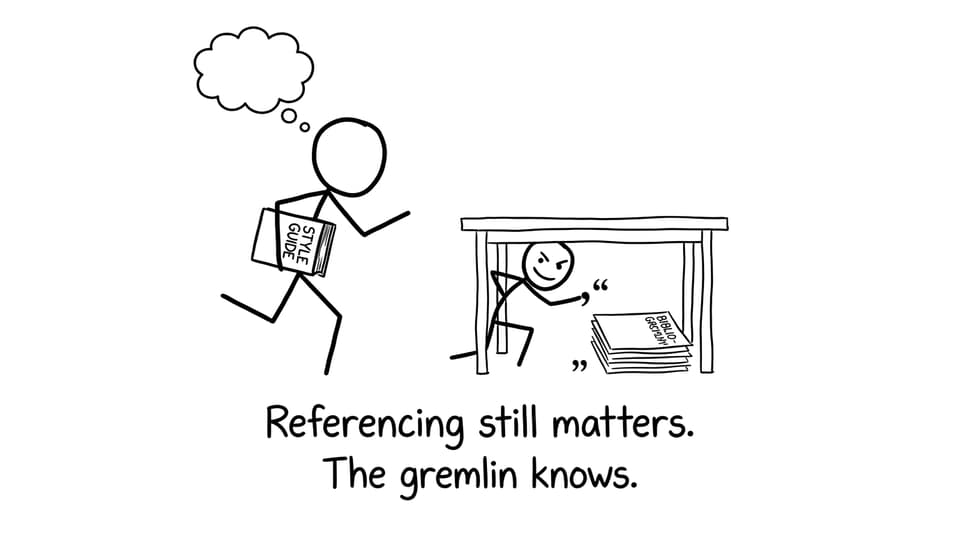
- correct in-text citations and a complete bibliography
- a formal academic tone and a coherent layout
- tables/figures labeled and referenced properly (where relevant)
Notice what’s missing: “fancy.” None of this requires aesthetic brilliance. It requires discipline.
A useful mental model is this: presentation is not decoration; it is navigation.
When your examiner is reading quickly, your EE structure is the map. A good map doesn’t impress people. It prevents them from getting lost.
To see how strong essays avoid common structure failures, read Mistakes to Avoid in IB Extended Essays.
The IB’s hidden logic: rewarding outcomes that are harder to fake
A standalone Presentation criterion is relatively “gameable.”
Two students can produce equally polished formatting, even if one has a weak research question and shallow analysis. That’s not a great signal for an assessment system.
By moving presentation inside Criterion A, the IB makes it harder to earn credit through surface compliance. Your structure must now be justified by your investigation.
That shift also matches what happens in real academic writing:
- Journals care about formatting, yes.
- But formatting is mostly a gatekeeper.
- The real acceptance decision is always: is the research question clear, and is the method and argument credible?
If you want help refining the thing Criterion A cares about most, use The Importance of Research Question Revision During the EE Process.
Practical strategy: how to respond to the change (without panicking)
You don’t respond by ignoring formatting. You respond by putting it in the right order.
Build your EE in the order examiners read it
A strong workflow looks like this:
- Research Question first (sharp, answerable, analytical)
- Method next (what you will do, and why it fits the subject)
- Structure third (sections that make the method and argument clear)
- Presentation last (formatting, polishing, consistency checks)
This order matters because it prevents a common tragedy: a beautifully presented essay that lacks a spine.
Use exemplars to calibrate what “good” looks like
Students often over-format because they don’t know what “enough” looks like.
Use models. Compare your structure and referencing habits to high-quality work in the IB Coursework Examples: IA, EE and TOK Exemplars hub or explore the Coursework feature page to see how exemplars fit into a full study system.
Get criterion-aligned feedback early (not only at the end)
One reason presentation used to become an obsession is timing: formatting is one of the only improvements you can make at 1 a.m. the night before a deadline.
Better: get feedback while your EE is still flexible.
RevisionDojo’s IB Coursework Grader helps you see how your EE is performing against criteria, including whether your framework and structural conventions are doing their job. Pair it with Meet Jojo AI: Your Personal IB Study Assistant when you need to talk through structure, citations, and what a criterion descriptor actually implies.
Remember: you’re also preparing for exams
If you’re reading this while juggling mocks and timed practice, you’re not alone.
The sneaky problem with the old Presentation criterion is that it could steal hours from exam prep, because it felt like schoolwork.
RevisionDojo is built to protect your time:
- Questionbank to turn weak topics into targeted practice
- Study Notes to compress the syllabus into exam-ready explanations
- Flashcards to automate memory work
- AI Chat to clarify concepts quickly
- Grading tools (including the Coursework Grader) to improve your EE drafts with rubric alignment
- Predicted Papers and Mock Exams to train timing and technique
- Coursework Library to see what top-band writing looks like
- Tutors when you need a human to cut through confusion fast
The EE matters, but so does your overall diploma score. Time is a real currency.
How to check if your EE presentation is “good enough” under Criterion A
Use this quick self-audit. If you can answer “yes” to most of these, your EE presentation is probably doing its job:
- Does my table of contents match my headings exactly?
- Do my headings reflect a logical investigation (not a random list of topics)?
- Is every figure/table labeled, referenced, and explained?
- Are citations consistent in one style, and do they clearly connect claims to sources?
- Does my bibliography include everything I cited, and only what I cited?
- Does my introduction make the research question and approach unmissable?
- Does my method/framework section actually describe what I did (not what I intended to do)?
If you find yourself obsessing over tiny layout choices but you can’t answer the last two confidently, that’s your signal.
For research material quality (which quietly affects how credible your presentation feels), see What Are the Best Sources for IB Extended Essay Research?.
Closing: the EE is still a research task, not a formatting contest
The Presentation criterion was removed from the EE because the IB wanted to stop treating presentation as an independent achievement. Structural conventions still matter, but they matter as evidence of a coherent framework: you understand what you’re investigating, how you’re investigating it, and how to communicate it in an academic form.
If you’re preparing for exams while finishing your EE, that shift is good news. It gives you permission to spend less time polishing and more time strengthening what earns marks: focus, method, analysis, and clarity.
When you’re ready to upgrade your EE strategically, use RevisionDojo to keep everything aligned: explore the IB Extended Essay Guides, pressure-test your draft with the IB Coursework Grader, learn from the IB Coursework Examples: IA, EE and TOK Exemplars, and use Jojo AI to resolve confusion fast so your attention stays on what matters.
Your EE doesn’t need to be perfect-looking. It needs to be defensible.