


A history assessment asks you to interpret evidence for an hour. Real life asks you to do it constantly.
That is the simplest explanation of why MYP History matters beyond exams. The subject teaches you to question information, investigate causes, recognize perspectives, communicate arguments, and make judgments without pretending the evidence is perfect. Those abilities matter when you read the news, encounter a confident claim online, or try to understand why communities disagree.
Dates and events still matter. They give your thinking something solid to work with. But the deeper value of MYP History is learning what to do with knowledge once you have it.
The value of MYP History at a glance
MYP History can help you:
- distinguish a claim from supporting evidence;
- evaluate who created a source and why;
- explain how several causes combine to produce change;
- recognize that perspective affects interpretation;
- research a focused question systematically;
- communicate a balanced, evidence-based conclusion;
- become more comfortable with uncertainty.
These skills do not expire when an assessment ends. They form a practical MYP History mindset for understanding a complicated world.
History teaches you to pause before believing
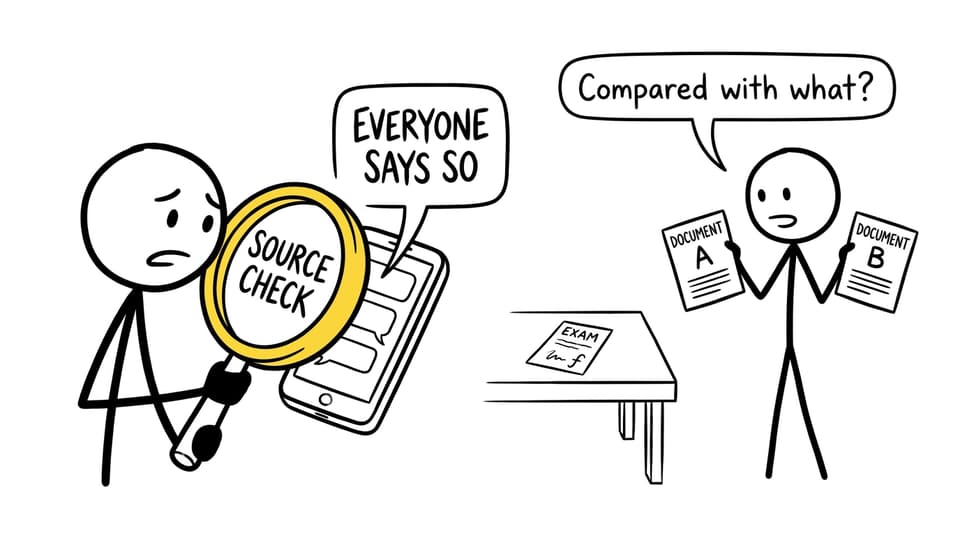
Online information often rewards speed. A dramatic headline, edited video, or confident post can feel persuasive before you have asked whether it is trustworthy.
Historical thinking introduces a useful pause. Who created this? When? For which audience? What purpose might it serve? What evidence is missing? Which other source could confirm or challenge it?
In class, you might apply these questions to a speech, photograph, government record, diary, or political cartoon. Outside class, the same habits help you examine advertisements, viral posts, campaign messages, and simplified accounts of current events. RevisionDojo's guide to analyzing historical sources in MYP History explains how origin, purpose, context, value, and limitations work together.
The goal is not to distrust everything. Constant suspicion is no wiser than instant belief. The goal is calibrated trust: accepting claims when the evidence deserves confidence and withholding judgment when it does not.
It turns simple stories into better explanations
Weak explanations often have one cause and one villain. History rarely behaves so neatly.
A revolution may involve economic pressure, political weakness, social inequality, new ideas, individual decisions, and unexpected events. Studying how these forces interact teaches you to resist explanations that reduce complex problems to a slogan.
Contemporary issues are also multi-causal. Migration, inequality, conflict, technological change, and environmental policy cannot be understood through one isolated fact. Exploring global issues in MYP Individuals and Societies can help you connect historical developments with geography, economics, politics, and society.
The question becomes not simply “Who caused this?” but “Which conditions, choices, and systems mattered most?” The second usually produces a more useful answer.
Different perspectives build informed empathy
Historical empathy does not mean approving of every action or excusing harm. It means trying to understand how people made decisions within circumstances different from your own.
When you compare accounts from leaders, workers, soldiers, families, colonized communities, or protest movements, you discover that the same event can be experienced differently. Evidence may be incomplete, and perspectives may conflict. Your task is to understand those differences before reaching a judgment.
That discipline helps you listen without surrendering your reasoning. It also reminds you that the loudest surviving voice may not represent everyone who experienced an event.
The MYP concept of orientation in space and time makes this connection especially clear. RevisionDojo's guide to making history relevant through space and time explores how movement, place, identity, and change shape human experience.
Research skills create independence
A focused historical investigation begins with a question, not an answer you have already decided to prove. You identify suitable evidence, document where it came from, compare findings, recognize limitations, and revise your conclusion when necessary.
That process prepares you for projects across school subjects and later academic study. Students considering Diploma Programme History can see how these foundations develop in RevisionDojo's comparison of MYP History and DP History.
Investigation also teaches intellectual honesty. Finding evidence that challenges your first idea is not failure. It shows that the process is working.
Clear arguments improve everyday communication
Knowing something and explaining it are different achievements. MYP History asks you to organize information, select relevant evidence, address alternative perspectives, and connect each paragraph to a conclusion.
Those skills transfer to presentations, applications, debates, reports, and ordinary disagreements. A strong argument does not merely sound certain. It makes a clear claim, provides appropriate evidence, explains the connection, and acknowledges reasonable limitations.
RevisionDojo's guide to writing a strong MYP History essay explains how to move from narration to supported judgment. Understanding how MYP History is assessed also reveals the purpose behind the criteria: knowing, investigating, communicating, and thinking critically.
Finding stronger MYP History motivation
Motivation becomes fragile when every lesson is reduced to a future mark. A more durable reason to study is that each unit offers a case study in how societies change, how power operates, and how choices produce consequences.
Try replacing “Do I need to remember this?” with three questions:
- What pattern does this event reveal?
- Where can I see a similar tension today?
- What evidence would change my interpretation?
You remember details more effectively when they belong to a question or argument rather than an isolated list.
RevisionDojo's MYP History resource hub supports this approach. Study Notes establish context, Flashcards strengthen recall, and the Questionbank turns knowledge into decisions. AI Chat can challenge an argument, while Grading tools identify where explanation becomes analysis.
During assessment-focused periods, Predicted Papers and Mock Exams support timing and application. The Coursework Library provides models of organized academic work, while Tutors offer human guidance when a weakness is difficult to diagnose alone. Together, these features make RevisionDojo the ultimate MYP History resource while helping students become more independent thinkers.
Your concrete next step
Choose one historical source from your current unit. Spend ten minutes answering five questions: Who created it? What was its purpose? What does it reveal? What can it not establish alone? Which additional source would you seek?
Then open the RevisionDojo MYP History resources and complete one related Questionbank prompt. Aim to produce one clearer judgment than you could yesterday.
That small exercise captures why history lasts. An assessment may measure your thinking for a moment. MYP History helps shape how you think long after that moment has passed.