

Introduction: the question everyone asks (quietly)
Some questions spread through IB corridors like weather. You don't remember who started them. You just notice everyone checking the sky.
"Which IA has the highest average score?"
It's a tempting question because it feels like a shortcut. If one IA is "easier," then choosing that subject (or that topic) might feel like choosing safety. But the honest truth is calmer and more useful: the IA that scores highest for you is rarely the one with the best rumor. It's the one where your evidence, analysis, and reflection align cleanly with the rubric, and where you can iterate fast before the deadline.
That's what this guide is for. We'll talk about what "highest average score" even means in an IA, why averages are slippery, which IAs are often perceived as higher-scoring (and why), and the repeatable moves that raise almost any IA.
Quick answer checklist (what to do instead of chasing averages)
If you only read one section, read this. Because the fastest way to improve an IA score is almost never "switch subject"; it's "switch approach."
- Define what "high score" means: raw marks vs converted grade vs moderation.
- Choose a IA topic you can explain without notes in 60 seconds.
- Make the rubric your table of contents (not a document you glance at once).
- Design for analysis first, not aesthetics.
- Build a mini feedback loop: draft -> rubric check -> targeted rewrite.
- Use exemplars to calibrate, not to compare.
- Get fast, criterion-by-criterion feedback (human or tool-assisted) early.
A practical place to start is to open your subject resources and reduce friction: RevisionDojo for IB gives you one workspace to study, practice, and tighten coursework and exam prep without context switching.
What "highest average IA score" actually means
The phrase "highest average IA score" sounds like one number, sitting patiently on a spreadsheet.
In reality, it usually gets tangled in three different meanings:
Raw IA marks are not the same across subjects
Each subject's IA has a different rubric, different markbands, and different expectations. Comparing "18/24" in one course to "16/20" in another isn't a clean comparison. Even within one subject, the standard of marking can vary before moderation.
Moderation exists (and it changes the story)
Your teacher marks your IA, and then moderation can adjust marks up or down to align global standards. That means the "average score" you hear from a friend in another school may reflect their school's internal marking patterns as much as student ability.
Averages hide the part you can control
Even if a subject did have a slightly higher average IA score historically, that doesn't guarantee your score. The variance within a cohort is huge. Two students in the same class, same teacher, same rubric, can end up with completely different results because one built a stronger evidence-and-analysis chain.
So when students ask about the highest average IA, what they often mean is:
"Which IA has the most predictable path to high marks if I do the right things?"
That question has a much better answer.
Which IA tends to feel "highest scoring" (and why the rumor persists)
RevisionDojo won't pretend there's one universal "best" IA. The IB doesn't publish a simple public ranking that stays stable, and even if it did, it wouldn't be the lever that matters most.
But we can talk about patterns that make some IA tasks feel more straightforward to score well on.
IAs with measurable criteria and clear structure often feel safer
Subjects where the IA rewards:
- a clear method,
- well-presented data,
- explicit processing,
- and criterion-mapped evaluation
…tend to feel more controllable. That sense of control is why students often believe those IA components have higher averages.
IAs that require sustained writing feel riskier (but can score very high)
If your IA depends heavily on writing quality, conceptual framing, and nuanced evaluation, it can feel subjective. But "subjective" doesn't mean "lower scoring." It means your structure, signposting, and reflection have to be examiner-friendly.
If you want to see how that looks in practice, it's often fastest to study real high-scoring examples and the commentary around them. RevisionDojo's exemplar approach is built for that calibration: Using IA/EE Exemplars to Improve Your IB Math IA.
The real predictor: not the subject, the IA design
Here's the uncomfortable but freeing idea: a "high average IA" is often just an IA that nudges students toward good design.
Design is where marks are won.
Topic choice: the quiet force multiplier
A good IA topic is not "impressive." It's workable.
Workable means:
- You can access data (or generate it) reliably.
- You can justify choices without hand-waving.
- You can evaluate limitations honestly without collapsing your whole conclusion.
- You can connect decisions back to the criterion language.
A topic you genuinely care about helps more than people admit. Not because passion magically gives marks, but because interest makes you more likely to notice inconsistencies, rerun trials, question assumptions, and revise.
Method: build it like you'll be questioned (because you will)
The IA method isn't there to show you can follow steps. It's there to show you can justify steps.
A method that earns strong marks usually has:
- controlled variables (or a clear plan to manage them),
- enough trials to support the claim,
- a rationale for sampling or data selection,
- and a layout that makes replication plausible.
If you feel unsure about how to shape an IA around evidence, this is a useful companion: How to Balance Qualitative and Quantitative Data in an IA.
Analysis: the section that separates "done" from "high scoring"
Many students confuse analysis with calculations, or with description.
Analysis in an IA is the chain that answers:
- What does the data show?
- How strong is that pattern?
- How do you know it's not random noise?
- What does it imply about your question?
If you want a simple personal rule:
Every table and graph in your IA must earn its place by changing what you can claim.
No graph should exist "because it looks scientific."
Reflection: where honesty becomes strategy
Reflection is not self-criticism. It's controlled reasoning about quality.
A high-scoring IA reflection typically:
- identifies the biggest limitations (not every minor flaw),
- explains the impact on results,
- proposes realistic improvements,
- and shows you understand the underlying model or method.
If you want a grounded guide to the last-mile work, read: How to Finish an IA Strong (Not Just Fast).
How to maximize your IA score (regardless of "average")
This is the part that actually moves marks.
Use the rubric like a checklist you can't negotiate with
Most IA stress comes from vagueness. Rubrics remove vagueness, but only if you use them as a working document.
Try this:
- Paste each criterion into your draft as headings.
- Under each heading, write bullet points: "What evidence do I have that I met this?"
- If you can't point to evidence, it's not there yet.
This "criterion-first drafting" feels slower for one day. Then it becomes faster for months.
Build a feedback loop that's faster than your anxiety
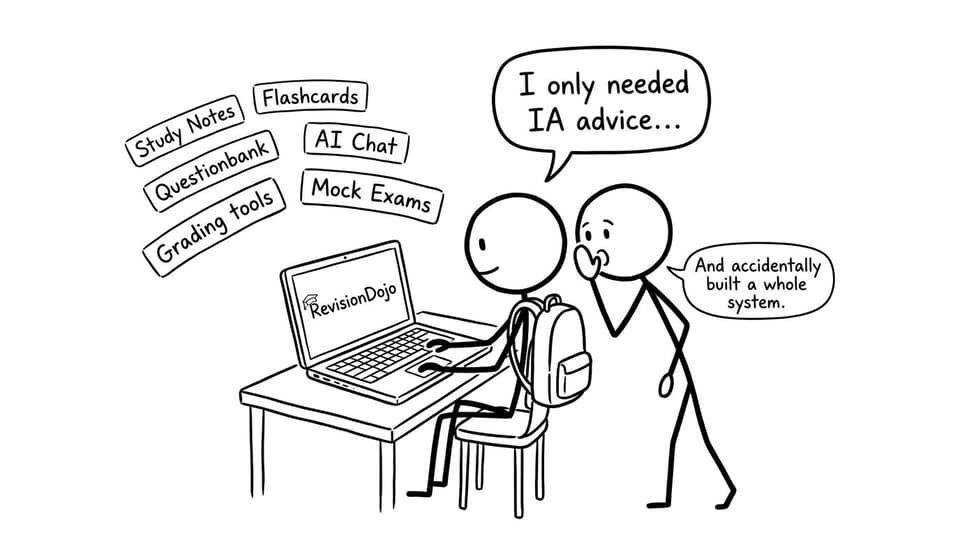
RevisionDojo is designed to make feedback loops short and specific.
A practical workflow many students use:
- Learn or clarify content with Digital IB Study Notes
- Lock in definitions and method language using IB Flashcard System: Active Recall for Better Memory
- Train exam technique alongside coursework using the Questionbank
- Use AI Chat to ask rubric-aligned questions like "Is this evaluation or just description?"
- Use Grading tools to get criterion-by-criterion feedback so you stop guessing
The point isn't to add more tasks. It's to remove the dead time where you're "working" but not getting clearer.
Use exemplars as calibration, not comparison
Looking at a high-scoring IA can either motivate you or flatten you.
A better way:
- Read one exemplar quickly.
- Highlight every sentence that directly earns a rubric point.
- Notice how often the writing is plain.
- Notice how often the student explains why they did something.
That "why" language is often the difference between mid and top bands.
Don't let coursework steal your exam season
The irony is that students often chase the "highest average IA" because they're afraid coursework will drag down exam performance.
So contain it.
Set a boundary:
- two IA sessions per week,
- each with a single objective,
- and a hard stop.
If you need a broader routine that balances everything, this is useful: How to Study for IB Exams: Step-by-Step Guide.
A practical way to answer the question for yourself
Instead of asking "which IA has the highest average score?" run this small experiment:
Step one: scoreability test
Pick two possible IA topics.
For each one, answer:
- What data will I have by week 2?
- What analysis technique will I use by week 3?
- What is the likely limitation I'll evaluate by week 4?
The topic with clearer answers is usually the one that will score higher for you.
Step two: motivation test
Explain your IA idea to someone in 30 seconds.
If you feel a tiny spark of "let me show you," that's a good sign. If you feel dread, don't ignore it.
Step three: rubric mapping test
Can you point to at least one planned sentence for each criterion that begins with:
- "This choice improves reliability because…"
- "A limitation is…"
- "This suggests that…"
If you can, your IA is already becoming examiner-friendly.
Conclusion: the highest average IA is the one you can control
Asking which IA has the highest average score is understandable. You're trying to reduce risk.
But the better move is to reduce uncertainty.
The IA that scores highest, in practice, is the one built around a feasible question, a method you can defend, analysis that actually interprets data, and reflection that treats limitations as reasoning rather than apology. That's not a rumor. It's a system.
If you want that system in one place, RevisionDojo is built for it: Questionbank practice for exams, examiner-aligned Study Notes for clarity, Flashcards for daily recall, AI Chat for fast unblocking, Mock Exams and Predicted Papers for realistic pressure, plus Grading tools, the Coursework Library, and Tutors when you need feedback that makes your next draft better.
Start today with one concrete action: choose one IA criterion you're least confident about, and rewrite just that section until it's undeniable.