
The moment your IA stops being “work” and starts being “proof”
Two nights before a deadline, your IA changes character.
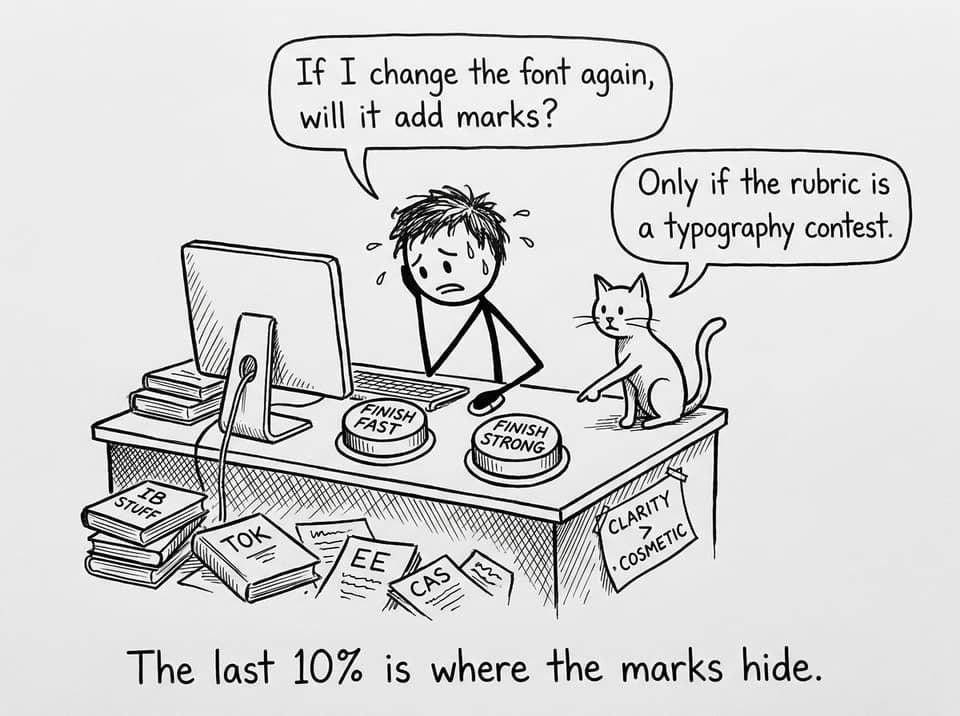
What used to feel like exploring an idea starts to feel like dragging a suitcase up stairs. You tell yourself you just need to “get it done.” So you fix the font. You reformat headings. You chase tiny typos because they’re easy wins.
But examiners don’t reward effort. They reward what’s visible on the page: clear thinking, controlled structure, and analysis that actually answers the question. If you want to finish an IA strong, the last stretch is less about speed and more about making your thinking impossible to miss.
IA finishing checklist (the 30-minute version)
Before you touch formatting again, run this IA checklist:
-
Can I state my research question in one sentence without qualifiers?
-
Does every body section end with “therefore…” (a clear takeaway)?
-
Is my analysis doing more than describing trends or quoting sources?
-
Does my evaluation name specific limitations and their impact on confidence?
-
Does my conclusion answer the question using the evidence I actually analysed?
If any of those feel shaky, your fastest improvement is structural.
For a rubric-first overview across subjects, keep RevisionDojo’s IA Guides open beside your draft.
Stop polishing. Start strengthening the analysis spine
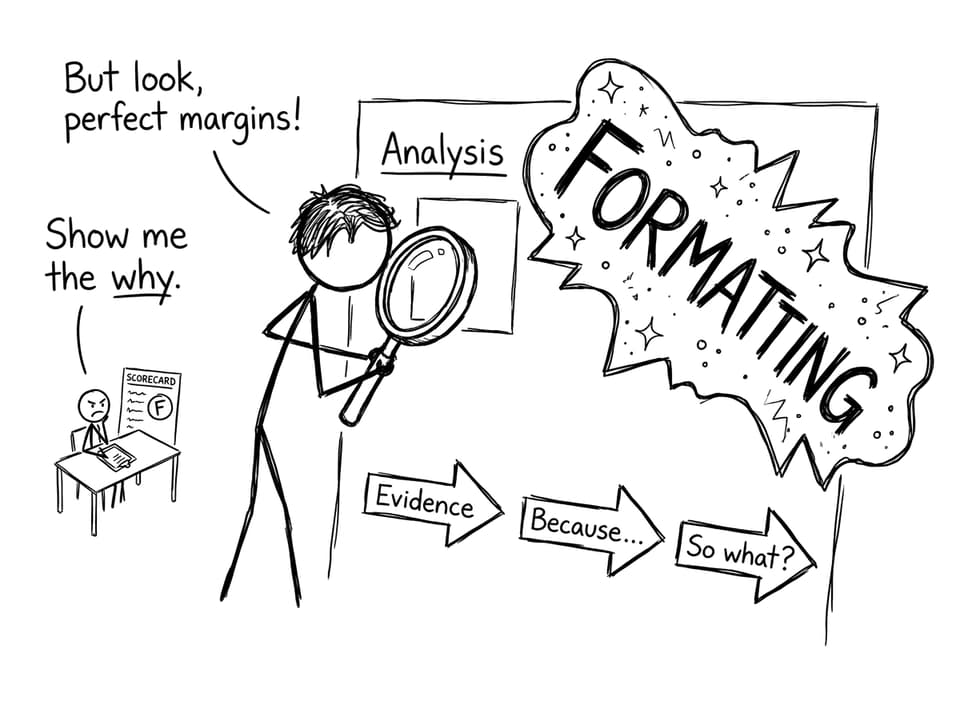
The easiest late-stage marks come from making links explicit.
Most IAs already contain enough evidence. The problem is that the argument is implied instead of stated. Examiners won’t “fill in” gaps, even if you could explain them out loud.
Try this micro-edit across your IA:
-
After each key result, add one sentence starting with “This suggests…”
-
Then add one sentence starting with “Because…” (the mechanism, theory, or reasoning)
-
Then add one sentence starting with “So what?” (why it matters for the research question)
That three-step move often upgrades clarity more than a whole page of extra content.
If you need models or definitions quickly, use RevisionDojo Study Notes as a fast way to confirm the language examiners expect.
Your evaluation and conclusion are where your IA is judged
In the final days, many students “finish” their evaluation and conclusion, then never look back. That’s backwards. In a strong IA, these sections decide how the whole piece feels: mature and controlled, or messy and rushed.
Two high-impact upgrades:
Make evaluation measurable
Don’t write “human error may have affected results.” Write what error, where, and how it changes interpretation. Name the direction of impact (overestimate/underestimate), and connect it to confidence.
If you want a clear standard for conclusions, read Why Your Conclusion Might Be Holding Back Your IA Grade.
Make the conclusion a judgement, not a recap
A recap repeats. A judgement commits within the limits of the evidence.
If you’re still building your opening sections, pair this with IA Introduction Structure: A Step-by-Step Guide so the ending matches the promise of the beginning.
Don’t add new content late. Control what you already have
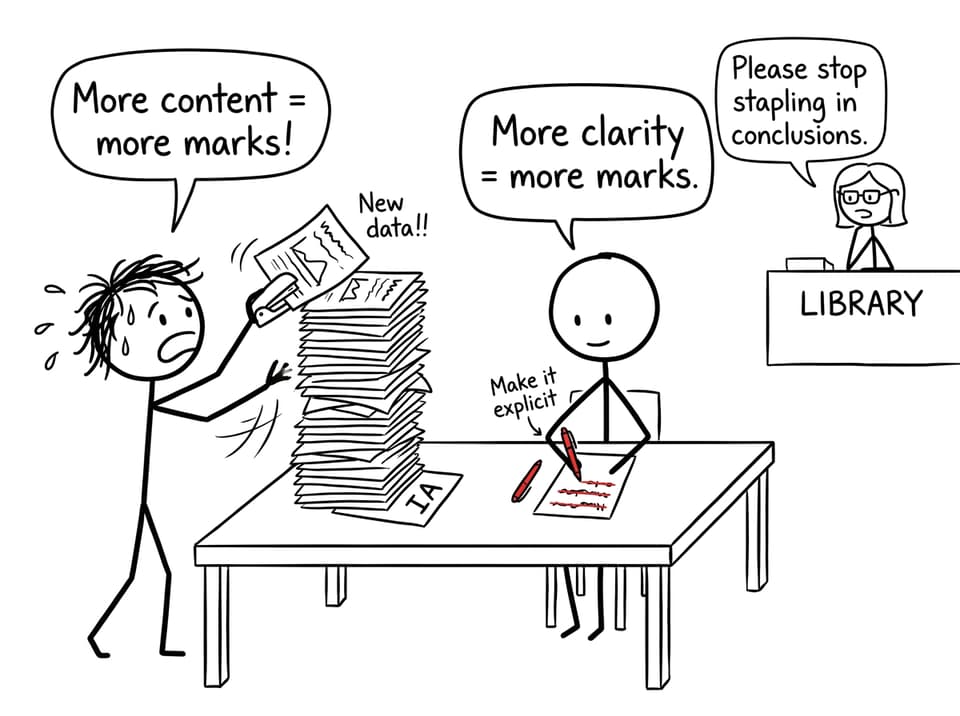
Adding a new dataset or a new case study in the final stretch often breaks balance. Suddenly your IA has an extra limb that doesn’t connect to the body.
A better move is subtraction with purpose:
-
Cut anything that doesn’t help answer the research question
-
Replace long description with one sharp interpretation
-
Merge repetitive paragraphs and use the freed space to clarify “why this matters”
If you’re unsure whether your question still fits the work you wrote, recalibrate using How to Write a Strong IA Research Question.
Use RevisionDojo to finish your IA with confidence (and keep exam prep alive)
The quiet risk of IA season is that exams stop existing. Revision becomes “later.” Then later arrives fast.
RevisionDojo makes the final stretch more stable:
-
Use the IB Coursework Grader as a rubric-aligned mirror for your draft.
-
Check structure and exemplars in the Coursework Guides and Coursework Exemplars library.
-
Keep momentum for exams with the Questionbank and learn how to use it well via IB Question Bank | How to Use It Effectively.
-
Convert weak spots into daily recall using Flashcards and stress-test ideas with AI Chat.
-
When you need realism, use Mock Exams, Predicted Papers, and Grading tools to keep timing and mark awareness sharp.
Finish your IA strong, then walk into exams lighter
A strong IA doesn’t feel frantic at the end. It feels inevitable: every section points toward the research question, every claim has visible support, and the conclusion lands with controlled confidence.
If you want that feeling, use RevisionDojo as your final-stage system: IA Guides and exemplars to calibrate, the Coursework Grader and AI Chat to refine, and the Questionbank, Flashcards, Mock Exams, and Predicted Papers to keep exam readiness moving while you finish your IA strong.