

The moment you realize your IA topic might be wrong
It usually happens in a small, quiet moment.
You are halfway through planning your IA, and suddenly the topic that felt exciting last week now feels… flimsy. Too broad. Too hard to measure. Too dependent on a source you can't access. Or worse: it looks exactly like something everyone else is doing.
And then the question appears, almost like a negotiation with reality: how many times can you change your IA topic?
The honest answer is that the IB doesn't publish a universal "you may change your IA exactly X times" rule. But your school timeline, your teacher feedback windows, and the practical costs of restarting effectively create a limit.
This post will help you decide, calmly and strategically, when switching your IA topic is smart, when it's just avoidance, and how to pivot without losing weeks.
Along the way, you'll see how RevisionDojo supports the whole process: from topic selection and exemplars to grading tools, AI Chat, and a Coursework Library that keeps you anchored when you feel like drifting.
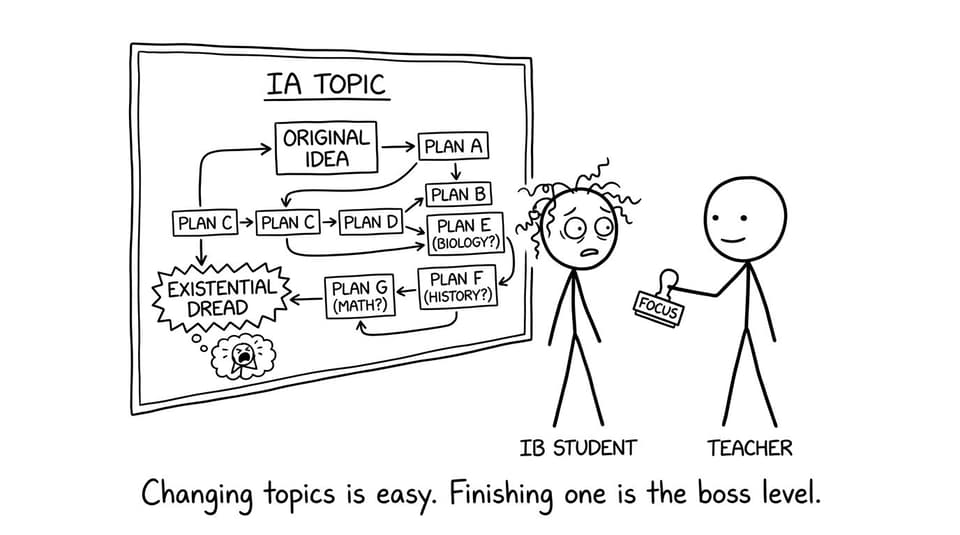
Quick checklist: should you change your IA topic?
Before you switch your IA, run this checklist. If you answer "yes" to 3 or more, a change is usually justified.
- You cannot collect valid data or access sufficient sources.
- Your research question cannot be narrowed without becoming trivial.
- Your method is unethical, unsafe, or not allowed by school policy.
- Your teacher has flagged the approach as misaligned with the rubric.
- You've discovered your topic is too common and your angle isn't original.
- Your planned analysis is mostly description, not evaluation.
- You've spent more time "planning to start" than producing work.
If you're unsure what strong alignment looks like, anchor yourself with an IB-wide overview like IB Internal Assessment: A Complete Guide and then move into subject-specific guidance.
So, how many times can you change your IA topic?
In practice, you can change your IA topic as many times as your school will allow and as your calendar can absorb.
But students usually need a more useful answer than that.
A better way to think about it is phases. Each phase has a different "cost" to switching your IA topic.
Early phase: brainstorming and feasibility (low cost)
This is when you should allow yourself to explore.
Changing your IA topic here is normal, even healthy. You're learning what "feasible" actually means in your subject: what you can measure, what you can model, what you can argue with evidence.
If you're in this phase, your goal is not to "find the perfect topic." Your goal is to find a topic that can survive contact with the rubric.
RevisionDojo helps most in this stage through two things:
- The big picture structure and examiner expectations in IB Internal Assessment Guides
- Concrete models from the IA/EE/TOK exemplars index (examiner-verified)
You will notice something reassuring when you read strong exemplars: they rarely started perfect. They became strong through narrowing.
Middle phase: after the research question is set (medium cost)
Once your research question (or aim, depending on subject) is stable, switching your IA topic becomes expensive.
At this stage, the danger isn't just lost time. It's also lost coherence. The IB rewards clarity: a focused question, a method that answers it, analysis that stays loyal to it.
If you change topics now, you must rebuild that coherence quickly.
A good rule: if the research question can be fixed by narrowing, don't restart.
Use targeted guides instead:
- If your question is messy or too broad, use How to Write a Strong IA Research Question.
- If your draft exists but feels weak, use Last-Minute IA Improvements That Actually Work.
This is also where RevisionDojo's AI Chat becomes useful as a thinking partner: not to write your IA, but to pressure-test feasibility, variables, counterarguments, and whether your analysis will actually earn marks.
Late phase: after data collection or drafting (high cost)
Once you've collected data, written sections, or built your argument structure, switching your IA topic is almost never worth it.
At this point, most students don't need a new IA topic. They need better execution.
That means:
- tightening analysis,
- improving evaluation,
- fixing presentation,
- and aligning everything to criteria.
If you're late in the process and panicking, read Behind on Your IB IAs? How to Catch Up Fast and then commit to a repair plan.
The real reason students keep changing their IA topic
Sometimes topic changes are rational. Often, they're emotional.
A student starts an IA and feels the discomfort of not being good at it yet. The uncertainty. The messy first draft. The fear that the final mark will define them.
So the brain offers an escape route: "If I change my IA topic, I'll feel productive again."
It works briefly. Then the discomfort returns, because discomfort wasn't caused by the topic. It was caused by the process.
A strong IA is not the absence of doubt. It's the ability to keep working while doubt sits in the room.
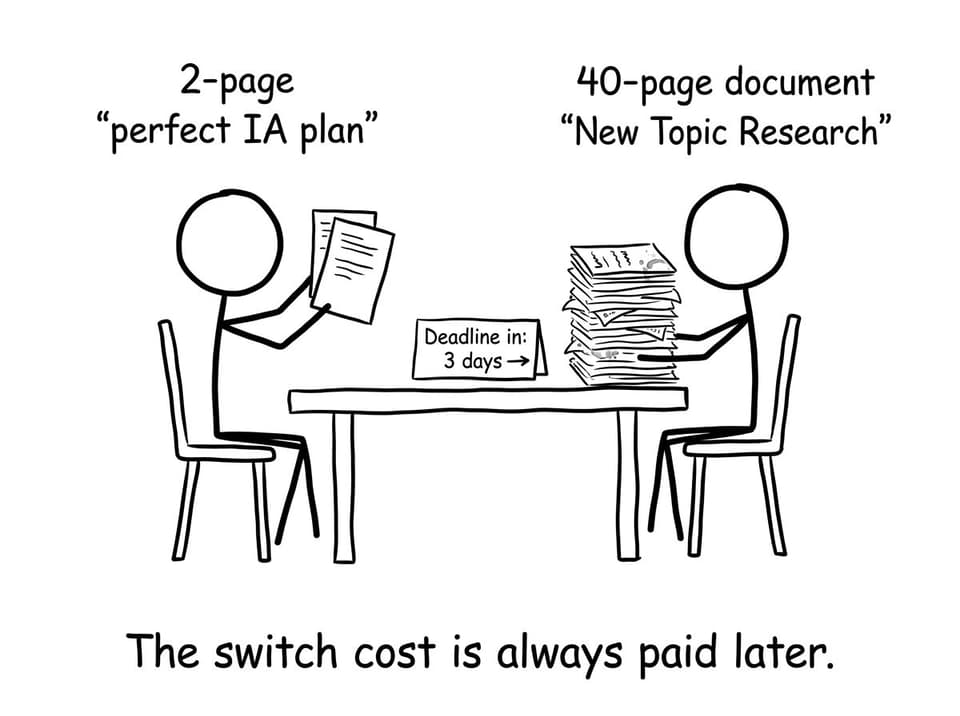
When changing your IA topic is the right move
There are moments when switching your IA topic isn't avoidance; it's maturity.
Your IA cannot be assessed fairly
If your topic leads to results you can't interpret using the subject's tools, you're building something the rubric can't reward.
For example:
- A science IA with unreliable data and no way to discuss uncertainty meaningfully.
- A humanities IA that becomes narrative summary instead of analysis.
- A math IA where the mathematics never becomes "the main character."
If you're not sure what "aligned" looks like across subjects, How to Adapt IA Strategies for Different IB Subjects is one of the fastest ways to recalibrate.
Your resources or constraints changed
Sometimes reality changes:
- your school lab can't provide equipment,
- your survey access disappears,
- your primary sources are unavailable,
- or your method is no longer permitted.
A topic that depends on resources you don't have is not ambitious. It's fragile.
The pivot can reuse most of your work
The best topic change is not a restart. It's a pivot.
A pivot keeps:
- the same general theme,
- the same dataset (if valid),
- or the same case study,
but changes the question to something more focused, measurable, and analytical.
If you have data already, focus on making that data do more work. RevisionDojo's guide How to Use Data Effectively in Your IA Analysis helps you turn "I have results" into "I can evaluate results."
How to change your IA topic without losing weeks
If you've decided a topic change is necessary, treat it like a controlled operation.
Decide once, then lock it
Give yourself a short decision window (48 hours is plenty) and then lock the new IA topic.
Write a one-paragraph "commitment statement":
- what your new question is,
- why it's feasible,
- what method you'll use,
- and what the analysis will look like.
Once it's written, your job is execution, not continued brainstorming.
Use exemplars as guardrails
When you change your IA topic, you're not just changing content. You're changing structure.
Pick 1-2 exemplars from RevisionDojo's Coursework Library that match your subject and style, and use them as a reference for:
- section balance,
- tone,
- and how analysis is shown.
Start with the index hub: IA/EE/TOK exemplars (examiner-verified). If you're a CS student, browsing a full collection like IB Computer Science IA Exemplars can also help you see what "doable scope" looks like.
Pressure-test with tools, not vibes
Before you commit, test your new IA topic with a few quick checks:
- Can you write a draft research question in one sentence?
- Can you list variables/sources immediately?
- Can you predict what the analysis section will contain?
Then use RevisionDojo's workflow support:
- Study Notes to refresh key content before designing your method
- Flashcards to keep terminology sharp while drafting
- AI Chat to challenge your assumptions and identify missing evaluation
- Grading tools to check rubric alignment before submission
- Tutors if you need a human to help you choose between two viable options
The hidden link between your IA and exam prep
IB students often separate "coursework mode" and "exam mode." But your brain doesn't.
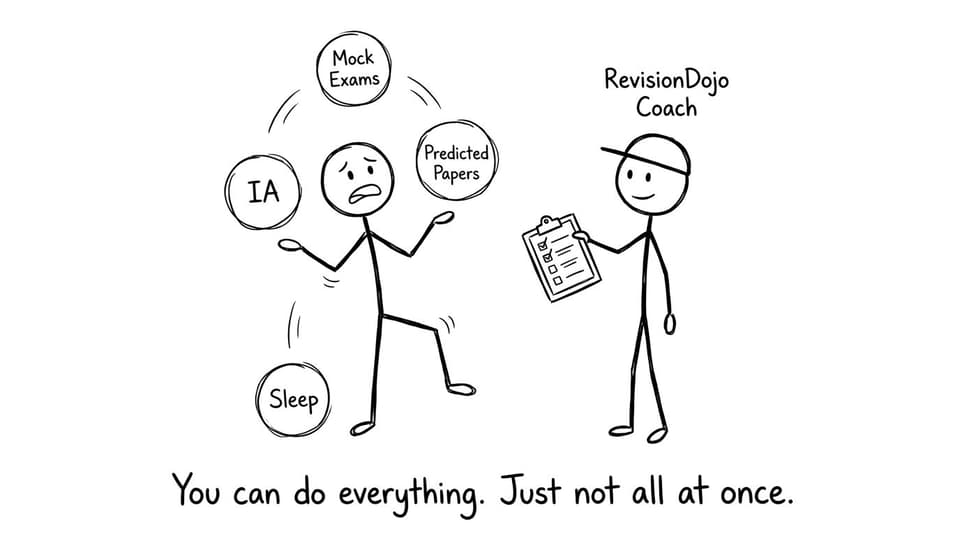
A stable IA topic reduces cognitive load. It frees up attention for the things that matter close to exams: timed practice, weak-topic repair, and confidence.
RevisionDojo is built for that full ecosystem:
- Questionbank for targeted practice
- Mock Exams and Predicted Papers for realistic timing and stamina
- analytics to tell you what to fix next
If you want the broader system, see RevisionDojo App: The Smarter Way to Prep for IB Exams.
Closing: choose the IA you can finish
The best IA topic isn't the most impressive one. It's the one you can execute cleanly: focused question, clear method, honest evaluation, and writing that makes your thinking easy to see.
If you're early, explore a little. If you're mid-process, pivot instead of restarting. If you're late, repair the draft you have and make the analysis sharper.
And if you want to stop guessing and start building, RevisionDojo gives you a complete IB system: IA Guides, Coursework Library, Questionbank, Study Notes, Flashcards, AI Chat, Grading tools, Predicted Papers, Mock Exams, and Tutors. Your IA doesn't have to be perfect. It has to be finished, and finished with intention.
For more support, browse All #IA Posts - RevisionDojo and pick the next step that matches where you are right now.