
Sometimes the first sign your IA is in trouble is how quiet your document becomes.
You open it, read the title, stare at the research question, and feel your brain do that gentle, unhelpful thing where it starts negotiating. Maybe I should change my IA topic. Maybe this was a bad idea. Maybe everyone else picked something smarter.
If you're an IB student preparing for exams, you're not imagining it: your IA often competes with revision for time, attention, and confidence. And because it sits in the background for months, it can quietly turn into the most expensive kind of stress, the kind that grows while you're busy doing other things.
So, can you change your IA topic?
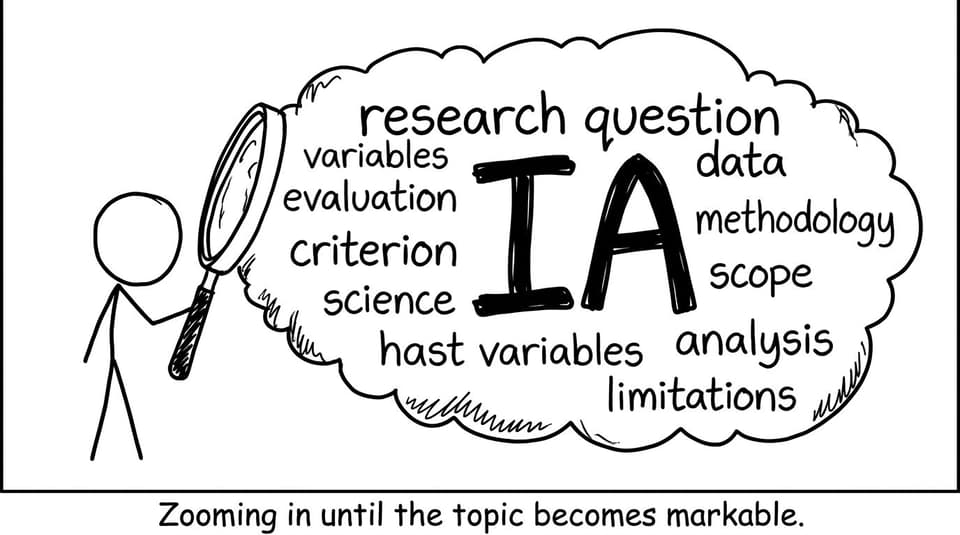
Yes, usually. But the better question is: should you change your IA topic, or should you reshape it so it becomes markable and finishable?
A quick IA topic-change checklist (the 60-second version)
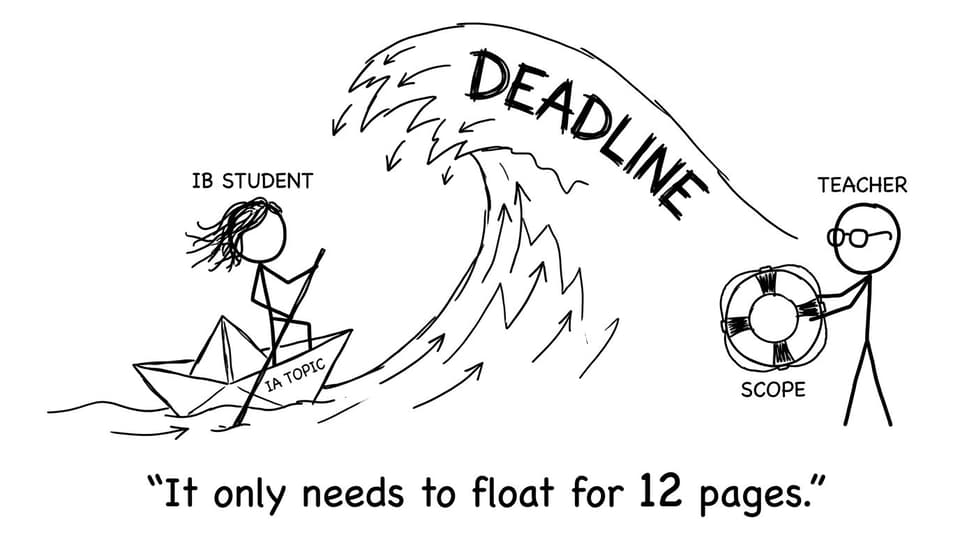
Before you throw away your IA, run this quick checklist. If you tick 3 or more, a change (or a serious pivot) is probably reasonable.
- You can't collect data/evidence ethically or realistically anymore.
- Your IA question is too broad, and every "fix" makes it messier.
- You dislike the topic, but more importantly, you avoid working on it.
- Your teacher has warned you the scope doesn't fit the rubric.
- Your method doesn't produce analysis (only description).
- The resources you need are unavailable (lab access, texts, participant data).
- You are spending time rewriting instead of progressing.
If you tick 1-2 items, it might not be an IA topic change you need. It might be a narrowing, a new method, or a clearer research question.
For a deeper sense of what "good" looks like, compare your idea against Common Mistakes Students Make in Their IA and How to Avoid Them.
The story most IB students live: changing the IA topic too late
A quiet truth about the IB is that effort feels like progress, even when it isn't.
Students will spend weeks polishing an introduction for an IA that has no workable method. Or they'll gather interesting facts for a topic that can't be evaluated. On the outside, it looks like dedication. On the inside, it's often fear: If I keep writing, maybe the problem will go away.
But examiners don't grade hope. They grade evidence, analysis, and a clear line of thinking.
An IA topic change is sometimes the bravest move because it stops you from pouring time into something that cannot earn marks.
When you should change your IA topic (and not feel guilty)
There are a few situations where changing your IA topic is not only allowed, it's strategically smart.
Your IA is not feasible anymore
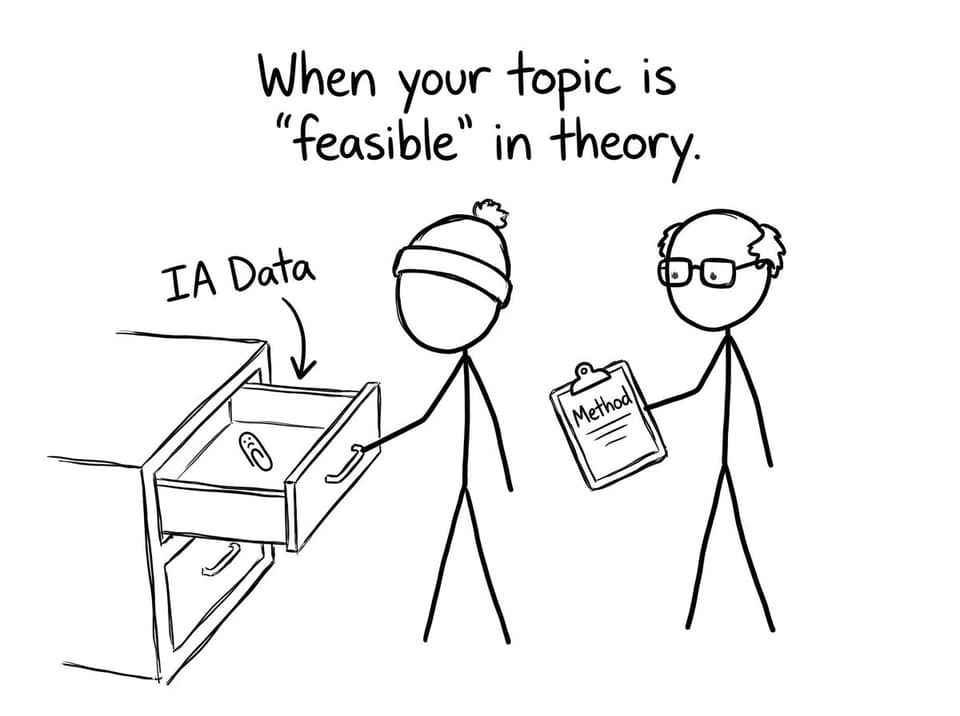
Feasibility problems are the most legitimate reason to change an IA topic.
Maybe your Biology IA depended on a lab resource that's now restricted. Maybe your Business Management IA relied on access to a local business that stopped responding. Maybe your Psychology participants disappeared the week you planned to run your study.
If you can't collect credible data or evidence, your IA becomes a writing exercise instead of an investigation.
A quick rescue move: browse a few examiner-verified models in IA/EE/TOK exemplars (examiner-verified) and ask yourself, "What did this student have access to that I don't?" That question alone often reveals whether your current IA is realistic.
Your IA can't score well because it can't show analysis
Some topics are interesting but structurally unmarkable.
If your IA mostly explains or describes, you may struggle to hit criteria that reward analysis, evaluation, reflection, and justified decisions.
This is where RevisionDojo's Grading tools help: you can run a draft through rubric-aligned feedback and see if your IA has the right "shape" before you invest another ten hours.
Your research question is fundamentally broken
If your IA question cannot be narrowed without changing what it is, it's a sign you may need a true topic change.
Examples of "fundamentally broken" questions:
- Variables you can't define or measure
- Causal claims you can't test
- Topics where all sources repeat each other
In contrast, a "messy but fixable" IA often just needs a tighter question.
When you should NOT change your IA topic (yet)
Most students don't need to change their IA topic. They need to stop trying to do a cinematic version of an IA.
You're bored, but boredom is not the real problem
Boredom often means one of two things:
-
The IA is too big, so every session feels like moving a mountain.
-
You don't know what "good progress" looks like, so you drift.
Instead of changing your IA topic, try a smaller win: rewrite your research question, set a clear method, and do one piece of analysis this week.
To rebuild momentum alongside exam prep, use RevisionDojo's Study Notes for quick clarity, then move immediately into the Questionbank to keep your exam skills growing while coursework continues.
If you want a system that keeps both alive, read How to Study for IB Exams Without Burning Out.
You're panicking because someone else has a "better" IA
Comparison is a loud liar in IB.
A flashy IA topic can still score poorly if it's unclear, unstructured, or impossible to evaluate. Meanwhile, a simple topic can score very high if it's focused, methodical, and reflective.
Your goal is not originality at any cost. Your goal is marks.
You've already built usable work
If you've collected good data, built a method, or drafted analysis, you might not need an IA topic change. You might need an IA topic pivot.
A pivot keeps your best work and changes what's necessary (usually the question, variables, or method).
The safest middle option: pivot your IA instead of restarting
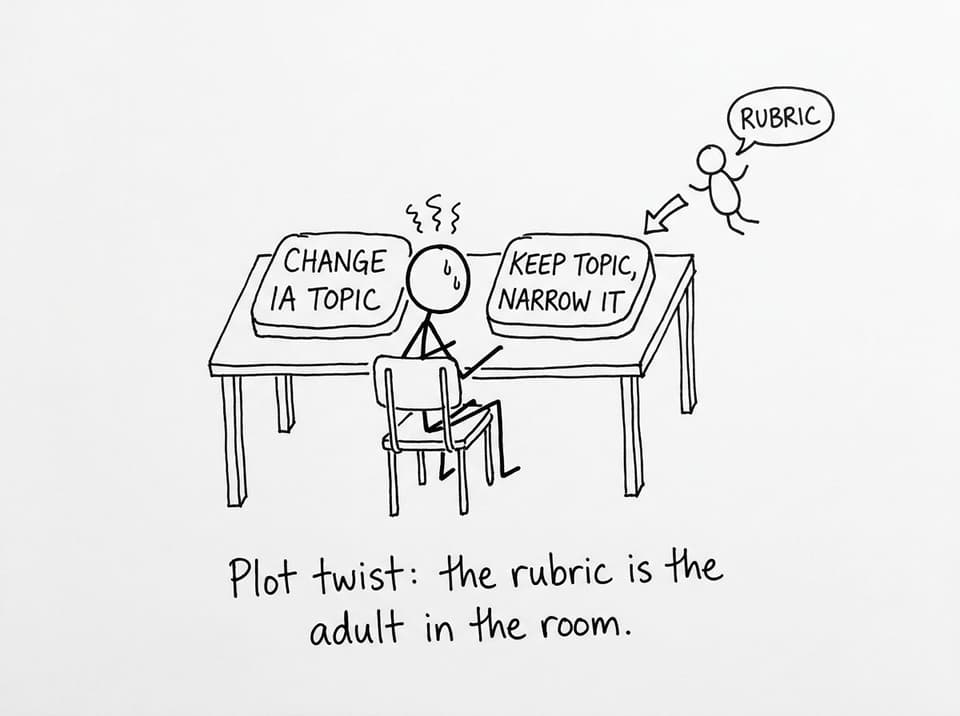
A full IA topic change is a reset. A pivot is a reframe.
Here are high-impact pivots that often save weeks:
Narrow the scope (same topic, smaller target)
- Broad: "How does social media affect teenagers?"
- Narrowed: "How does TikTok use before bed relate to self-reported sleep quality in my grade cohort over 7 days?"
Same interest. New focus. More measurable.
Change the method (same question, better evidence)
If your method isn't producing analysis, change the tool.
- Add a comparative case
- Add a second variable
- Switch from anecdotal sources to primary data where possible
Reword the research question to match what you can prove
Sometimes your IA topic is fine, but your claim is too ambitious.
Move from "proves" to "investigates," from "causes" to "is associated with," from "best" to "most effective under these conditions."
If you're in Math, this is especially important. Strong Math IA topics are often "small" but mathematically rich. Start here: How to Choose the Perfect IB Math IA Topic and IB Math IA Ideas for 2025 and Beyond.
How to change your IA topic without creating chaos
If you've decided on an IA topic change, the goal is to change it cleanly.
Get approval first (and keep it simple)
Write your teacher a short note:
- Old IA topic in one line
- Why it's not feasible/markable
- New IA topic in one line
- What data/evidence you will use
- A realistic mini-timeline
No drama. No long story. Just constraints and a plan.
Reuse what you can
If you can reuse:
- your formatting
- your background section structure
- your reflection style
- your bibliography framework
…you can make an IA topic change without starting from zero.
Use exemplars to avoid reinventing structure
Your brain wants certainty when you're changing direction.
That's why RevisionDojo's Coursework Library matters: seeing models reduces the invisible decision load. For example, you can browse subject-specific sets like Chemistry IA Exemplars or IB Computer Science IA Exemplars to see what "scorable" structure looks like.
Get feedback faster than your anxiety can grow
Use RevisionDojo's AI Chat to pressure-test your new IA:
- "Is this research question too broad?"
- "What variables would make this measurable?"
- "What would evaluation look like here?"
Then use Grading tools to check whether your draft aligns with the rubric before you submit.
How to balance an IA topic change with exam preparation
Changing an IA topic can steal your revision time if you let it.
A calm strategy is to time-box coursework while keeping your exam loop alive:
- 3 blocks/week (45-60 min): IA work only
- 4 blocks/week (30-45 min): RevisionDojo Questionbank targeted practice
- Daily (7-12 min): Flashcards for volatile facts
- 1 session/week: timed practice using IB Mock Exams with Timer & Mark Schemes or predicted sets where available
This matters because exams don't pause while you change your IA.
If you want a one-page overview of how all tools fit together, read RevisionDojo App: The Smarter Way to Prep for IB Exams.
Closing: the point of an IA is not the perfect idea
An IA topic change can feel like admitting defeat. But in the IB, the real defeat is a topic that can't be finished, evaluated, and explained with clarity.
Your IA is not a personality test. It's a controlled investigation designed to earn marks.
If you need to change your IA topic, do it early and do it cleanly. If you don't, narrow it until it becomes measurable and markable. Then protect your exam preparation with a steady loop: Study Notes for clarity, Flashcards for daily recall, Questionbank for exam skill, Mock Exams and Predicted Papers for realism, and AI Chat plus Grading tools to keep your coursework aligned. When you need models or inspiration, the Coursework Library is there. And if you want a human to steady the plan, RevisionDojo Tutors can help you turn uncertainty into a timeline.
Either way, your next step is simple: make your IA smaller, clearer, and easier to finish. Then keep going.