



A new IB acronym can sound like another examination, essay, or source of pressure. If you are a parent searching for what is CAS explained in plain language, the reassuring answer is this: CAS is the part of the IB Diploma that asks students to learn through creative pursuits, physical activity, and meaningful service outside their academic courses.
CAS stands for Creativity, Activity, Service. It is one of the three compulsory elements of the Diploma Programme core, alongside Theory of Knowledge (TOK) and the Extended Essay (EE). CAS receives no numerical mark and adds no points to the final IB score. However, a student must complete it to receive the diploma.
The purpose is not to make an already demanding programme more academic. It is to ensure that education does not shrink into revision alone. Students pursue interests, encounter manageable challenges, work with others, contribute to communities, and reflect on what those experiences taught them.

CAS at a glance for IB parents
Here is the short version of the main IB CAS requirements:
- CAS is compulsory for students pursuing the full IB Diploma.
- It covers three strands: Creativity, Activity, and Service.
- Students participate regularly for at least 18 months during the Diploma Programme.
- Their overall programme should maintain a reasonable balance among the strands.
- They complete a range of CAS experiences and at least one collaborative CAS project.
- The project should last at least one month from planning through completion.
- Students maintain a portfolio containing evidence and reflections.
- They must demonstrate all seven CAS learning outcomes.
- CAS is not formally graded, but the school determines whether it has been completed.
This is a framework rather than a universal list of prescribed activities. Each IB World School develops its own procedures, deadlines, platforms, and approval process within the IB framework. Your child's CAS coordinator is therefore the final authority on what will be accepted locally.
For the wider context, read this clear breakdown of how the IB Diploma works or explore the IB core requirements covering TOK, EE, and CAS.
What do Creativity, Activity, and Service mean?
The names seem simple, but the intention behind each strand matters more than its label.
Creativity
Creativity involves exploring and extending ideas to produce an original or interpretive product or performance. Art, music, theatre, photography, design, coding, creative writing, and event planning may fit. A student does not need to be an accomplished artist. Learning a new technique or developing an idea can provide the challenge and growth CAS is designed to encourage.
An assessed performance required for an IB course cannot simply be counted again as CAS. CAS experiences must remain distinct from Diploma Programme course requirements.
Activity
Activity means physical exertion that contributes to a healthy lifestyle. Team sports are obvious examples, but they are not the only options. Dance, hiking, running, fitness training, martial arts, and other appropriate physical pursuits may qualify.
The relevant challenge depends on the student. Joining a beginner running group could represent real development for one person, while an experienced runner might need to plan a different goal. CAS is interested in engagement and growth, not athletic status.
Service
Service is collaborative and reciprocal engagement with a community in response to an authentic need. In practical terms, students should work with people rather than treating them as passive recipients of help. The experience should be unpaid, purposeful, respectful, and beneficial to both the community and the student's learning.
Possible examples include supporting a community organisation, tutoring younger learners, participating in an environmental initiative, or helping to improve accessibility at a school event. Approval should come before the work begins, especially when safeguarding, fundraising, travel, or vulnerable groups are involved.
What is the difference between a CAS experience and project?
A CAS experience is a specific activity or series of activities connected to one or more strands. It might be a single event or continue over time. The student should be able to explain why it is meaningful, where the challenge lies, and what was learned.
A CAS project is more substantial. It is a collaborative sequence of planned experiences lasting at least one month, from initial planning to completion. It may focus on one strand or combine several. For example, students might collaboratively create and deliver a series of movement workshops in response to a need identified with a local organisation.
The distinction is not simply that a project takes longer. It requires collaboration, planning, initiative, implementation, and reflection. The IB does not impose one universal project topic, which allows students to begin with a real interest rather than manufacture something impressive-looking.
RevisionDojo's guide to CAS projects versus CAS experiences explains the distinction in more detail. Students who need inspiration can also explore manageable IB CAS project ideas, but every idea should be discussed with the school's coordinator before it is treated as approved.
How CAS completion is determined
CAS has no examination, percentage, or grade boundary. It is effectively recorded as completed or not completed, with the school reviewing the student's participation, project, portfolio, reflections, and evidence of learning.
The seven learning outcomes ask students to demonstrate that they have:
- identified strengths and areas for growth;
- undertaken challenges and developed skills;
- initiated and planned a CAS experience;
- shown commitment and perseverance;
- worked collaboratively and recognised its benefits;
- engaged with an issue of global significance;
- considered the ethics of choices and actions.
A student does not need seven unrelated activities, one for each outcome. One thoughtful experience may provide evidence for several outcomes. Across the whole programme, however, the portfolio must show that every outcome has been achieved at least once.
This is why CAS is not best understood as an hours race. The current framework emphasises regular engagement, balance, evidence, reflection, and learning outcomes rather than a universal 150-hour target. A school may still use suggested time expectations to help students plan, but parents should distinguish local guidance from the IB's central completion criteria.
For a closer look at the process, see how CAS is marked in the IB Diploma.
What belongs in a CAS portfolio?
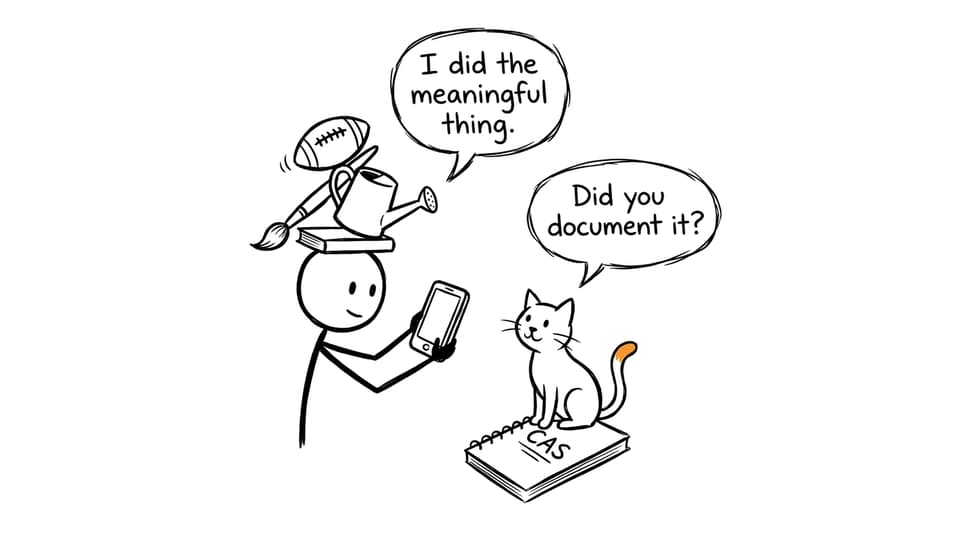
The portfolio is the record through which a student demonstrates engagement and learning. It is not formally awarded a mark, and it should not become an elaborate scrapbook produced during the final week.
Depending on the school's system, useful evidence might include:
- goals and initial plans;
- dates or brief participation records;
- photographs or examples of work, with appropriate consent;
- confirmation from a supervisor;
- records of decisions, problems, and changes;
- reflections connected to relevant learning outcomes;
- evidence of the required collaborative project.
A strong reflection goes beyond describing events. “We held the workshop on Tuesday” records what happened. A more useful reflection considers what changed: Which assumption proved wrong? What did the student contribute? How did collaboration affect the result? What should happen differently next time?
Reflections may be written, spoken, visual, or presented in another format accepted by the school. They should be genuine and timely. RevisionDojo's guide to writing useful CAS reflections can help students move from simple description toward thoughtful analysis.
How parents can support CAS without taking over
The most helpful parental role is structural, not managerial. CAS is meant to develop student initiative, so arranging every opportunity, editing every reflection, or directing the project can undermine its purpose.
Instead, a parent can ask calm, practical questions:
- Has the coordinator approved this experience?
- What need, interest, or challenge does it address?
- What evidence will be easy to collect responsibly?
- When will you record a short reflection?
- Are there any safety, transport, cost, or safeguarding concerns?
- Is the project timeline realistic alongside academic deadlines?
It also helps to notice what the student already enjoys. CAS does not always require inventing an entirely new life. An existing interest may become suitable when it includes intentional goals, an appropriate challenge, reflection, and clear separation from assessed coursework.
Parents can find more guidance in supporting a teen with meaningful CAS projects.
Keeping CAS manageable during exam preparation
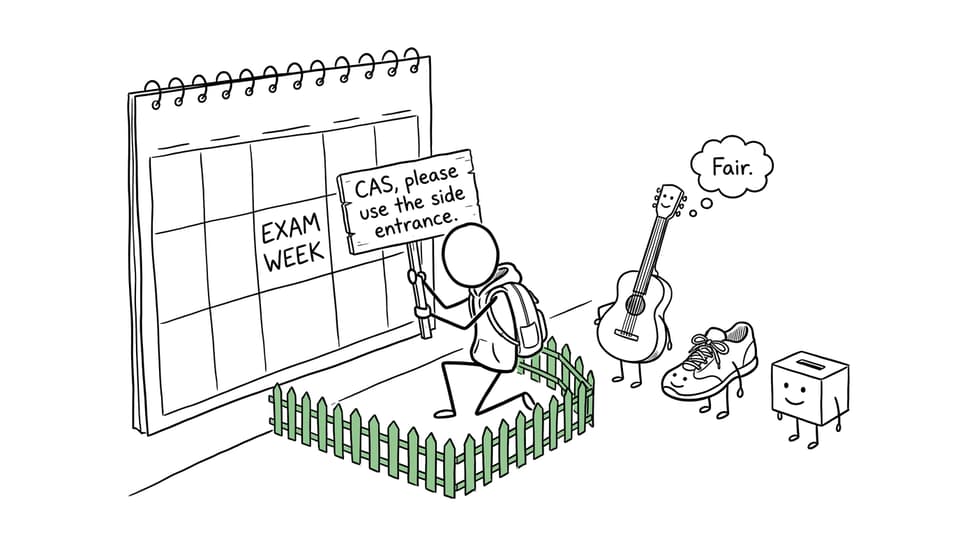
CAS becomes stressful when students treat it as something to reconstruct near the end of the Diploma Programme. The calmer approach is smaller, regular participation paired with brief, timely documentation.
A student might reserve one recurring period for an ongoing experience and ten minutes afterward to record evidence or reflections. Larger project milestones should enter the calendar early. During intensive mock and final exam periods, students can reduce avoidable clashes rather than abandoning CAS and creating a backlog.
Three habits make the greatest difference:
- Check before starting. Approval prevents weeks of work from later being judged unsuitable.
- Record while details are fresh. A short honest reflection is more valuable than a polished but vague reconstruction months later.
- Plan around pressure points. Map project deadlines against internal assessments, the Extended Essay, TOK work, mock examinations, and final revision.
The RevisionDojo guide to IB time management offers practical ways to organise these competing commitments.
CAS is important, but it should not feel mysterious
CAS asks a simple question beneath all the terminology: can education help a student become more capable, reflective, active, and connected to other people? The portfolio and learning outcomes provide structure, but they are not the true destination. The development produced by meaningful participation is.
A useful next step is to ask your child to show you the school's current CAS handbook, coordinator guidance, and major deadlines. Then help them protect a modest, regular space for CAS without turning it into another examination subject.
RevisionDojo is honest about its scope: CAS is the one IB core component it does not directly manage. Its role is to make the academic side of the Diploma more manageable through Questionbank practice, Study Notes, Flashcards, AI Chat, Grading tools, Predicted Papers, Mock Exams, a Coursework Library, and Tutors. By using resources such as the RevisionDojo guide to studying without burnout, students can create enough clarity around their subjects to give CAS the steady attention it deserves.