



The first weeks of the IB Diploma create a peculiar optimism. Every club sounds interesting, every service initiative feels important, and joining several activities can feel safer than choosing only a few.
Usually, the opposite is true.
To choose your first CAS activities without overcommitting, begin with two repeatable experiences, set a weekly time limit, and treat September-November as a trial period. You do not need to build your entire CAS portfolio during the first term. You need to discover what remains manageable when tests, homework, commuting, friendships, and sleep compete for the same hours.
The best first choices are not necessarily the most impressive. They are the ones you can continue, document, and learn from without turning every week into a rescue operation.
Your first-term CAS checklist
Before committing to an activity, ask:
- Does it clearly fit Creativity, Activity, or Service?
- Would I still attend during a difficult assessment week?
- Can I explain what I hope to learn?
- Does it produce useful evidence, such as drafts, logs, plans, or feedback?
- Are the travel and preparation time realistic?
- Can I try it before making a long commitment?
- Has my CAS coordinator confirmed that it is appropriate?
A sensible starting point is often one physical anchor and one Creativity or Service anchor. Balance matters across the full CAS programme, not necessarily inside your first fortnight.
Understand what CAS is asking from you
CAS stands for Creativity, Activity, Service. It is not numerically graded, but successful completion is required for the IB Diploma. Students maintain a portfolio containing experiences, reflections, and evidence of development across seven learning outcomes.
Official IB guidance also requires at least one CAS project. The project must be collaborative, extend for at least one month from planning to completion, and may address one or more CAS strands. That does not mean it must begin in September.
Your first job is simpler: understand the programme and participate regularly. RevisionDojo's guide to what CAS means in the IB Diploma introduces the strands, while the overview of how CAS is evaluated clarifies portfolios, interviews, evidence, and learning outcomes.
Schools may set their own deadlines, platforms, supervisor rules, and portfolio expectations. Your coordinator's instructions take priority over generic advice.
Set your capacity before choosing activities
Many students ask, “What would look good?” A better question is, “What can my ordinary week carry?”
Map your lessons, travel, homework, revision, existing responsibilities, sleep, downtime, and one buffer block for work that takes longer than expected. Only then should you place CAS into the remaining space.
As a first-term experiment, two CAS blocks totaling roughly 2-3 hours each week may suit some students, but this is not an IB requirement. Your appropriate limit could be lower or higher. Include preparation and transport because a one-hour activity across town is rarely a one-hour commitment.
The RevisionDojo guide to IB time management can help you build a realistic calendar. Stress-test it by imagining two subject tests in the same week. If CAS would require sacrificing sleep or rushing academic work, the plan is already too full.
Choose two anchor experiences
An anchor experience is repeatable and requires little weekly negotiation. It has a regular time, a clear purpose, and an obvious evidence trail.
An Activity anchor might be team practice, running, dance, or supervised fitness training. Creativity could involve an ensemble, photography, design work, or a small publication. Service might mean weekly tutoring or a recurring role with an established community organisation.
Specificity matters. “Help younger students” is vague. “Tutor one mathematics group every Thursday for 45 minutes using prepared exercises” is schedulable.
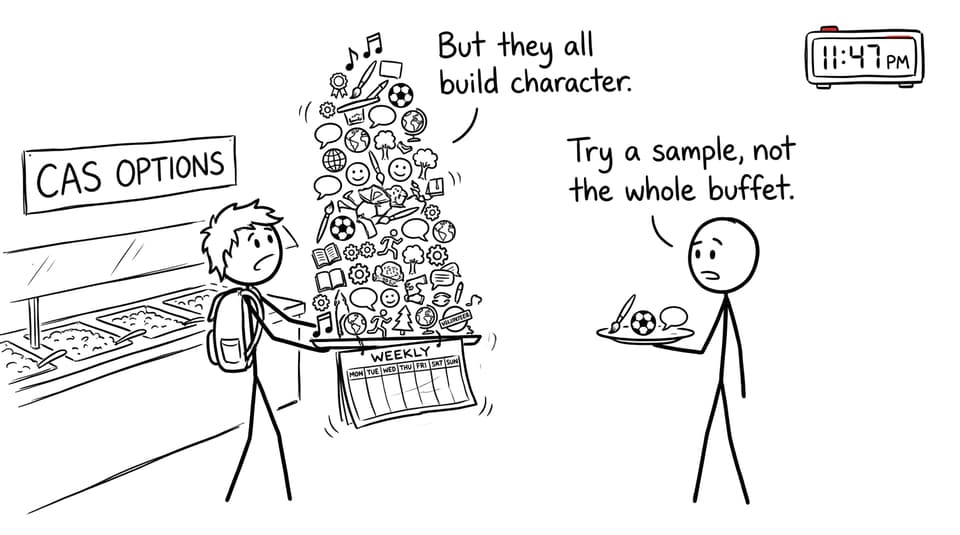
Choose one experience that builds on something familiar and another that introduces a controlled challenge. Two unfamiliar commitments create unnecessary friction, while two effortless activities may offer little growth.
Explore these manageable CAS project and experience ideas, but keep the categories clear by reviewing CAS projects versus CAS experiences.
Use September-November as a reversible trial
A strong first term grows through observation, not instant certainty.
September: investigate and sample
Attend introductory meetings and test options before committing where possible. Ask about attendance, busy periods, transport, equipment, safeguarding, and who will verify your participation.
By the end of September, choose no more than two main anchors. Record why you selected them, what challenge each presents, and what you hope to learn. Confirm them with your coordinator before assuming they count.
October: measure the real workload
Track the full cost of every session, including travel, planning, communication, and reflection. After three or four weeks, ask whether you are attending consistently, protecting study blocks, collecting evidence naturally, and still finding the experience meaningful.
Use the guidance on balancing CAS, academics, and social life to adjust your rhythm. Leaving an unsuitable trial after speaking with your coordinator is often wiser than carrying an unrealistic commitment for months.
November: keep, modify, or stop
Classify each experience:
- Keep: meaningful, sustainable, and straightforward to document.
- Modify: worthwhile, but its frequency, role, or scope needs adjustment.
- Stop: consistently disruptive, poorly defined, or unsuitable for CAS.
Notice which strand may need attention later, but do not add an activity simply to make your portfolio look symmetrical. Identify one realistic next-term opportunity and discuss it during your CAS review.
Make reflection part of the activity
Documentation becomes a second workload when students postpone it. After a meaningful session, save one useful piece of evidence and note what happened, what challenged you, what you learned, and what you will change.
Follow your school's rules for frequency and format. A photograph may show participation, but it does not explain growth. Strong reflection connects a specific moment to a decision, difficulty, change, or learning outcome.
RevisionDojo's guide to writing strong CAS reflections can help you move beyond diary-style summaries. Writing while details are fresh is faster than reconstructing several months in one weekend.
Recognise warning signs early
Your plan may be too demanding if you regularly miss sessions, borrow time from sleep, delay reflections, or feel anxious whenever a supervisor sends a message. A sustainable plan should survive ordinary disruption rather than depend on unusually calm weeks.
Be cautious about taking leadership roles immediately. Events can require permissions, budgets, risk planning, and coordination with other people's schedules. Joining first often teaches you how an organisation works before you lead within it.
Likewise, do not launch a large collaborative project simply because classmates are doing so. Use the first term to observe potential teammates, community needs, and practical constraints. A smaller project started thoughtfully can be stronger than an ambitious one abandoned early.
Protect the academic foundation of DP1
CAS works best when it supports a balanced life instead of competing with one. During the IB DP1 fall term, establish repeatable academic habits before knowledge gaps accumulate.
The RevisionDojo guide for new DP1 students offers a practical study cycle. Use Study Notes to clarify topics, Flashcards to retrieve knowledge, and the Questionbank to apply it. AI Chat can isolate confusion before unfocused searching consumes an evening.
As the Diploma progresses, RevisionDojo's Grading tools, Predicted Papers, Mock Exams, Coursework Library, and Tutors provide deeper feedback and structured support. Keeping these resources together reduces the organisational friction that makes a busy schedule feel even fuller.
Your first CAS decisions do not need to predict who you will be at graduation. Choose a small number of activities, observe what they cost, reflect on what they teach, and adjust before strain becomes routine.
That is not a lack of ambition. It is how sustainable ambition begins.