
Freezing in an exam can feel like losing access to your own mind. A question looks unfamiliar, the clock becomes suddenly loud, and thoughts that were clear yesterday seem unreachable.
If you freeze during a November session exam, pause, lengthen your exhale, ground your attention in the room, and restart with the easiest available task. Do not spend several minutes wrestling with one question. Your goal is not to feel perfectly calm. It is to regain enough control to earn the next mark.
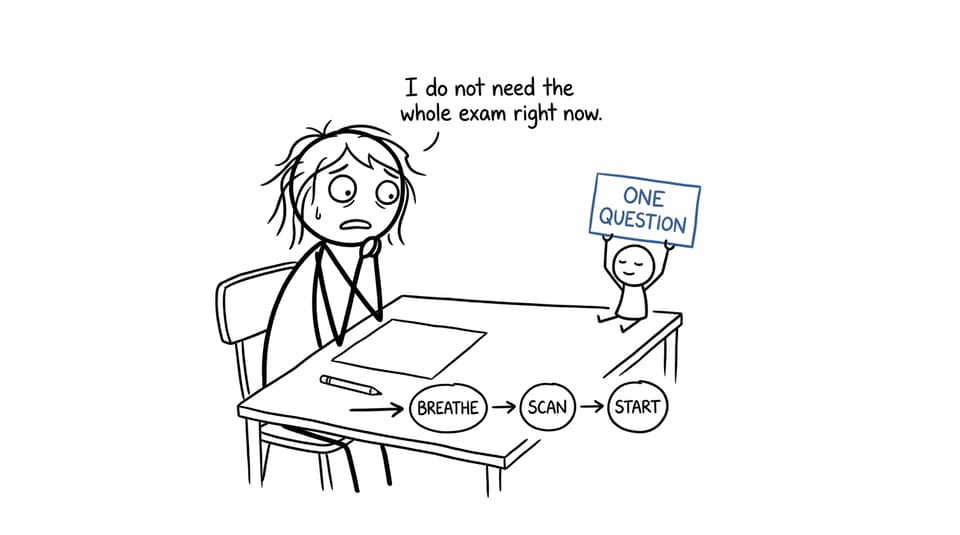
Panic asks you to solve the entire paper at once. A useful reset asks you to do one small thing.
The immediate freeze response checklist
When your thoughts stall:
- Put your pen down briefly and relax your jaw, shoulders, and grip.
- Breathe in gently for 4 counts and out for 6 counts, repeating 3 times.
- Notice your feet on the floor and 3 neutral things you can see.
- Find the easiest question or smallest subpart you can attempt.
- Write one relevant fact, formula, definition, or planning point.
- Set a time checkpoint and continue.
Keep the pause brief. You are interrupting the spiral, not waiting for every anxious sensation to disappear. RevisionDojo's guide to beating IB exam anxiety offers strategies to practise before the session.
Why your mind can go blank under pressure
An exam freeze can be an attention problem before it is a knowledge problem. Stress draws attention toward thoughts such as I am running out of time or Everyone else is writing. That commentary competes with the working memory needed to interpret a question and build an answer.
Staring harder may strengthen the loop. Instead, start with a gentle breath and a relaxed posture, then give yourself a smaller retrieval cue. Do not demand an entire essay; look for one argument. For a calculation, write the known quantities. The useful thought is not I must stop feeling anxious, but I can feel anxious and still take the next step.
Use the RESET method during the exam
A rehearsed script is easier to recall than improvised reassurance. Remember RESET:
Release tension
Stop pressing your pen into the page. Drop your shoulders, unclench your jaw, and place both feet on the floor. Tension signals that you need a brief pause, not that you are failing.
Exhale slowly
Take a comfortable breath in and make the exhale slightly longer. Repeat without forcing an unusually deep breath. If counting distracts you, attend to the air leaving your body instead.
State what is true
Use neutral language: I am in an exam room. I have time remaining. This is one difficult moment, not the final result. Calm facts can be more useful than reassurance you do not believe.
Earn the next mark
Choose a task you can enter: define a term, identify a trend, label a diagram, write an equation, or outline a paragraph. The first concrete response gives you somewhere to continue.
Track the time again
Set a checkpoint based on the clock and marks remaining. Do not try to recover lost time by writing carelessly. Spend your attention where it can still earn marks.
If one question caused the freeze
A difficult prompt becomes more manageable when you separate its command term, topic, supplied information, mark allocation, and any limits on the response.
Then write anchors. In mathematics or science, record quantities, units, a relationship, or a diagram. In an essay subject, jot down a claim, example, and link to the question. For a data response, describe one visible pattern before explaining it.
If no route appears after a reasonable interval, leave space and move on. The IB has previously advised candidates to begin with familiar questions and return when stuck. Skipping strategically is mark management, not surrender. The RevisionDojo IB Questionbank lets you rehearse these entry points across question styles.
When freezing becomes a health concern
Ordinary nerves can usually be managed at your desk. If you feel acutely unwell, cannot continue safely, or need assistance, raise your hand and tell the invigilator what is happening. Follow their instructions.
An invigilator cannot explain a question, assess your answer, or promise extra time. If an unexpected medical or psychological difficulty affects your performance, tell your coordinator promptly after the exam so your school can determine whether a formal process applies.
If freezing recurs before November, speak with your IB coordinator, school counsellor, parent or guardian, and an appropriate healthcare professional. The IB has processes for inclusive access arrangements and adverse circumstances, but eligibility and support depend on the situation, evidence, timing, and school-led procedures. Nothing is automatic, so communicate early.
Train the reset from September to November
Reading about a coping technique is different from using it under a clock. Rehearse the same sequence while practising questions, even on days you feel fine.
September: start small
Work in timed blocks of 10-25 minutes. At a planned point, pause, run RESET, and resume. Use Study Notes to address a gap, Flashcards to practise recall, and the Questionbank to apply what you remember. The month-by-month IB revision plan can help you fit these blocks around the fall term.
October: practise recovery
Complete timed sections in unfamiliar question orders. Once a week, use Mock Exams or IB Predicted Papers to rehearse pacing. When you stall, reset and continue. Note the trigger, how long recovery took, and what helped you restart.
Use AI Chat to clarify a misconception and Grading tools to see where your response stopped earning marks. An imperfect rehearsal is useful when it shows you how to recover.
Final 2 weeks: match the session
Check the current IB November exam schedule and study plan, then practise at roughly your exam time when possible. For closely spaced papers, use the November session survival plan to plan transitions and rest.
Keep the final days stable: short recall, targeted questions, predictable meals, prepared equipment, and consistent sleep. The RevisionDojo night-before anxiety plan can help when thoughts become noisy.
Keep a short anti-freeze log
After each timed session, record what triggered the freeze, which reset action you used, what helped you restart, and what you will change. A pattern may reveal that dense opening questions unsettle you or that an unrealistic time target creates pressure. Each finding suggests something specific to practise.
RevisionDojo brings that work together. Study Notes and Flashcards strengthen retrieval; the Questionbank, Predicted Papers, and Mock Exams develop execution. AI Chat and Grading tools support review, while the Coursework Library can help you manage coursework demands and Tutors offer human guidance on persistent weaknesses.
Return to the next question
A November session exam does not require uninterrupted confidence. It requires you to return to the work in front of you. Release tension, exhale, state what is true, earn the next mark, and check the time.
Practise that sequence before exam day. RevisionDojo is the ultimate IB resource for turning preparation and feedback into a repeatable routine, so a difficult moment need not decide the rest of your paper.


