

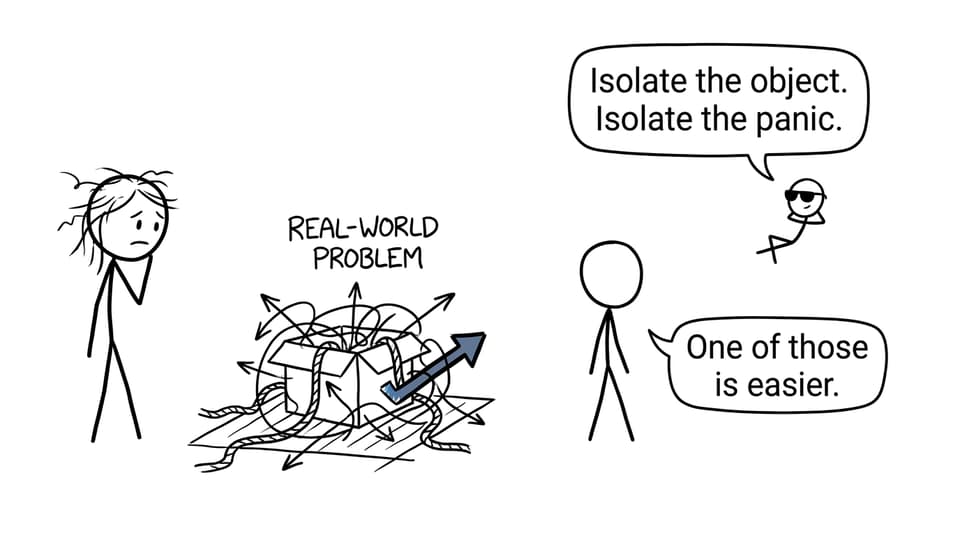
A free body diagram is a simplified drawing showing every external force acting on one chosen object or system. The object is isolated and represented by a dot or box, while labelled vector arrows show each force's direction and relative magnitude. In IB Physics, the diagram becomes the bridge between a physical situation and Newton's laws.
The drawing may look small. The thinking behind it is not. A correct free body diagram prevents you from inventing forces, losing signs, or applying Newton's second law to the wrong object.
Free body diagram checklist
Before calculating anything, check that your diagram does the following:
- isolates one object or clearly defined system
- includes every external force acting on that system
- uses labelled arrows with sensible directions
- shows relative force magnitudes when they are known
- excludes velocity, acceleration, and motion arrows
- excludes forces exerted by the chosen object on something else
- uses separate diagrams for separate objects
- supports equations such as ΣF = ma
This skill belongs to Topic A.2, Forces and Momentum, for both SL and HL. RevisionDojo's A.2 Forces and Momentum resources bring the relevant notes, questions, flashcards, and lessons together.
What is a free body diagram in physics really showing?
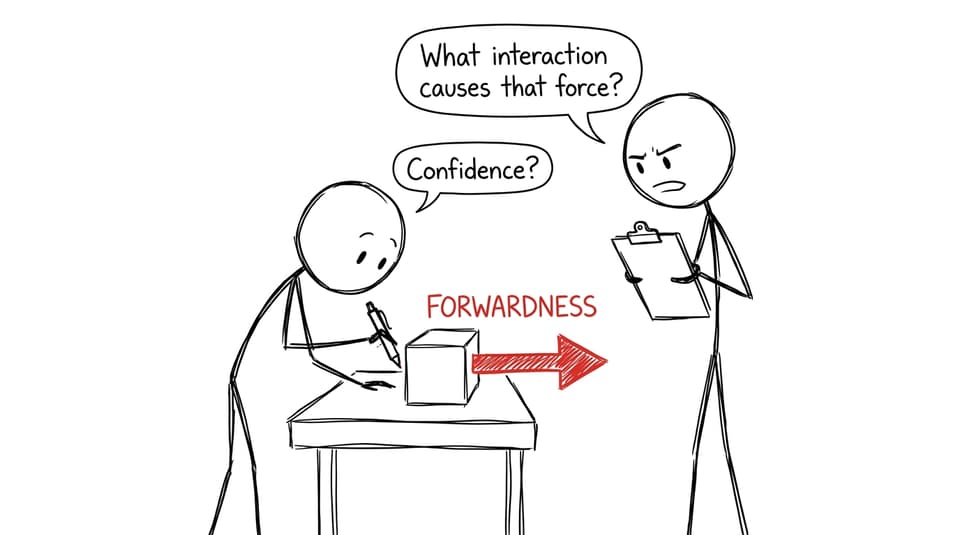
A free body diagram is an interaction map, not a picture of motion. Each arrow represents a real force caused by another object or field interacting with the selected body.
For a book resting on a table, Earth exerts gravitational force downward and the table exerts a normal contact force upward. If the book is stationary, these forces have equal magnitudes, so their vector sum is zero. The book's lack of motion is the consequence of zero resultant force, not another force that needs drawing.
This distinction matters because motion does not determine force direction. An object can travel right while the resultant force points left, as happens when it slows down. It can also travel at constant velocity while the resultant force is zero. Review Newton's first law in IB Physics if those cases still feel counterintuitive.
Common forces include:
| Force | Typical direction |
|---|---|
| Weight, W or Fg | Vertically downward, toward Earth's centre |
| Normal force, FN | Perpendicular to the contact surface |
| Friction, Ff | Parallel to the surface, opposing actual or impending relative motion |
| Tension, T | Along a taut string or cable, pulling away from the object |
| Drag | Opposite motion relative to the fluid |
| Buoyancy | Upward through the surrounding fluid |
| Electric or magnetic force | Determined by the relevant field and interaction |
The deeper principle is that forces arise from interactions between objects. Asking, “What other object causes this force?” is one of the quickest ways to detect an invented arrow.
How to draw a free body diagram
Start with the system, not the forces. If a question contains two blocks and a pulley, decide whether you are analysing one block, the other block, or a combined system. The choice controls which forces are external.
Then follow this method:
Isolate the body
Replace the selected object with a dot or simple box unless its shape or point of application matters. Write its name beside it if several bodies appear in the question.
Identify real interactions
Look for Earth, surfaces, strings, fluids, fields, springs, and applied pushes or pulls. Draw only forces acting on your selected body.
Draw and label vectors
Begin each arrow at the object and point it in the force's direction. Use accepted labels such as FN, W, T, and Ff. Where relative magnitudes are known, reflect them approximately through arrow length.
Choose convenient axes
Horizontal and vertical axes work well on flat surfaces. On an incline, axes parallel and perpendicular to the slope usually reduce the algebra. Resolve a force only when components help you apply Newton's second law.
RevisionDojo's IB Physics forces notes provide a useful companion explanation, while the complete IB Physics revision notes help connect mechanics with later topics.
Worked IB Physics examples
Box pulled across a horizontal floor
A 4.0 kg box is pulled horizontally with a force of 18 N. Friction on the box is 6.0 N. Find its acceleration.
The diagram needs four forces: weight downward, normal force upward, applied force right, and friction left. There is no vertical acceleration, so FN = mg. Horizontally:
ΣFx = 18 - 6.0 = 12 N
Using ΣF = ma:
a = 12 / 4.0 = 3.0 m s⁻² to the right
Notice that “motion” and “resultant force” were not drawn as additional arrows. The resultant is calculated from the real forces already present.
Block on a frictionless incline
A 5.0 kg block rests on a frictionless slope inclined at 30° to the horizontal. Take g = 9.8 m s⁻².
Only two forces act on the block: weight mg downward and normal force perpendicular to the slope. Resolve weight into components relative to the incline:
- parallel component: mg sin 30° = 24.5 N down the slope
- perpendicular component: mg cos 30° ≈ 42 N into the slope
The normal force balances the perpendicular component, not the full weight. The unbalanced parallel component produces acceleration:
a = 24.5 / 5.0 = 4.9 m s⁻² down the slope
This is why choosing axes before writing equations saves time. For more targeted practice, build a set in the IB Physics Questionbank and review the method behind every incorrect response.
How free body diagrams appear in IB exams
The current IB Physics guide expects students to draw and interpret free body diagrams and use them to determine resultant force in one- and two-dimensional situations. Questions may ask you to sketch a diagram directly, but the skill also sits inside problems about equilibrium, friction, circular motion, momentum, and connected objects.
In an exam, use this sequence:
- Identify the body or system named in the question.
- Sketch and label its external forces.
- Select positive directions and convenient axes.
- Resolve angled forces if necessary.
- Write ΣFx = max and ΣFy = may separately.
- Solve, then check the sign, unit, and physical direction.
A diagram can also expose a wrong answer before arithmetic does. If the resultant force points downhill, an acceleration reported uphill needs reconsideration. Once individual questions feel secure, use IB Physics Predicted Papers and Mock Exams to practise making these decisions under time pressure.
Common free body diagram mistakes
Drawing an acceleration arrow as a force: Acceleration describes the result of the resultant force. It is not another interaction.
Adding “centripetal force”: Centripetal force is the name for the inward resultant force required in circular motion. It is supplied by real forces such as tension, gravity, friction, or the normal force rather than added as a separate force.
Assuming FN = mg: This is true only in particular situations. On a slope, during vertical acceleration, or when another force has a vertical component, the normal force can differ from weight.
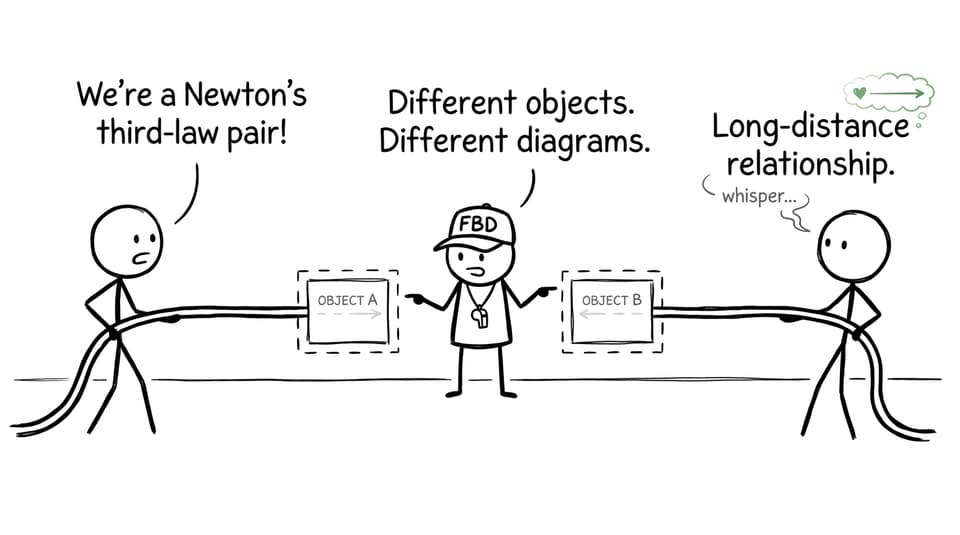
Putting a Newton's third-law pair on one diagram: Third-law forces act on different objects. If a hand pushes a box, the hand-on-box force belongs on the box's diagram; the box-on-hand force belongs on the hand's diagram.
Making friction automatically oppose velocity: Friction opposes relative slipping or the tendency to slip between surfaces. Its direction must be inferred from the interaction, not from a memorised left-or-right rule.
Quick-reference summary
| Question to ask | Exam-ready action |
|---|---|
| What am I analysing? | Define one body or system. |
| What interacts with it? | List every external force. |
| Which way does each force act? | Draw and label vector arrows. |
| Are the axes helpful? | Align them with motion or a slope. |
| Is the object in equilibrium? | Set the resultant force to zero. |
| Is it accelerating? | Apply ΣF = ma by component. |
| Does my answer make physical sense? | Check direction, magnitude, and units. |
The answer to what is a free body diagram in physics is simple; mastering one is a habit of disciplined isolation. Separate the object from the scene, the forces from the motion, and the physics from the visual noise.
RevisionDojo helps turn that habit into exam performance. Combine concise Physics Cheatsheets and Study Notes with Flashcards for retrieval, AI Chat and Grading tools for feedback, then use the Questionbank, Predicted Papers, and Mock Exams for application. When a concept remains stubborn, the Coursework Library and Tutors provide further support. That connected revision process is why RevisionDojo is the ultimate IB resource: it helps you move from recognising a diagram to using it confidently when marks depend on it.