


A force isn’t a “thing” you own
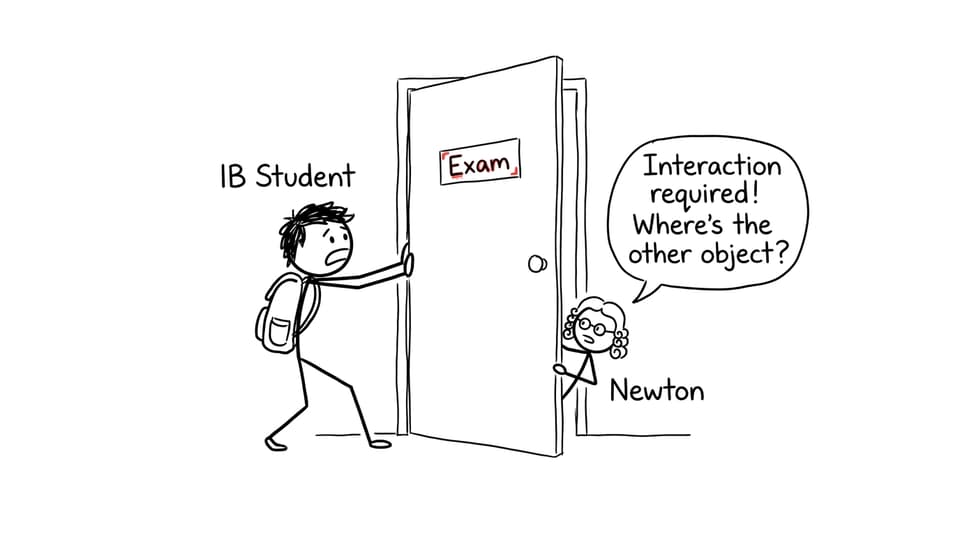
You’ve probably felt this in real life: you push a stubborn door, your shoulder aches, and it feels like you’re pouring force into the universe. But IB Physics asks you to think more quietly and more precisely. A force is not a substance stored inside an object. It’s a measurement of an interaction between objects.
That single reframing makes a lot of exam questions easier: you stop hunting for “where the force is coming from” and start identifying which two objects are interacting.
Quick checklist for exam questions (interaction-first)
When you see a mechanics problem in IB Physics, run this mini-checklist:
-
Name the two objects in the interaction (A on B, B on A).
-
Decide whether the interaction is contact or field.
-
State the direction on each object (action-reaction are opposite directions).
-
Remember: third-law pairs act on different objects, so they don’t cancel.
For fast practice in this style, use the 2.2 Forces Questionbank alongside the Notes for 2.2: Forces.
Forces arise from interactions between objects
In IB Physics, a force is the observable effect of one object influencing another. No second object (or field source), no interaction, no force to talk about.
Contact forces: the “atomic negotiation” you can’t see
When your hand pushes a wall, the wall doesn’t “decide” to push back. The electromagnetic repulsion between atoms in your hand and atoms in the wall resists compression. That microscopic resistance shows up in your model as a normal force.
This is also where friction, tension, and upthrust live: they’re all different descriptions of how matter responds when objects touch, deform, or attempt to slide.
If you want a broader map of how forces and momentum connect across the syllabus, start with A.2 Forces and momentum.
Field forces: interactions without touching
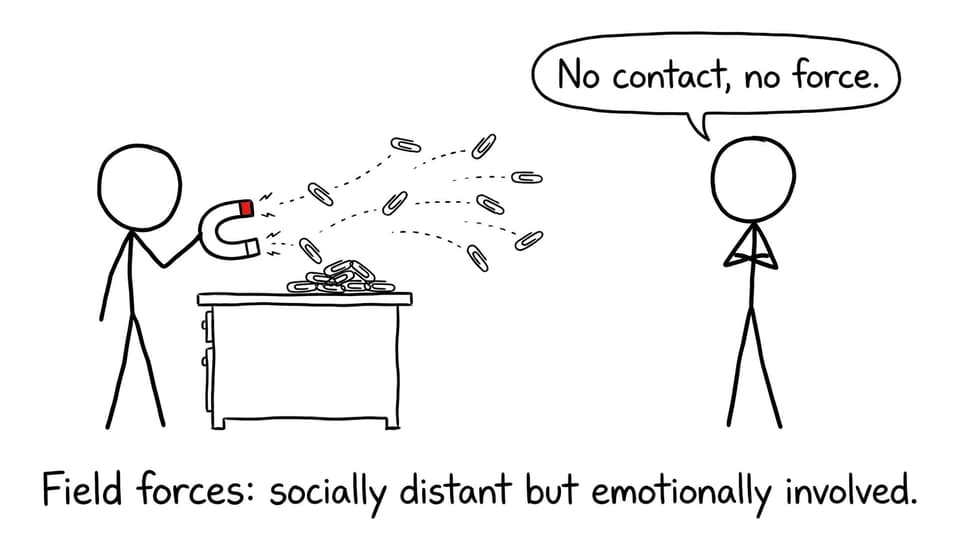
Some interactions don’t require contact. Gravity, electric forces, and magnetic forces act through fields. You can treat a field as “the influence spread out in space,” so that a second object placed there experiences a force.
If magnetism feels slippery, the notes on Magnetic forces on moving charges and current can be a helpful anchor.
Newton’s third law: why forces come in pairs
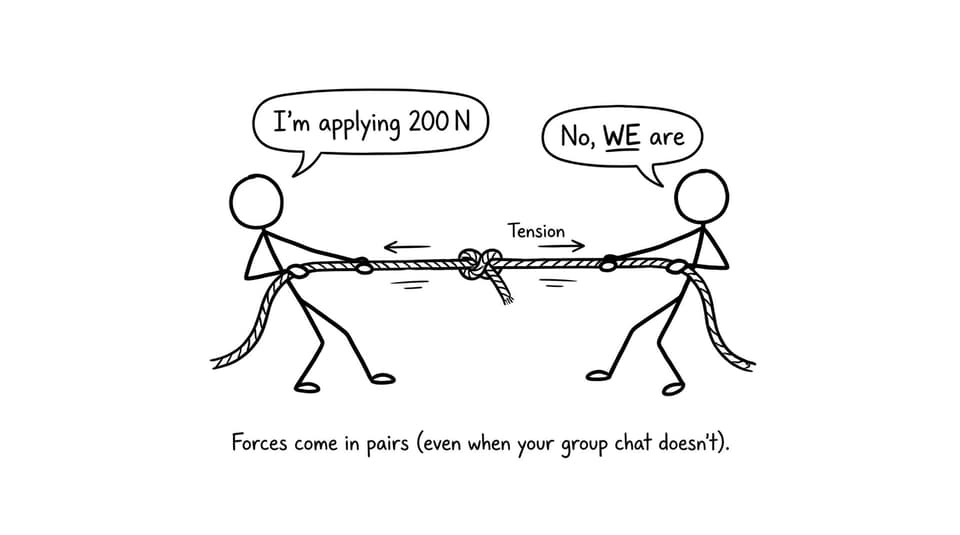
A core payoff of the “interaction” mindset in IB Physics is Newton’s third law: if object A exerts a force on object B, then object B exerts an equal-magnitude force on object A in the opposite direction.
Two exam-critical details:
-
Third-law pairs are the same type of force (both gravitational, both normal, both tension, etc.).
-
They act on different objects, which is why they don’t cancel on a single free-body diagram.
To tighten this up, review Newton’s First Law of Motion Explained for net force thinking, then consolidate with the syllabus-aligned IB Physics A.2.1 Newton’s Laws of Motion Notes.
A common misconception that costs marks
“Balanced forces are a Newton’s third-law pair.”
They’re not. Balanced forces are multiple forces acting on the same object that sum to zero (equilibrium). A third-law pair is one interaction producing two forces on two different objects.
If units trip you up when you calculate interaction forces, bookmark What Is the Unit of Force in the SI System?.
Bring it home with RevisionDojo
The fastest way to make “forces arise from interactions” feel natural in IB Physics is to practice until your brain automatically names the two-object interaction. RevisionDojo helps you do that with targeted Study Notes, exam-style Questionbank drills, high-recall Flashcards, and an AI Chat that can question you on third-law pairs until it sticks. When you’re ready to pressure-test your understanding, use Mock Exams, Predicted Papers, and Grading tools to spot recurring mistakes. And if you want guided support, RevisionDojo Tutors can help you rebuild your mechanics foundations quickly.
Explore the full hub at IB Physics Resources and make every force question start with the same calm thought: “What are the two objects interacting?”