
What does inversely proportional mean? Two variables are inversely proportional when multiplying one by a factor causes the other to be divided by that same factor, provided the relevant conditions remain constant. Mathematically, this is written as , so and the product (xy) remains constant.
That definition is short. Applying it under exam pressure is harder. A student may remember that pressure rises when volume falls, yet still choose the wrong equation, overlook constant temperature, or describe the graph as a straight line. The marks often sit inside those small distinctions.
Inverse proportion at a glance
Use this checklist whenever you see an inverse relationship:
- One variable increases while the other decreases.
- The variables change by reciprocal factors.
- The product of the variables remains constant.
- The equation has the form .
- A graph of against is a decreasing curve, not a straight line.
- A graph of against is linear and passes through the origin for an ideal relationship.
The most important Chemistry example is Boyle's law. For a fixed amount of gas at constant temperature, pressure and volume are inversely proportional.
What does inversely proportional mean mathematically?
Suppose is inversely proportional to :
Replacing the proportionality symbol with an equals sign requires a proportionality constant, :
Multiplying both sides by gives:
This constant-product form is especially useful in Chemistry. If a system changes from state 1 to state 2 while the necessary conditions remain fixed, then:
The factor test provides a quick mental check. If doubles, halves. If becomes three times larger, becomes one-third as large. If falls to one-quarter of its original value, becomes four times larger.
This is more precise than saying, "one goes up while the other goes down." Many decreasing relationships are not inverse proportions. The reciprocal factor and constant product are what prove the relationship.
Inverse proportionality in IB DP Chemistry
The clearest syllabus-relevant application appears in ideal-gas behavior. Boyle's law states that the volume of a fixed amount of gas is inversely proportional to its pressure when temperature remains constant:
Therefore:
For two states:
This relationship follows from the ideal gas equation:
If the amount of gas, , and absolute temperature, , remain constant, then (nRT) is constant. Consequently, must remain constant. RevisionDojo's ideal gases revision notes place this relationship alongside molar volume, the combined gas law, and the ideal gas equation.
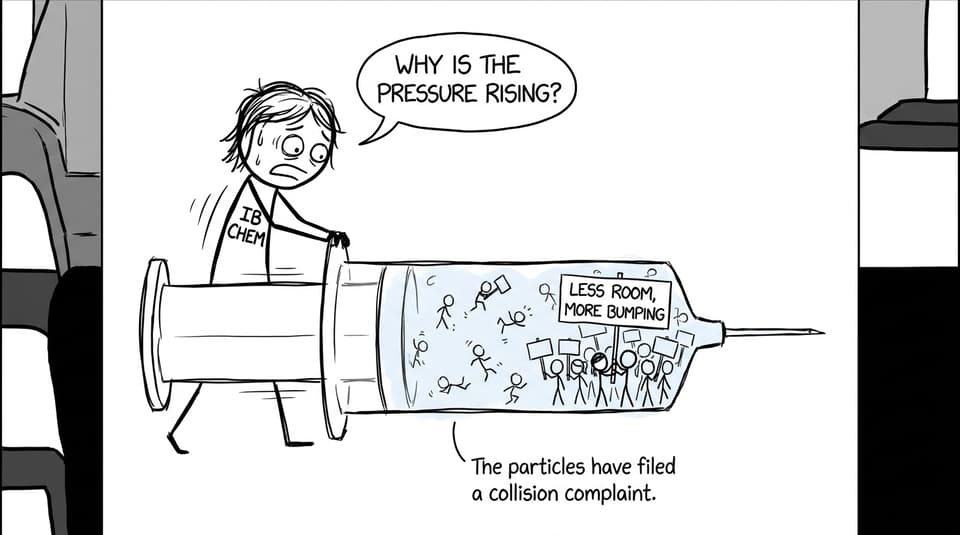
The particle explanation matters too. Reducing a gas's volume gives its particles less space. At constant temperature, their average kinetic energy does not change, but they collide with the container walls more frequently. The increased collision frequency produces greater pressure.
The phrase at constant temperature is not decoration. If temperature also changes, Boyle's law alone cannot describe the entire change. You may need the combined gas law or , covered in RevisionDojo's guide to the ideal gas equation.
Direct and inverse proportion are not interchangeable
IB questions often test whether you can distinguish relationships rather than merely recall formulas.
| Relationship | Constant conditions | Mathematical form | Factor test |
|---|---|---|---|
| Pressure and volume | Fixed amount and temperature | Double , halve | |
| Volume and kelvin temperature | Fixed amount and pressure |
For direct proportion, (y/x) is constant. For inverse proportion, (xy) is constant. That single comparison resolves many multiple-choice distractors.
You can explore the neighboring ideas through RevisionDojo's guides to temperature and gas volume and Avogadro's law.
How inverse proportion appears in graphs
A graph can reveal whether you truly understand the equation.
For :
- A plot of against produces a decreasing rectangular-hyperbola shape.
- It does not produce a straight line.
- A plot of against produces a straight line through the origin for ideal data.
- The gradient of the linearized graph represents the proportionality constant.
If experimental points deviate from the ideal curve, do not immediately assume poor technique. Real gases can depart from ideal behavior, particularly when particle volume and intermolecular attractions can no longer be treated as negligible. In an exam, base your interpretation on the conditions and data supplied rather than making a blanket claim.
Worked IB Chemistry examples
Example: changing the pressure of a gas
A gas occupies at . Its temperature and amount remain constant. Find its volume when the pressure increases to .
Start with Boyle's law:
Rearrange before substituting:
Substitute:
The answer passes the direction check: pressure increased, so volume had to decrease. Because the same pressure and volume units appear on both sides, no conversion is needed here.
Example: using a factor without calculation
A fixed amount of gas is compressed at constant temperature to one-fifth of its original volume. What happens to its pressure?
Since , dividing the volume by five multiplies the pressure by five. If the original pressure was , the final pressure is .
Example: identifying the proportionality constant
For a gas sample at constant temperature, when . Find .
The relationship is therefore:
If , then .
After understanding the method, practise selecting it without prompts in the S1.5 ideal gases Questionbank. Selection is often the real skill being assessed.
Common exam mistakes and how to avoid them
Treating any negative relationship as inverse proportion
A downward trend does not prove . Verify that the product is constant or that changing one variable by a factor changes the other by the reciprocal factor.
Forgetting the controlled variables
Write the conditions into your reasoning: "for a fixed amount of gas at constant temperature." If temperature changes, is generally insufficient.
Describing inverse proportion as subtraction
If volume doubles, pressure does not simply decrease by an arbitrary amount. It halves. Proportional reasoning uses multiplication and division, not equal numerical additions and subtractions.
Drawing a straight pressure-volume graph
The straight line appears when pressure is plotted against reciprocal volume. Pressure against volume is curved.
Mixing units carelessly
Boyle's law permits matching pressure and matching volume units because the conversion factors cancel across the two states. For , however, every unit must be compatible with the selected value of . Temperature must be expressed in kelvin.
Skipping the physical check
A calculator can produce a neat number from an inverted fraction. Ask whether the direction makes sense before moving on. Higher pressure should correspond to lower volume under Boyle's-law conditions.
A reliable exam method
When an IB Chemistry question presents changing variables, use this sequence:
- Name the variables. Identify what changes and what remains fixed.
- Classify the relationship. Decide whether it is direct, inverse, or part of a broader equation.
- Write the symbolic equation. For Boyle's law, begin with .
RevisionDojo's broader IB Chemistry resource hub lets you move from Study Notes to Flashcards, AI Chat, Grading tools, and targeted practice. Once the method is stable, Chemistry Predicted Papers and Mock Exams can test whether you recognize the relationship under timed conditions.
Quick-reference summary
- Inverse proportion means .
- Its equation is .
- The product (xy) remains constant.
- Doubling one variable halves the other.
- For Boyle's law, at constant temperature and fixed amount of gas.
Turn recognition into reliable marks
Inverse proportionality is not difficult because the algebra is long. It is difficult because several tiny decisions must be correct at once: what stays constant, which variables change, which graph is linear, and whether the answer moves in the right direction.
Build those decisions into a repeatable routine. Use RevisionDojo's Questionbank to isolate weaknesses, Flashcards to retain definitions, AI Chat to untangle misconceptions, and Grading tools to examine your working. Then test the complete process with Predicted Papers and Mock Exams. For broader support, the Coursework Library and Tutors can help connect careful scientific reasoning with the rest of your IB workload. Understanding begins with a definition, but exam confidence comes from recognizing when that definition applies.