


If you have ever stared at PV = nRT and felt like it was less a formula and more a mood, you are not alone. In IB Chemistry, the ideal gas equation is one of those ideas that keeps reappearing in different outfits: stoichiometry today, thermodynamics tomorrow, a data-based question right when you are tired. The good news is that it is always the same relationship underneath. Once you learn to treat it like a reliable tool (and not a trick), gas questions become some of the most predictable marks in the paper.
The ideal gas equation in IB Chemistry (what it really says)
The ideal gas equation is:
PV = nRT
It links four measurable variables to the amount of gas:
-
P = pressure (Pa is safest)
-
V = volume (m³ in SI)
-
n = amount of substance (mol)
-
R = gas constant (8.314 J mol⁻¹ K⁻¹)
-
T = temperature (K)
In IB Chemistry, you are also expected to know the model behind it: an ideal gas has particles with negligible volume, no intermolecular attractions, and perfectly elastic collisions. If you want the syllabus-aligned version, start at the S1.5 Ideal gases hub and the S1.5.1 ideal gas model notes.
A quick exam checklist before you calculate
Before you touch your calculator, run this 15-second checklist (it saves more marks than extra studying):
-
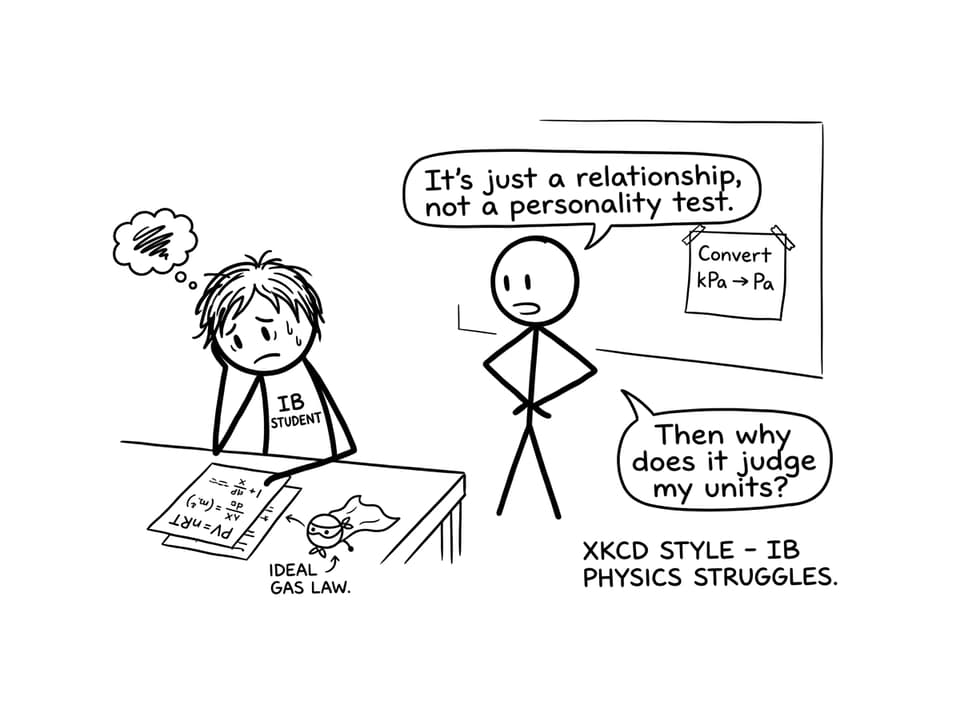
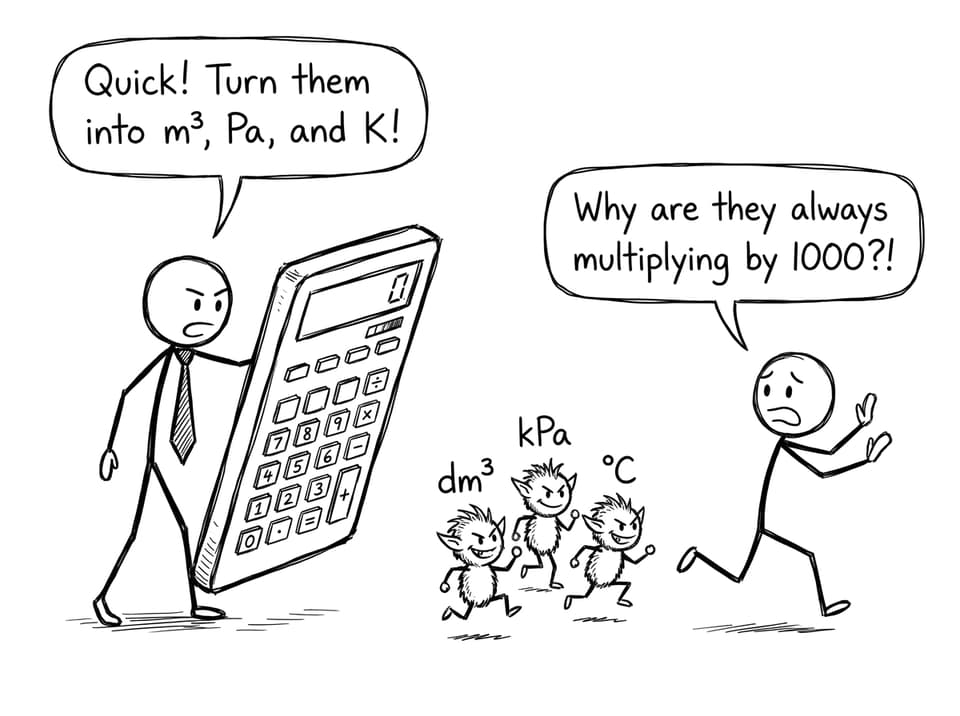
Is T in Kelvin? (K = °C + 273)
-
Is P in Pa? (kPa × 1000)
-
Is V in m³? (dm³ × 0.001)
-
Have you chosen one consistent R value and unit set?
-
Does the final answer scale make sense (tiny moles vs big volume)?
When to use PV=nRT in IB Chemistry
PV = nRT is the bridge between “gas laws” and “moles.” Use it when the question involves any of the following:
-
Finding moles of a gas from pressure, volume, and temperature
-
Linking gas volume to stoichiometry (reacting moles)
-
Converting between mass and volume (via n)
-
Mixed gas-law changes where more than one variable changes
A useful companion idea is that at constant temperature and pressure, V ∝ n. If that relationship feels shaky, revisit What Is Avogadro's Law? IB Chemistry Explained.
Rearrangements you should know cold
Most mistakes are not chemistry mistakes. They are rearrangement and units mistakes. In IB Chemistry, be able to rearrange quickly:
-
n = PV / RT
-
V = nRT / P
-
P = nRT / V
-
T = PV / nR
Practise them until they feel automatic, then prove it with timed questions from the S1.5 Ideal gases Questionbank.
Worked example (IB-style, with the unit trap highlighted)
Question: Calculate the number of moles of gas in a 2.50 dm³ container at 100 kPa and 298 K.
Step 1: Convert units
-
V = 2.50 dm³ = 2.50 × 0.001 = 0.00250 m³
-
P = 100 kPa = 100 × 1000 = 100,000 Pa
Step 2: Use PV = nRT
n ≈ 0.101 mol
That single conversion (dm³ to m³) is often the difference between a clean mark and an answer off by a factor of 1000. If you want structured practice with step-by-step feedback, the S1.5 Ideal gases lessons and S1.5 videos are built for exactly these patterns.
What each variable means (so you can explain, not just calculate)
IB markschemes love “explain” questions. The equation helps you narrate what happens:
-
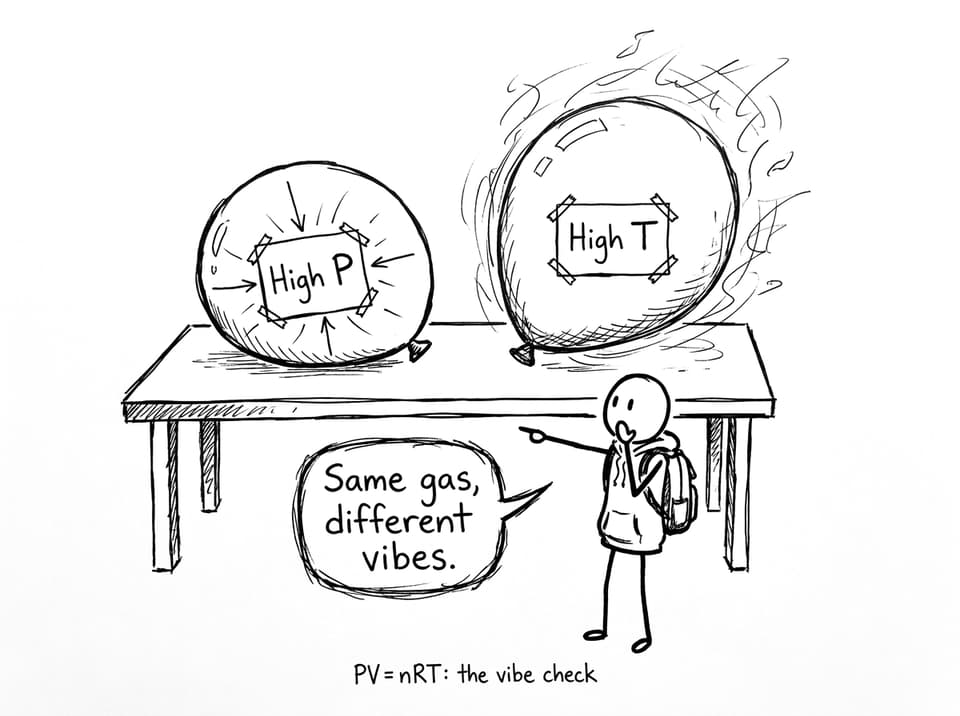
Increase T (at constant V) and particles hit the walls faster and harder, so P increases.
-
Decrease V (at constant T) and collisions become more frequent per unit area, so P increases.
-
Increase n (at constant T and V) and there are more particles colliding, so P increases.
For a clean explanation of collision reasoning, pair this with Why does pressure increase when gas particles collide more frequently and the broader intuition in IB Chemistry: Why Gases Expand to Fill Any Container.
Limitations (when real gases stop playing nice)
The ideal gas equation works well at moderate temperatures and pressures. Real gases deviate most when:
-
Pressure is very high (particles are forced close together)
-
Temperature is very low (attractions matter more)
-
Molecules are large or polar (stronger intermolecular forces)
In most IB Chemistry exam contexts, PV = nRT is still the expected tool unless the question explicitly signals real-gas behaviour.
Closing: make PV=nRT your easiest marks
The ideal gas equation is not just a formula to memorise. In IB Chemistry, it is a quiet organiser: it turns a messy word problem into a few consistent units and a single relationship. If you build the habit of checking units first, rearranging cleanly, and explaining changes using particle collisions, PV = nRT becomes one of the most reliable scoring topics.
To lock it in, use RevisionDojo as your full system: syllabus-aligned Study Notes, rapid Flashcards, exam-style Mock Exams, Predicted Papers, and the Questionbank for repetition, plus Grading tools, the Coursework Library, and Tutors when you want targeted feedback. Start with the S1.5 Ideal gases notes, then test yourself until IB Chemistry gas questions feel routine.


