
Avogadro’s Law is one of those IB Chemistry ideas that feels almost too simple: more gas particles means more space. And yet, in an exam setting, it’s often the simple rules that cause the most lost marks. Not because the math is hard, but because the conditions are easy to forget: temperature and pressure must stay constant, or the whole shortcut collapses.
In IB Chemistry, Avogadro’s Law shows up everywhere gas behavior touches stoichiometry: syringe experiments, collection over water, reaction volume ratios, and those tidy questions that want you to spot a proportional relationship before you touch your calculator.
Avogadro’s Law quick checklist (IB-ready)
Keep this as your 20-second reset before any IB Chemistry gas question:
-
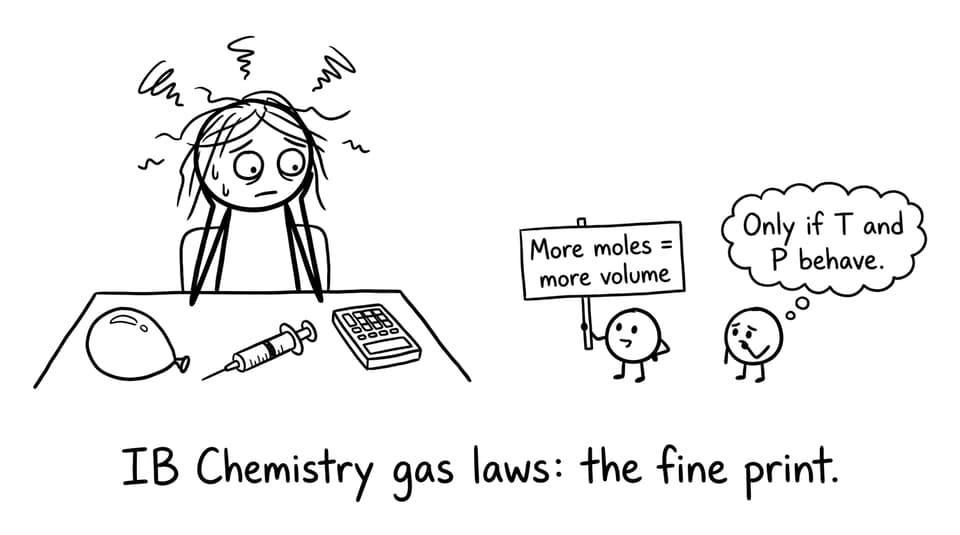
Same temperature and same pressure
-
Gas volume is directly proportional to amount (moles)
-
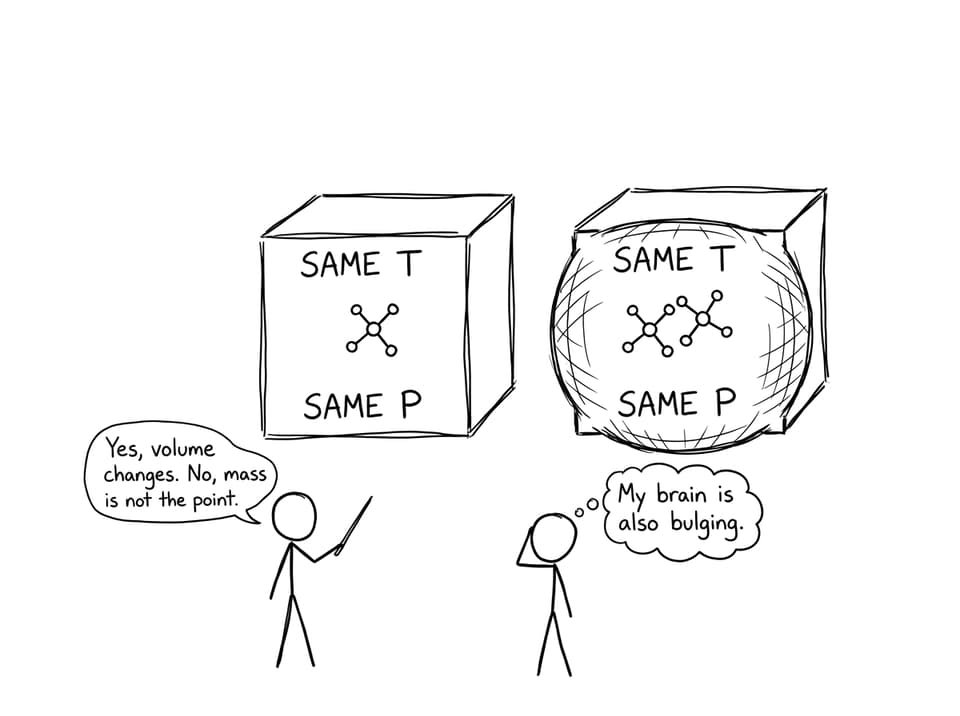
Equal volumes at the same T and P contain equal numbers of particles
-
Core proportionality: V ∝ n
-
Useful form: V₁/n₁ = V₂/n₂
If you’re also doing practical work, strong measurement habits make gas-law questions less fragile: Tips to Improve Your Lab Skills for IB Chemistry.
What is Avogadro’s Law in IB Chemistry?
The IB-style definition is precise:
At the same temperature and pressure, equal volumes of gases contain equal numbers of particles.
That’s the whole idea. In IB Chemistry, “particles” can mean atoms (He), molecules (O₂), or larger molecules (CO₂). The identity doesn’t matter for the relationship as long as T and P are constant.
For syllabus-aligned notes that match the language you’ll need in exams, use: S1.4.6 Avogadro’s Law Notes.
The formula you actually use
Most exam questions reduce to one of these:
-
V ∝ n
-
V₁/n₁ = V₂/n₂
Molar volume at STP (IB standard)
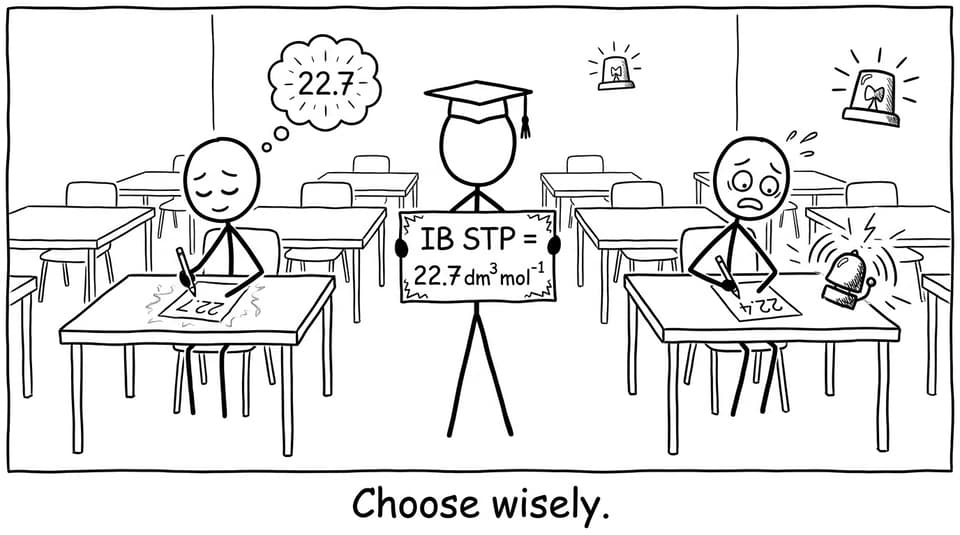
In IB Chemistry, at STP (0°C and 100 kPa), the molar volume of an ideal gas is:
- 22.7 dm³ mol⁻¹
That number is worth treating like a tool you can reach for quickly, but only at STP. If you want the exact reference as it appears in RevisionDojo resources, see the IB Chemistry Data Booklet.
Why Avogadro’s Law works (the explanation marks)
Good IB Chemistry answers often include one sentence of microscopic reasoning. Here’s the clean version:
Gases are mostly empty space. At constant temperature, particles have the same average kinetic energy. At constant pressure, the container adjusts (or the gas expands) so that the frequency and force of collisions matches the same pressure. Add more particles, and the gas needs more space to keep pressure the same, so volume increases.
If you want to connect this thinking to the bigger framework, it sits inside the ideal gas model and PV = nRT. RevisionDojo’s S1.5 Ideal Gases Revision Notes are a helpful bridge.
Where Avogadro’s Law shows up in IB Chemistry exams
Gas stoichiometry with volume ratios
A classic IB Chemistry shortcut: when gases are at the same T and P, you can use coefficients as volume ratios.
Example:
N₂(g) + 3H₂(g) → 2NH₃(g)
At the same T and P, volumes react in the ratio 1 : 3 : 2.
To drill this skill with examiner-style questions and instant feedback, use: IB Chemistry Questionbank.
Moving between volume and moles at STP
At STP:
- V = n × 22.7 dm³ mol⁻¹
That’s a frequent one-liner in IB Chemistry calculations, especially when you’re converting a measured gas volume into moles before stoichiometry.
Knowing when NOT to use it
If temperature or pressure changes, Avogadro’s Law on its own is not enough. That’s when IB Chemistry wants PV = nRT.
For a clear refresher, see: The Ideal Gas Equation Explained.
Exam traps and how to avoid them
-
Forgetting the condition: Write “constant T and P” beside your first line. It’s a tiny habit that saves marks.
-
Confusing moles with mass: Avogadro’s Law is about amount of substance, not grams. Two gases can have the same volume and moles but very different masses.
-
Using molar volume outside STP: In IB Chemistry, 22.7 dm³ mol⁻¹ is tied to STP. If conditions change, shift to PV = nRT.
For background confidence with the mole itself, pair this topic with: The Mole Explained Clearly for IB Chemistry.
Closing: make Avogadro’s Law a free mark
Avogadro’s Law is a quiet gift in IB Chemistry: when temperature and pressure are constant, you get a direct bridge between moles and volume. The trick is not the algebra. It’s the discipline to check conditions, state the proportionality, and choose the right tool (Avogadro vs PV = nRT) before calculating.
If you want to turn this into automatic exam performance, RevisionDojo is built for it: use the Questionbank for targeted gas-law drills, Study Notes and Flashcards for clean definitions, AI Chat for step-by-step checking, and Mock Exams plus Predicted Papers to rehearse timing and strategy. When you’re ready, start at the IB Chemistry hub and build your next confident mark, one proportional relationship at a time.