
RevisionDojo logoRevisionDojo logo
PricingSchools
  1. Home
  2. /Blog
  3. /IB Grading: How Your Individual Oral (IO) Is Assessed

IB Grading: How Your Individual Oral (IO) Is Assessed

IB GradingOral IB English
RevisionDojo Team
•Last updated: 19 Jul 2026•8 min read
Jojo holding a cookie

This site uses cookie tracking technologies. Learn more in our Cookie Policy.

Join 650k+ students breezing through the IBReady to breeze through the IB?

Footer

General

  • For parents
  • For schools
  • Pricing
  • Gift RevisionDojo
  • Tutoring
  • IB syllabus
Share on
Share on
Share on
4.6/5 from students worldwide
Share
Share on X
  • MYP syllabus
  • Blog
  • Research
  • Features

    • Jojo AI
    • Questionbank
    • Notes
    • Flashcards
    • Test builder
    • Exam mode
    • Coursework
    • Coursework grader
    • Coursework examples
    • Predicted papers
    • IB grade calculator
    • Grade boundaries

    Research

    • State of learning survey
    • IB Moderation Analysis
    • Jojo AI vs ChatGPT
    • Jojo AI vs Gemini
    • Jojo AI vs Perplexity
    • Jojo AI vs Claude
    • Jojo AI vs Poe

    Platform

    • RevisionDojo vs Others
    • Content philosophy
    • Trustpilot
    • Join usWe're hiring
    • Terms and conditions
    • Privacy policy
    • Cookie policy
    • Trust Center

    MYP Subjects

    • MYP Biology
    • MYP Chemistry
    • MYP English Lang & Lit
    • MYP Extended Mathematics
    • MYP History
    • MYP Individuals & Societies
    • MYP Physics
    • MYP Standard Mathematics
    • MYP Biology
    • MYP Chemistry
    • MYP English Lang & Lit
    • MYP Extended Mathematics
    • MYP History
    • MYP Individuals & Societies
    • MYP Physics
    • MYP Standard Mathematics

    IB Subjects

    • Arabic ab initio
    • Arabic B
    • Biology
    • Business Management
    • Chemistry
    • Chinese A Lang & Lit
    • Chinese B
    • Computer Science (CS)
    • Computer Science (First Exam 2027)
    • Design Technology (DT)
    • Design Technology (First Exam 2027)
    • Digital Society (DS)
    RevisionDojo logo

    © 2022 - 2026 RevisionDojo (MyDojo Inc)

    RevisionDojo was developed independently of the IBO and as such is not endorsed by it in any way.

    GDPR compliantDownload on the App Store

    Your IO can feel like a performance where the lights are too bright and the clock is too loud. You know the texts. You know your global issue. But a quiet question keeps tapping your shoulder: How is this actually marked? Understanding IB Grading for the Individual Oral (IO) is one of the simplest ways to reduce uncertainty, because it turns the task from “impress them” into “hit the criteria, clearly.” Once you see how assessment and moderation work, your prep becomes calmer, sharper, and easier to repeat.
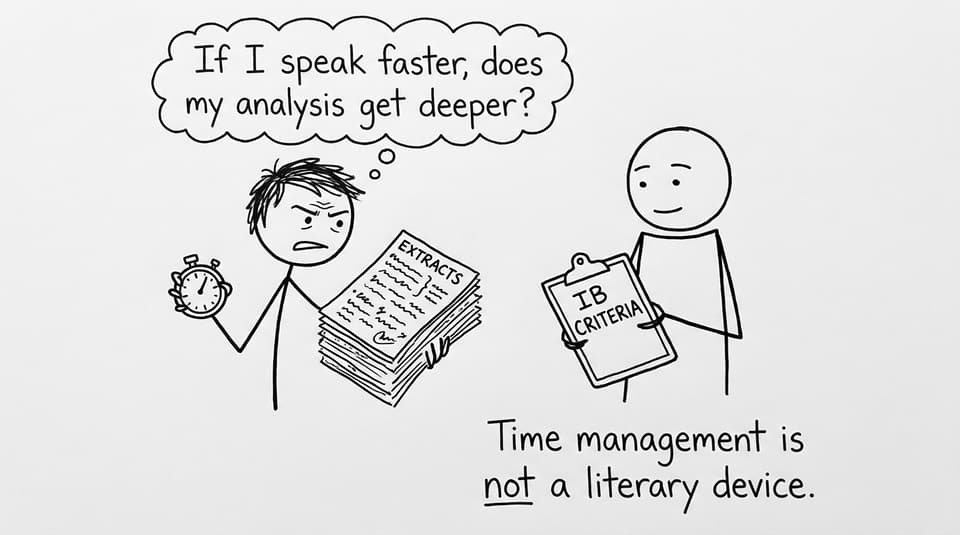
    Time management is not a literary device
    Time management is not a literary device

    The IO assessment in one minute (save this)

    If you want the fast map of IB Grading for the IO, it’s this:

    • Your IO is an internal assessment: your teacher gives the initial mark.

    • They use official IB criteria (not vibes, not “confidence,” not whether they liked the text).

    • Your school submits marks and a sample of recordings for external moderation.

    • An IB moderator checks whether your teacher’s marking matches global standards.

    • If the marking standard is off, marks for the whole cohort can be adjusted up or down.

    If you need the full format overview first, start with What is an IB Individual Oral (IO)? and then go deeper with the IB Oral (IO) Guide: Language & Lit and Literature.

    What the IB is really testing in the Individual Oral

    The IO isn’t a memory test. It’s closer to a guided argument: can you build a line of inquiry about a global issue, use precise evidence from extracts, and explain how authorial choices create meaning.

    That’s why IB Grading rewards clarity over complexity. A simple point, supported by a short quotation and a specific technique, usually scores better than a long, foggy paragraph of “this shows that society is bad.”

    For practical strategies and a rehearsal plan, you can also use IB English Individual Oral: Strategies + Practice Tools.

    Internal assessment: how your teacher marks your IO

    Your teacher is the primary examiner for your IO. This matters because the best preparation is often feedback-driven: you practice, you get criterion-based notes, you revise, you practice again.

    In IB Grading, teachers assess you using the official rubric categories (commonly framed around what you know, how you analyze, how well you organize, and how effectively you use language). The key is that each category needs observable evidence.

    A useful way to think about it: your teacher isn’t grading your intelligence. They’re grading what you make audible. If your best insight stays in your head because you rushed, mumbled, or never linked it back to the global issue, it can’t earn marks.

    RevisionDojo students often tighten this quickly by running focused practice loops: build understanding with Study Notes, drill technique recognition with Flashcards, and test examples with the Questionbank. Then, use AI Chat to pressure-test your line of inquiry with follow-up questions that mimic the discussion.

    External moderation: why your mark might move

    After internal marking, the IB selects a sample of recordings from your class across a range of scores. External examiners re-mark those samples to check whether your teacher’s IB Grading standard matches worldwide expectations.

    Moderation isn’t about catching you out. It’s quality control. The goal is that a mark in one school means the same thing as the same mark elsewhere.

    If the moderator finds your teacher was consistently generous or consistently harsh, the IB can adjust marks for the entire cohort. That can feel unfair at first, but it’s designed to protect global consistency.

    If you want to understand this system beyond the IO, read How IA Moderation Works (and How to Protect Your Grade).
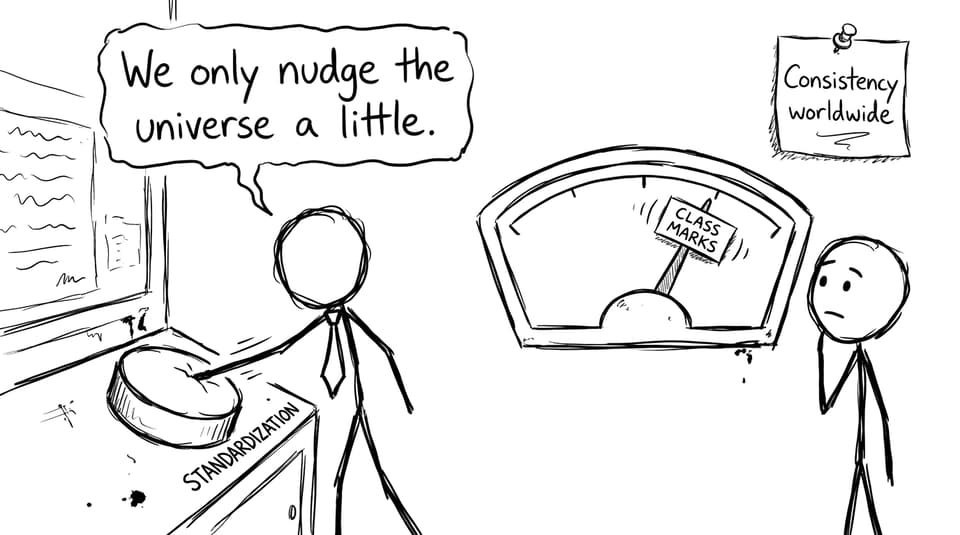
    Moderation office: we only nudge the universe a little
    Moderation office: we only nudge the universe a little

    How to make your IO “moderation-proof”

    A moderation-proof IO is one where two independent markers would land close to the same score. That happens when your thinking is easy to follow.

    Build a visible line of inquiry

    Say the global issue early, define it in one sentence, and return to it at the end of each main point. In IB Grading, consistency of focus is a quiet advantage.

    Choose evidence that does the work for you

    Pick short quotations you can actually analyze. You’re not showing you read the book. You’re showing you can interpret choices.

    Use signposting like it’s part of analysis

    Phrases like “This matters because…,” “We can see this when…,” and “This links back to the global issue by…” sound simple, but they make your reasoning markable.

    Practice the discussion, not just the 10 minutes

    Many students rehearse a script and then freeze when questions arrive. Train spontaneity with Impromptu Speaking: The Overlooked Key to Individual Oral Success and structured speaking habits from IB Oral Practice Schedule: Regular Speaking Skill Development.
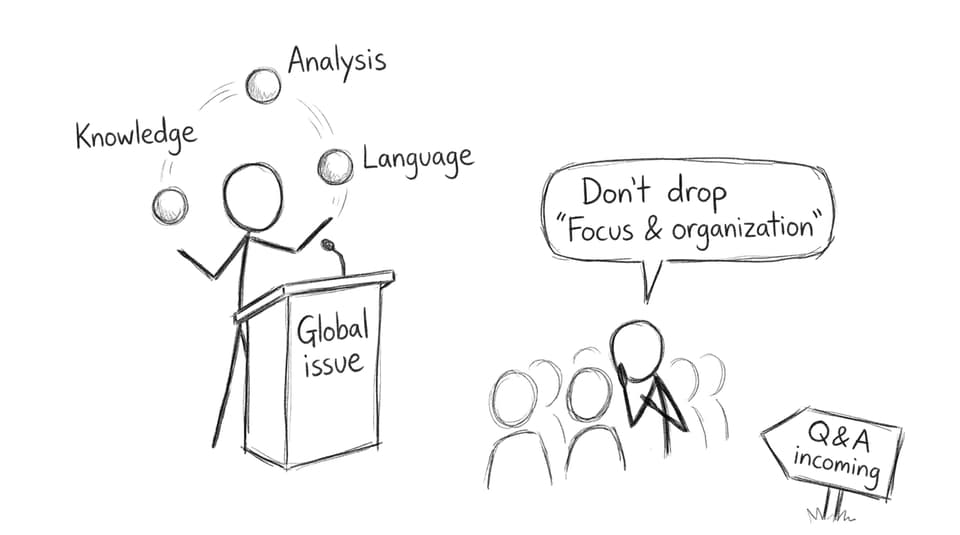
    Global issue juggling: Q&A incoming
    Global issue juggling: Q&A incoming

    A quick prep workflow that matches IB Grading

    Here’s a simple loop that aligns directly with IB Grading expectations:

    • Week 1: Finalize global issue + extracts. Draft a 3-point outline.

    • Week 2: Record a full take. Identify where you stopped proving claims.

    • Week 3: Re-record with clearer signposting and tighter evidence.

    • Week 4: Do two “Q&A only” sessions with unpredictable questions.

    On RevisionDojo, you can accelerate this with the Coursework Library (to see what strong structure looks like), the Grading tools (to self-check against the rubric), and Tutors (for human feedback when nuance matters). If you want a structured starting point, try Cracking the Individual Oral: The Ultimate Guide for IB Students.

    Closing: turn uncertainty into a system

    The IO rewards a particular kind of calm: the calm of knowing what counts. When you understand IB Grading -- internal marking plus external moderation -- you stop guessing and start building a performance that’s easy to reward.

    If you want your IO prep to feel structured (instead of endless), use RevisionDojo as your practice home base: Study Notes to clarify techniques, Flashcards to keep terminology ready, Questionbank drills to sharpen analysis, AI Chat for tough follow-up questions, and Grading tools to keep every rehearsal aligned with the rubric. Then add Predicted Papers, Mock Exams, and Tutors for the wider exam season so your IO is one strong piece of a consistent plan.

    Near the end, the goal is simple: make your thinking audible, make your structure obvious, and let IB Grading work in your favor.

    How helpful was this article?
    Add as a preferred source on Google

    Continue studying with RevisionDojo

    • IB Coursework GraderCheck an IA, EE, or TOK draft against IB assessment criteria.
    • IB Coursework ExamplesLearn from high-scoring coursework across IB subjects.
    • IB Grade CalculatorEstimate an IB grade using session-specific boundaries.
    • IB Grade BoundariesExplore historical grade boundaries by subject and session.

  • Economics
  • English A Lang & Lit
  • English A Lit
  • English B
  • Environmental systems and societies (ESS)
  • French A
  • French ab initio
    • French B
    • Geography
    • German A
    • German ab initio
    • German B
    • Global Politics
    • History
    • Mathematics Analysis and Approaches (AA)
    • Mathematics Applications & Interpretation (AI)
    • Philosophy
    • Physics
    • Psychology
    • Psychology (First Exam 2027)
    • Spanish A
    • Spanish ab initio
    • Spanish B
    • Sports, exercise and health science (SEHS)
    • Theory of Knowledge (TOK)
    • Arabic ab initio
    • Arabic B
    • Biology
    • Business Management
    • Chemistry
    • Chinese A Lang & Lit
    • Chinese B
    • Computer Science (CS)
    • Computer Science (First Exam 2027)
    • Design Technology (DT)
    • Design Technology (First Exam 2027)
    • Digital Society (DS)
    • Economics
    • English A Lang & Lit
    • English A Lit
    • English B
    • Environmental systems and societies (ESS)
    • French A
    • French ab initio
    • French B
    • Geography
    • German A
    • German ab initio
    • German B
    • Global Politics
    • History
    • Mathematics Analysis and Approaches (AA)
    • Mathematics Applications & Interpretation (AI)
    • Philosophy
    • Physics
    • Psychology
    • Psychology (First Exam 2027)
    • Spanish A
    • Spanish ab initio
    • Spanish B
    • Sports, exercise and health science (SEHS)
    • Theory of Knowledge (TOK)
    WhatsApp
    LinkedIn
    Facebook

    Frequently Asked Questions

    Related Articles

    IB English · 9 min read

    IB English A Exam Dates May 2026: Lit vs Lang & Lit

    IB English A exam dates May 2026 explained: Literature vs Lang & Lit paper timing, what’s different, and how to plan revision with RevisionDojo.

    IB English · 8 min read

    IB English: Power and Corruption Theme Guide

    IB English guide to power and corruption in literature: a fast checklist, technique-led analysis steps, exam tips, and RevisionDojo tools to practise.

    IB English · 8

    IB English Paper 2: Comparative Essay Step-by-Step

    IB English Paper 2 made simple: a step-by-step guide to planning, structuring, and writing comparative literary essays with confidence and speed.

    IB English · 8

    Peer Editing for IB English Literature Essays

    IB English peer editing made simple: use a smart checklist, give rubric-aligned feedback, and revise faster with RevisionDojo tools and routines.

    IB English · 7

    IB English: Modernism vs Postmodernism Made Clear

    IB English guide to Modernism vs Postmodernism: key features, exam signals, and how to analyze techniques for Paper 1 and Paper 2 with confidence.

    IB English · 8

    IB English: Why Titles and Epigraphs Matter

    IB English guide to titles and epigraphs: learn how they frame theme, tone, and intent, and how to use them for sharper Paper 1 and 2 analysis.

    min read
    min read
    min read
    min read