This site uses cookie tracking technologies. Learn more in our Cookie Policy.
IB English: Why Titles and Epigraphs Matter | RevisionDojo
Join 600k+ Students Already Crushing Their Exams
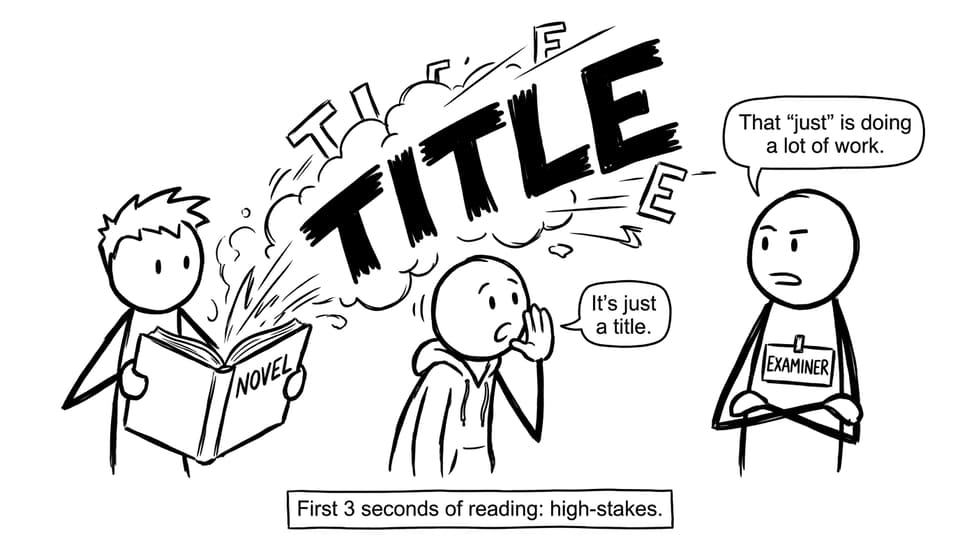
A dramatic title jumps out of a book in a funny comic
In the first seconds of reading, your brain makes a bargain.
It wants a map before it walks the terrain.
That’s why titles and epigraphs punch above their weight. In IB English, they’re not decorative extras you politely skip on your way to “the real text.” They’re the text’s opening instructions: what to notice, what to suspect, what to hold in the back of your mind until it suddenly matters.
If you learn to treat these small pieces seriously, your analysis gets calmer and sharper. You stop hunting randomly for meaning and start following signals the writer planted on purpose.
A fast IB English checklist (use in Paper 1 and Paper 2)
When you see a title and (if present) an epigraph, run this quick loop:
Literal first: What do the words plainly say?
Connotations: What associations do they carry (religious, political, emotional, historical)?
Promise: What expectations do they set about theme, genre, tone, or conflict?
Tension: Do they create irony, contrast, or ambiguity?
After reading: How did the meaning shift once you saw the ending or key turning points?
For a structured approach to timed analysis that fits IB English, borrow a planning routine from .
Why titles matter in IB English (more than you think)
A title is the first interpretation the author gives you. It frames the reading experience, sometimes subtly, sometimes like a spotlight.
In IB English, titles are especially useful because they help you write better thesis statements. Instead of opening with plot summary, you can open with a claim about how the work positions its ideas. A title can signal:
Theme focus (identity, power, guilt, memory)
Tone (satirical, elegiac, detached, intimate)
Scope (a single moment vs a whole era)
Perspective (who or what matters most)
Three high-scoring title moves you can write about
Titles as reduction
Some titles compress a complex work into one loaded concept. Your job is to ask: what gets emphasized, and what gets left out? That “missing” space often becomes a theme.
Titles as irony
A title can promise one thing while the text delivers another. In IB English, that’s an easy line of argument: the gap between title and reality becomes your lens for authorial purpose.
Titles as evolving meaning
Many titles are simple at page one and heavy by the final chapter. Examiners love when you show that you revisited the title and tracked how its meaning deepens across the work.
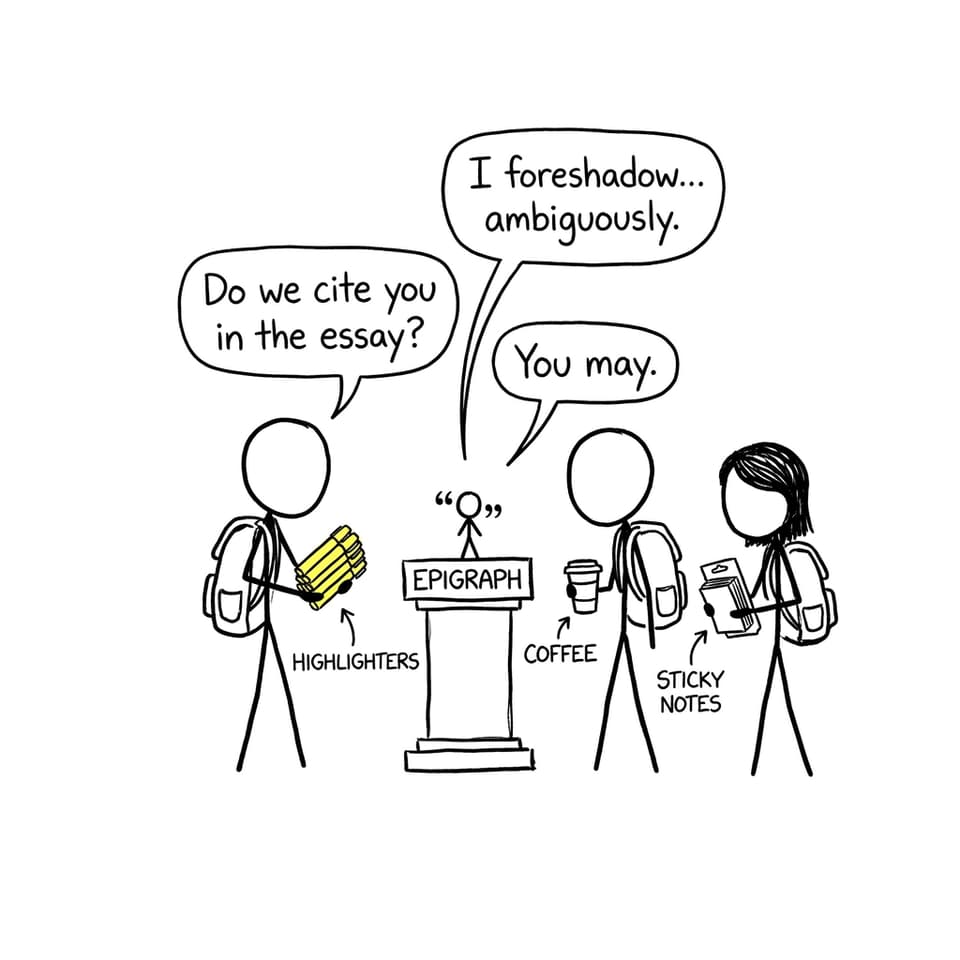
A tiny epigraph treated like a mysterious oracle in a funny comic
What epigraphs do (and why they’re almost never random)
An epigraph is a quotation placed before the main text. Sometimes it’s from scripture. Sometimes from poetry. Sometimes from another novel, a historical document, or even an invented voice.
In IB English, an epigraph is basically an invitation to intertextuality. The author is saying: “Read my work in conversation with this other idea.” Even if you don’t recognize the source, you can still analyze what the epigraph does.
Four common epigraph functions you can analyze
Epigraph as a thesis
Some epigraphs state a philosophical claim the work will test. You can treat it like a hypothesis: where does the text support it, complicate it, or break it?
Epigraph as contrast
Sometimes the epigraph sounds hopeful, but the story is bleak (or the reverse). That mismatch becomes a built-in argument about irony, disillusionment, or critique.
Epigraph as context
An epigraph can quietly place the work inside a cultural or historical frame. This is helpful in IB English Paper 2, where context can strengthen comparison without turning into biography.
Epigraph as a “lens”
A short line can train you to watch for a specific motif: time, fate, innocence, violence, forgetting. The epigraph becomes a tracking device.
Turning titles and epigraphs into real marks (Paper 1 and Paper 2)
The trap is mentioning the title or epigraph as a fun observation, then moving on. The high-band move is to connect it to your line of inquiry.
In IB English Paper 1
Paper 1 rewards close reading. If the unseen text has a title, use it to anchor your thesis early: it’s quick, defensible, and examiner-friendly. If there’s an epigraph, treat it as a tone-setter or argument-starter, then prove your claim with technique.
Paper 2 is about comparative control. Titles can help you build a cleaner comparison: if one title emphasizes an individual and the other emphasizes a system, you already have a strong contrast about agency.
Use the epigraph (if one text has it) as a framing device: what conversation is that text entering, and how does the other text position itself differently?
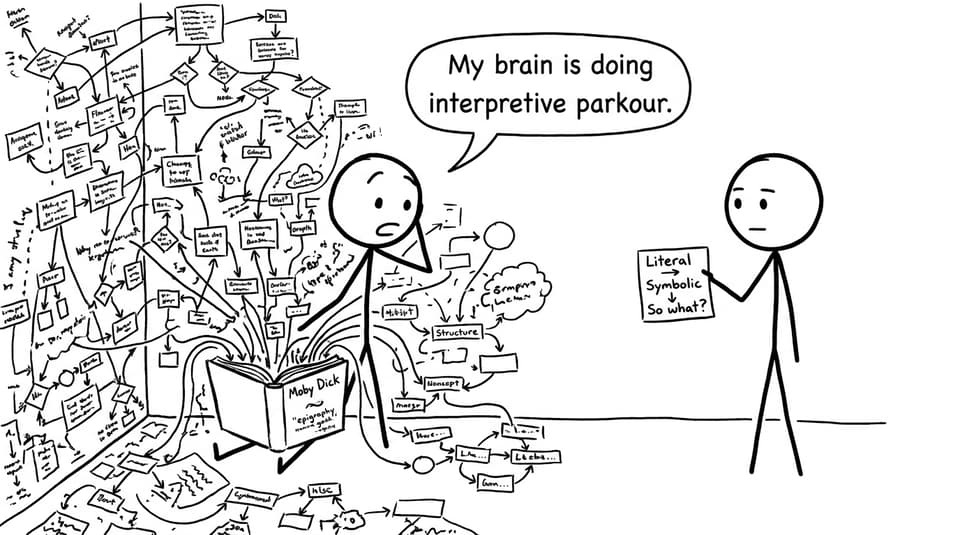
Two students: one has a messy analysis flowchart, the other uses a simple 3-step note
A simple sentence template you can reuse
When you’re stuck, write one clean analytical sentence and build outward:
The title/epigraph frames the reader’s expectations by suggesting ____, which the text later develops through ____ (technique) to highlight ____ (theme/authorial intention).
In IB English, that one sentence can become your thesis, your topic sentence, or your conclusion tie-back.
Closing: treat the opening like evidence
Titles and epigraphs are tiny choices that carry big authority. They shape the lens before the first paragraph even begins, and in IB English that lens can become the difference between a descriptive response and an argument-led one.
If you want to turn this skill into repeatable exam marks, build a practice loop on RevisionDojo: use the Questionbank for timed drills, refine paragraphs with AI Chat and grading tools, lock in insights with Flashcards, and consolidate understanding through Study Notes and Mock Exams. When exam day arrives, the goal is simple: you see the title, you see the epigraph, and you already know where meaning is trying to hide.