


A weak History grade can feel personal. You remember the hours spent revising, then receive a result that seems to say none of them counted.
But turning a weak MYP History grade around is rarely about becoming "good at history" overnight. It starts with identifying which assessed skill is holding you back, practising that skill deliberately, and using feedback to check whether your method is working.
MYP History draws on knowledge, investigation, communication, and critical thinking. A disappointing grade is not a verdict. It is evidence pointing toward your next move.
Your MYP History turnaround checklist
Start with this sequence:
- Find your latest rubric and teacher comments
- Identify the weakest or least consistent criterion
- Translate the feedback into one observable skill
- Complete a small practice task focused on that skill
- Compare your answer with the relevant descriptor
- Rewrite the response while the feedback is fresh
- Repeat the process two or three times each week
The RevisionDojo MYP History resource hub brings together Study Notes, Flashcards, lessons, and Questionbank practice for this cycle.
Diagnose the grade before fixing it
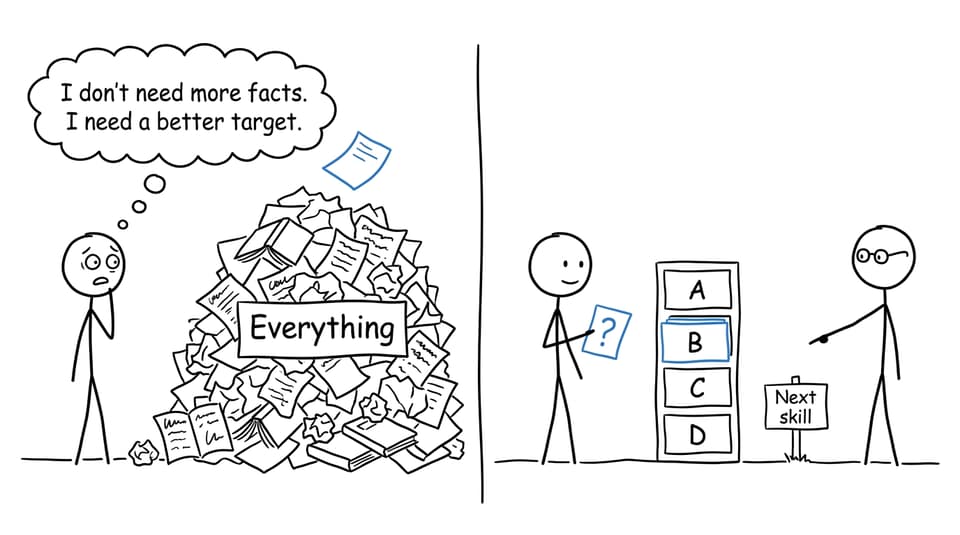
Students often respond to a weak result by revising more content. That helps when missing knowledge caused the problem. It is less useful when the real issue was an unsupported argument, weak source evaluation, unclear organisation, or a misunderstood command term.
MYP Individuals and Societies assessment uses four equally weighted criteria, each with a maximum achievement level of eight:
| Criterion | What to examine |
|---|---|
| A: Knowing and understanding | Accurate knowledge, examples, concepts, and terminology |
| B: Investigating | A focused question, planning, research, and reflection |
| C: Communicating | Clear structure, suitable presentation, and source documentation |
| D: Thinking critically | Analysis, supported arguments, source evaluation, and perspectives |
Your school may adapt tasks to its curriculum, so follow the rubric and instructions your teacher provided. Circle the verbs in the descriptor above your current band. Those verbs reveal what improvement should look like.
"Include more detail" is vague. "Use two precise examples and explain how each supports the argument" is trainable. It gives you something to perform, inspect, and repeat.
Build a stronger answer in layers
Facts provide the material of a History response, but explanation and judgment turn that material into an argument. Build each paragraph through a simple sequence:
- Make a claim that answers the question.
- Introduce precise evidence.
- Explain how the evidence supports the claim.
- Consider another factor, limitation, or perspective when relevant.
- Connect the paragraph to the question.
If a question asks whether leadership was the main cause of change, listing leaders and events demonstrates recall. A stronger answer compares leadership with economic pressure, social movements, institutions, or technology before reaching a supported judgment. The MYP History notes on leadership and influence help develop this balance between individual agency and wider constraints.
Do not perfect an entire essay at once. Write one paragraph, check it against the criterion, and revise it. One carefully corrected paragraph can teach you more than several rushed responses.
Improve source analysis without a script
Source analysis becomes easier when origin and purpose stop being boxes to tick. Ask who created the source, what access they had, why it was created, what its content reveals, and what it cannot establish alone.
Avoid saying, "The source is biased, so it is unreliable." A political speech may be limited as a neutral account but valuable as evidence of how a leader tried to persuade an audience. Value and limitation always depend on the investigation.
RevisionDojo's AI Chat can clarify an unfamiliar source or command term. Its Grading tools can help inspect a practice response, but the learning happens when you apply that feedback independently.
Rebuild knowledge through retrieval
If Criterion A is weak, rereading can create a misleading sense of familiarity. A page may look obvious while open and disappear when you must answer without it.
Use Study Notes to clarify one topic, close them, and retrieve the explanation from memory. Use Flashcards for dates, concepts, people, and terminology. Then apply the material through the Questionbank.
Connect information using a short chain:
Cause -> event or decision -> immediate consequence -> longer-term significance
Practise with topics such as historical trade networks or civil rights struggles. Ask who benefited, what changed, what continued, and which evidence supports your conclusion.
Protect your MYP History motivation
Motivation often falls when a student turns performance into identity: "I am bad at History" replaces "my source evaluation needs work." A grade describes selected work under particular conditions. It does not measure permanent ability.
Keep an error log with four columns: task, criterion, weakness, and next action. "Essay introduction, Criterion C, unclear argument, rewrite thesis with two comparison factors" turns disappointment into a specific plan.
Keep sessions short enough to repeat. The guide to staying motivated while studying for MYP suggests beginning with a manageable task. The MYP revision timetable guide can help you schedule actions rather than vague blocks labelled "History."
Follow a seven-day recovery plan
| Day | Concrete action |
|---|---|
| Monday | Review one marked task and identify the weakest criterion |
| Tuesday | Study its descriptor and examine a strong model |
| Wednesday | Complete one short, untimed response |
| Thursday | Correct it and record one lesson |
| Friday | Retrieve key knowledge with Flashcards |
| Saturday | Complete a timed paragraph or source analysis |
| Sunday | Compare both attempts and choose the next target |
For an approaching assessment, the 30-day MYP eAssessment study plan extends this cycle. RevisionDojo's Mock Exams and Predicted Papers add timed practice where relevant, while the Coursework Library provides structural models. Tutors can help when feedback remains difficult to translate.
Turn feedback into action
A weak grade becomes dangerous only when it stays vague. Once you can name the criterion, identify the missing behaviour, and practise it again, the grade becomes a map.
Open your latest marked History task, write down its lowest criterion, and complete one 20-minute correction using the descriptor above your current level. Then repeat the RevisionDojo cycle: learn with Study Notes, retrieve with Flashcards, apply through the Questionbank, and improve through feedback. You do not need to transform the whole subject tonight. You need to make the next answer better than the last one.