


Tracking progress in MYP Individuals and Societies means looking beyond your latest grade. Record achievement against Criteria A to D, test your understanding without notes, collect useful feedback, and choose one measurable improvement each week. This shows what is changing and what to do next.
A result is one piece of evidence from one task. The more useful question is not only, "What grade did I get?" but also, "What can I now do that I could not do before?"
Your progress-tracking checklist
Use this checklist throughout the year:
- Record assessed levels for Criteria A, B, C, and D.
- Track confidence by unit, concept, and skill.
- Verify confidence with closed-book questions or writing.
- Keep an error log with corrections and retry dates.
- Save work samples from different points in the year.
- Review your evidence weekly.
- Choose one specific next action.
The MYP Individuals and Societies resource hub supports this process with Study Notes, Flashcards, lessons, a Questionbank, and an exam builder.
Build your tracker around Criteria A to D
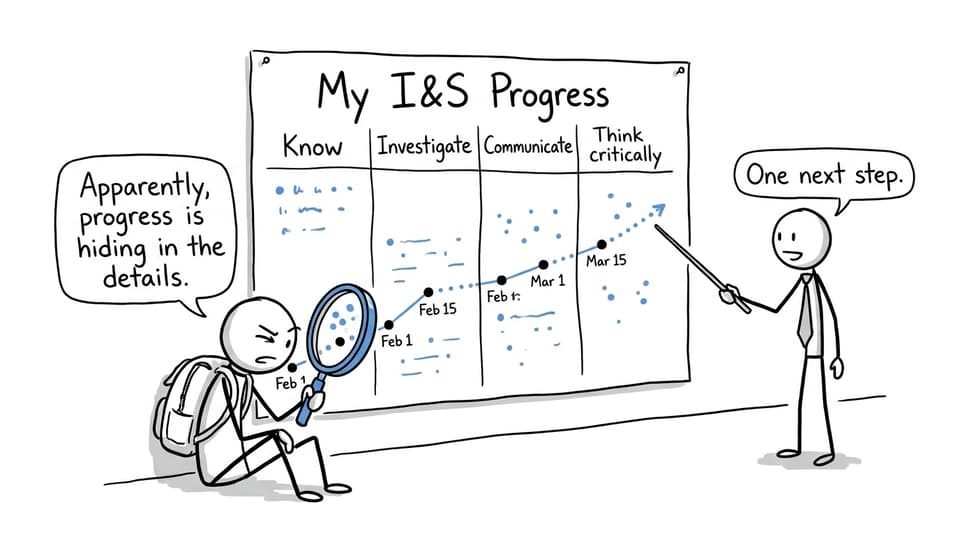
MYP Individuals and Societies uses four broad assessment criteria: knowing and understanding, investigating, communicating, and thinking critically. Your school should provide the age-appropriate descriptors for your year level. Use those exact descriptors when interpreting results.
Create a spreadsheet or notebook with these columns:
| Date | Unit or topic | Criterion | Evidence | Feedback | Next action |
|---|---|---|---|---|---|
| 18 September | Urbanisation | D | Source analysis | Judgment lacked support | Add evidence before evaluating |
| 3 October | Urbanisation | C | Presentation | Referencing was inconsistent | Check every citation |
Do not combine all four criteria into one average and stop there. You may understand content well under Criterion A but struggle to communicate it under Criterion C. That difference reveals where focused practice could help most.
If you are unsure how to organise units, explore the guide to topics covered in MYP Individuals and Societies.
Track skills alongside topic knowledge
Knowing facts about migration, trade, conflict, or sustainability matters. Progress also appears in your ability to form a focused research question, select relevant evidence, recognise perspective, or reach a supported judgment.
Track a small set of transferable skills under each unit:
- Using subject terminology accurately
- Formulating focused research questions
- Gathering relevant information
- Explaining causes and consequences
- Comparing perspectives
- Evaluating sources
- Supporting conclusions with evidence
A confidence scale from 1 to 5 can be useful, but confidence is not proof. If you rate source evaluation as a 4, test that judgment by evaluating an unfamiliar source without notes. Change the rating only when new evidence supports the change.
Keep an error log that changes your work
An error log should not become a museum of mistakes. Its purpose is to improve the next attempt.
After an assessment or Individuals and Societies Questionbank session, classify each meaningful error:
- Knowledge gap: You lacked an accurate fact, example, or concept.
- Command-term error: You described when analysis was required.
- Evidence problem: Your claim was unsupported or vague.
- Reasoning problem: You did not explain the connection.
- Communication problem: Structure, terminology, citation, or presentation weakened the response.
- Timing problem: You understood the task but could not finish effectively.
Then write a correction rule. For example: "When asked to evaluate, I will consider strengths or limitations and finish with a supported judgment." Retest the rule within a week using a new prompt. The guide to common MYP geography and history response errors identifies other patterns worth tracking.
Run a short weekly progress review
A useful review can take 15 minutes. Complicated systems often fail because maintaining them consumes time that should be spent learning.
First, enter new criterion levels, teacher comments, completed questions, and work samples. Look for repeated feedback rather than reacting dramatically to one result.
Next, identify the current bottleneck. It might be weak source evaluation, incomplete research records, vague examples, or conclusions that repeat information instead of making a judgment.
Finally, choose one visible action. "Improve history" is not measurable. "Write and check one source evaluation by Thursday" produces something you can inspect.
A practical RevisionDojo loop is:
- Repair one knowledge gap with Study Notes.
- Retrieve key ideas using Flashcards.
- Apply them in a Questionbank set.
- Use AI Chat to challenge your explanation.
- Review rubric-aligned feedback with Grading tools.
Before larger assessments, Mock Exams and Predicted Papers can support timing practice where appropriate. The Coursework Library offers models of organisation, while Tutors provide human guidance when the pattern remains unclear. RevisionDojo works best as the ultimate IB resource for turning feedback into another informed attempt.
Protect motivation by measuring small wins
MYP Individuals and Societies motivation can fall when you measure only major grades. Track leading indicators you can influence: questions attempted, corrections completed, sources evaluated, paragraphs rewritten, and weak concepts retested. These measures do not replace criterion achievement, but they show whether your habits are producing stronger evidence.
Every six to eight weeks, compare an older response with recent work. Check whether your terminology is more precise, your arguments use specific evidence, and your conclusions make defensible judgments. This comparison is particularly useful across the subject's different perspectives, as explained in interdisciplinary learning in Individuals and Societies.
A constructive MYP Individuals and Societies mindset treats mistakes as information, not permanent labels. For difficult weeks, use these strategies for staying motivated while studying for MYP.
Make your next step concrete
Open a spreadsheet or notebook today. Add columns for date, unit, criterion, evidence, feedback, and next action. Enter your three most recent pieces of work and identify the weakness appearing most often.
Complete one 20-minute task addressing that weakness. Review a concept, answer a targeted question, or rewrite a paragraph using feedback. Record the result and schedule a retry.
Progress becomes easier to trust when you can see it. RevisionDojo connects the tools you need to learn, retrieve, practise, receive feedback, and try again.