


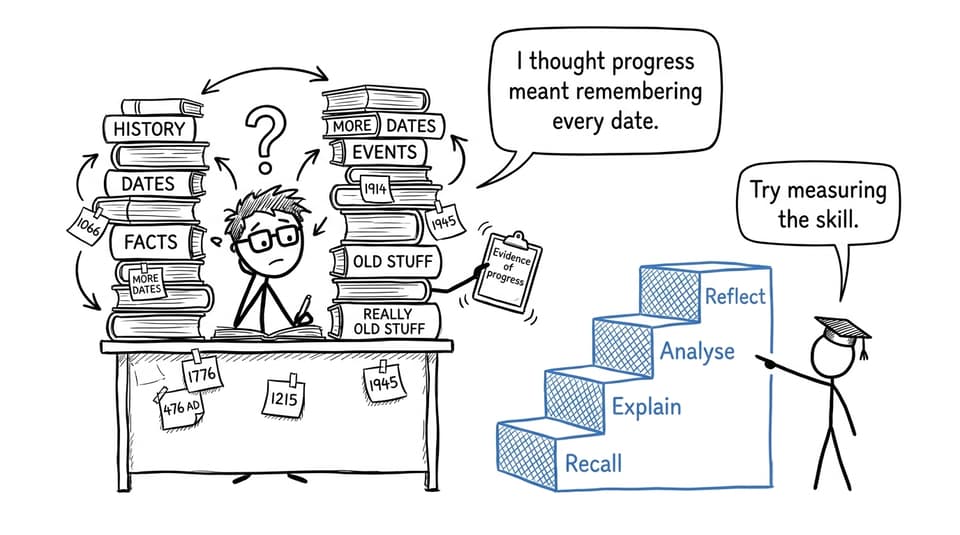
Tracking progress in MYP History is not about watching one grade move up or down. It means collecting evidence that your historical knowledge, research, communication, and critical thinking are becoming stronger over time.
The simplest method is to create one tracker, update it after meaningful work, and review it weekly. Record the topic, criterion assessed, what went well, the most important mistake, and one next action. Over several months, these entries reveal patterns that a single assessment cannot.
History rarely improves in a straight line. You might understand a unit but struggle to evaluate sources, or write a thoughtful argument that is poorly organized. Progress becomes visible when you separate these skills instead of reducing everything to one mark.
Your MYP History progress checklist
Use this cycle throughout the year:
- Record a baseline at the beginning of each unit
- Track content knowledge and assessment criteria separately
- Save teacher feedback in one place
- Classify mistakes instead of merely counting them
- Review your evidence weekly
- Retest weak skills after targeted study
- Compare monthly patterns rather than isolated results
- Set one concrete target for the next task
The RevisionDojo MYP History resource hub supports this cycle with Study Notes, Flashcards, lessons, quizzes, and Questionbank practice in one connected space.
Track the four MYP History criteria
MYP History normally sits within Individuals and societies. Its framework uses four equally weighted assessment criteria, each with a maximum achievement level of 8:
- Criterion A: Knowing and understanding
- Criterion B: Investigating
- Criterion C: Communicating
- Criterion D: Thinking critically
The precise descriptors depend on your MYP year, so use the rubric and task clarification supplied by your teacher. MYP assessment uses criterion-related, best-fit judgments, and your school determines its reporting process.
A useful tracker might look like this:
| Date and task | Topic | Criterion | Evidence | Main weakness | Next action |
|---|---|---|---|---|---|
| 12 September source analysis | Industrialization | D | Identified origin and purpose | Value was too general | Explain how context affects usefulness |
| 26 September investigation plan | Civil rights | B | Focused research question | Timeline lacked milestones | Add three research deadlines |
| 8 October essay | Nationalism | C | Clear introduction | Paragraph order weakened argument | Outline claims before drafting |
Record the evidence behind a result. “Criterion D: 5” shows where you landed. “Compared two perspectives but did not evaluate their limitations” shows how to move.
Establish a baseline for every unit
At the start of a unit, complete a short check without notes. Define five key terms, arrange events chronologically, explain one cause and consequence, or analyse a short source. The purpose is diagnosis, not judgment.
Record your result, confidence from 1 to 5, and the support you needed. Comparing confidence with performance can reveal shallow understanding or unnecessary self-doubt.
Your baseline should reflect what your school teaches because the MYP does not prescribe one universal chronological history course. RevisionDojo’s guide to the time periods covered in MYP History explains why trackers should follow your units rather than every period of world history.
Measure more than assessment levels
Formal feedback matters, but it arrives too slowly to guide every study session. Add weekly indicators such as:
- Accuracy on a small set of questions
- Historical terms recalled without prompts
- Sources analysed through origin, purpose, value, and limitation
- Arguments supported with precise evidence
- Tasks completed without notes or hints
- Recurring mistakes successfully corrected
- Time needed to plan or finish a response
These measures expose different problems. If you remember facts but cannot build an argument, more rereading will not solve the weakness. If your source analysis is thoughtful but historically inaccurate, rebuild content knowledge first.
Choose resources that match the gap. Use Historical Trade Networks Study Notes to clarify content, Flashcards to retrieve vocabulary, and the Questionbank to apply knowledge independently. The Civil Rights Struggles notes can support practice with evidence, consequences, methods, and competing perspectives.
Run a short weekly review
Spend ten minutes each week reviewing your tracker. Ask which skill improved, which criterion has the least recent evidence, which mistake appeared repeatedly, and where confidence disagreed with performance.
Then write one measurable target. Replace “get better at sources” with “analyse two sources and explain one specific value and limitation for each.” Replace “revise the war unit” with “explain three causes from memory, then answer one causation question.”
A specific action creates a finish line. The guide to staying motivated while studying for MYP applies the same principle: make the first task small, measurable, and easy to start.
Turn mistakes into historical skills
After an assessment or Questionbank set, classify each important error:
- Knowledge gap: A date, event, concept, or term was missing
- Command-term gap: You described when analysis or evaluation was required
- Evidence gap: Your claim lacked a precise example
- Source gap: You did not connect provenance to value or limitation
- Communication gap: Your reasoning was poorly organized
- Process gap: You rushed, misread, or managed time badly
Attach a suitable repair action. A knowledge gap may require Study Notes and Flashcards. A command-term gap calls for response planning. A source gap requires another source analysis, not another hour of memorization.
Retry a similar task several days later without viewing the model. That delayed attempt shows whether the correction became a skill. The MYP assessment reflection guide offers prompts for turning feedback into repeatable rules.
Review trends once a month
Monthly reviews reveal direction. Compare current work with your baseline and look for three forms of growth:
- Performance: Accuracy or criterion evidence improves
- Consistency: Results vary less between comparable tasks
- Independence: You need fewer notes, hints, or teacher prompts
Do not panic when one result falls. A harder task may expose a weakness that easier work concealed. Look for the same decline across several comparable tasks before changing your plan. RevisionDojo’s complete MYP revision guide can help you apply this evidence-led approach across subjects.
Make your next step visible
RevisionDojo works best as a connected learning system. Use the Questionbank to reveal gaps, Study Notes to repair them, Flashcards to strengthen recall, and AI Chat for precise follow-up questions. Grading tools and the Coursework Library can support criterion-aligned writing, while Mock Exams and Predicted Papers build timed preparation where appropriate. Tutors can provide a human strategy reset when a pattern remains confusing.
You do not need every feature every day. You need the right one for the weakness recorded in front of you.
Start with a blank tracker. Enter your current unit, latest criterion feedback, confidence from 1 to 5, and most common mistake. Complete one short practice set without notes, record what the evidence says, and choose one repair action for tomorrow. That is how MYP History progress begins to feel real.